





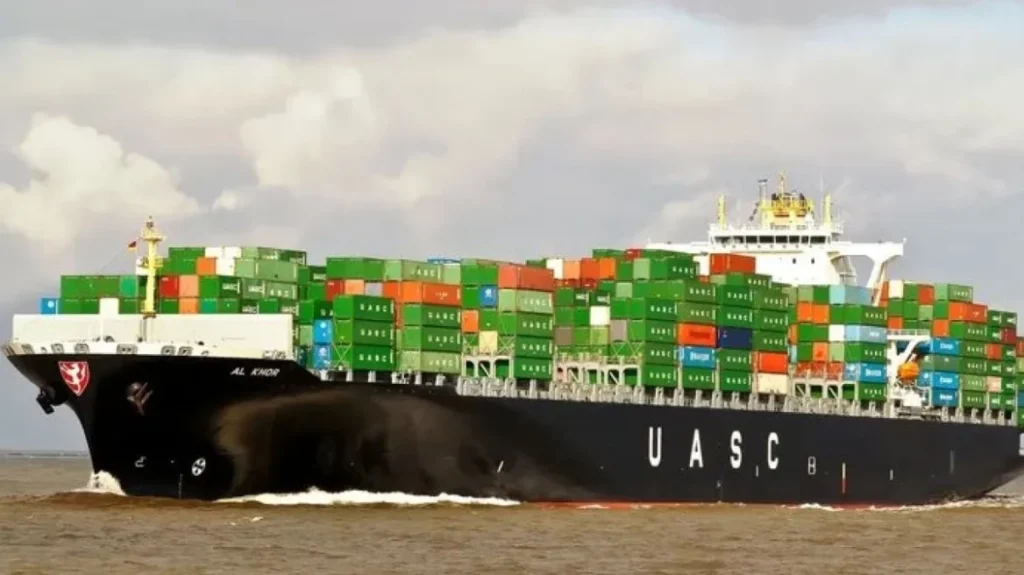
The volatile state of the Middle East, despite the memorandum of understanding signed by the United States and Iran, was laid bare by events over the last few hours, with Iran striking a Cyprus-flagged vessel and announcing the closure of the Strait of Hormuz, and the United States responding with strikes on 140 targets.
US Central Command (CENTCOM) said a crew member of the container ship M/V GFS Galaxy is missing after the vessel came under attack while transiting the Strait of Hormuz.
The UK Maritime Trade Operations (UKMTO), the maritime security agency operating under Britain’s Ministry of Defence, said the vessel’s crew “abandoned ship due to the fire that broke out and boarded a lifeboat,” adding that they were later rescued by the authorities.
Iran’s navy said late on Saturday that it had fired warning shots at a vessel that had allegedly attempted to cross the strait via an unauthorised route, adding that the vessel had switched off the transponder that continuously shows its position. Iran’s semi-official Fars news agency subsequently reported that the vessel had been struck by a cruise missile and had ignored calls from the Iranian authorities.
The US response
The US responded with strikes, the third of the week, which began at 2:15 a.m. Greek time (7:15 p.m. US Eastern time), “after Islamic Revolutionary Guard Corps (IRGC) forces blatantly attacked the M/V GFS Galaxy, a Cyprus-flagged container ship transiting the Strait of Hormuz. One crew member, a civilian, is missing, while the ship is unable to continue its voyage due to a fire onboard and significant damage to the engine room.”
A further statement said American forces “struck approximately 140 Iranian military targets with precision munitions launched from land and sea-based fighter aircraft, unmanned aircraft and naval vessels. The targets included Iranian missile and drone positions, naval assets, munitions storage facilities, communications networks and coastal surveillance sites.”
US Secretary of Defense Pete Hegseth said Iran “made a bad choice” by opening fire on a commercial vessel in the Strait of Hormuz, and that it is “now paying” for it.
Summing up the three US strikes carried out over the past week, CENTCOM said it had struck more than 300 targets on the orders of the commander in chief, US President Donald Trump, aiming to degrade Iran’s ability to attack naval and commercial vessels freely transiting the strait, adding that commercial shipping through the strait continues.
The same statement noted that, since early May, US forces have helped facilitate the safe passage of more than 800 commercial vessels and 400 million barrels of crude oil through the Strait of Hormuz.
Bahrain and Qatar intercept missiles
Following the US strikes, explosions were heard in the early hours of Sunday in Kuwait, as well as in Bahrain, Qatar, the United Arab Emirates and Jordan.
The Revolutionary Guards initially claimed to have struck a base in Jordan used by the US to operate MQ-9 drones.
They subsequently announced that they had struck and disabled a second vessel in the Strait of Hormuz, and had targeted the strategic US Al Udeid air base in Qatar with ballistic missiles, claiming to have destroyed the base’s fighter jet maintenance centre and a command and control facility.
In the same statement, Iran also claimed its aerospace forces had carried out a heavy strike on support and resupply platforms for a US aircraft carrier at the port of Duqm in Oman, in what it described as the third stage of its response to the “US military attack.”
Ask me anything
Explore related questions




