





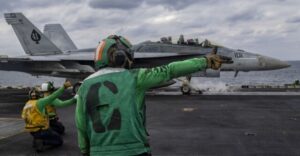
The Middle East is entering a fresh cycle of escalation, with the United States carrying out strikes on Iranian facilities in response to every move by Tehran it deems a threat to free navigation through the Strait of Hormuz. Iran, in turn, is targeting US positions across the wider region, along with commercial shipping.
Early on Monday morning, US forces bombed a series of targets in cities along the Strait of Hormuz, including Bandar Abbas, Sirik and Jask, as well as sites along the Persian Gulf coast, among them Bushehr. According to Al Jazeera, these areas hold major geostrategic significance for Iran’s efforts to assert control over the strait, and are also home to radar stations and military installations.
As the wave of attacks unfolded, a spokesperson for US Central Command (CENTCOM), which oversees American military operations in the Middle East, said Islamic Revolutionary Guard Corps (IRGC) forces “opened fire on commercial ships passing through the Strait of Hormuz,” adding that US aircraft had shot down an Iranian cruise missile and a suicide drone.
Iran responded by launching what it described as “large-scale” ballistic missile and drone attacks on “hostile bases” across the wider Middle East.
Sirens sounded in Bahrain, home to the headquarters of the US Navy’s Fifth Fleet, as well as in Jordan, where Iran had struck a base housing American MQ-9 surveillance drones just a day earlier. Amman Airport was closed as a precaution.
One dead in Iran
At least one person was killed and four others injured by the early hours of Monday when US bombing struck the city of Mahshahr in southwestern Iran’s Khuzestan province, a local official told the official IRNA news agency.
Iranian authorities said the strike hit an irrigation pumping station. Separately, reports indicate the intended target of the US attacks was a senior Revolutionary Guard official, who was killed inside an underground command centre.
Oil prices spike
Oil prices rose sharply in the early hours of Monday following the US strikes on Iran. The international benchmark Brent crude, for September delivery, climbed 3.75% to $78.86 a barrel around 1:10 a.m. as Asian markets opened, while the US benchmark, West Texas Intermediate (WTI), for August delivery, rose 3.65% to $74.02.
Analysts cited by Al Jazeera say that if the current wave of strikes continues, oil prices could climb back above $80 a barrel, underlining the exposure of the Middle East’s oil-dependent economies to the escalating conflict.
CENTCOM: goal is to prevent Iran from attacking commercial ships
In a statement, CENTCOM said that on President Trump’s orders, “at 5 p.m. [Eastern Time, midnight in Greece], US Central Command forces began launching new strikes against Iran, with the aim of continuing to limit its ability to attack civilians, sailors and commercial vessels passing freely through the Strait of Hormuz.” It added that the strikes were ordered “to hold Iranian forces accountable.”
Iran: the US is pressuring Oman
Iran’s Ministry of Foreign Affairs “strongly condemned” the US strikes, accusing Washington of “undermining all efforts of recent months” to restore peace in the Middle East. Tehran further accused the US of “blatantly violating nearly all the terms” of the Islamabad Memorandum of Understanding, the agreement signed by Washington and Tehran, and of causing the “return of insecurity” to the Strait of Hormuz.
The ministry said recent talks had focused on arrangements for managing the strait, adding that “unfortunately, the US prevented a resolution on this issue through open and covert pressure on Oman.” It also dismissed President Trump’s account of the talks as “pure lies stemming from desperation.”
Trump had told US media that Iran agreed to a deal on Saturday under which it “gave up everything,” but that “then, suddenly, two hours later, they struck a ship with a drone.”
US forces had begun striking Iran last week, with Tehran responding on Sunday by closing the Strait of Hormuz and launching a series of ballistic missile strikes against US positions across the Middle East. Iran had earlier attacked a Cyprus-flagged merchant ship, claiming it was following an “unauthorised route” through the strait. An Indian sailor remains missing following that attack.
Ask me anything
Explore related questions




