





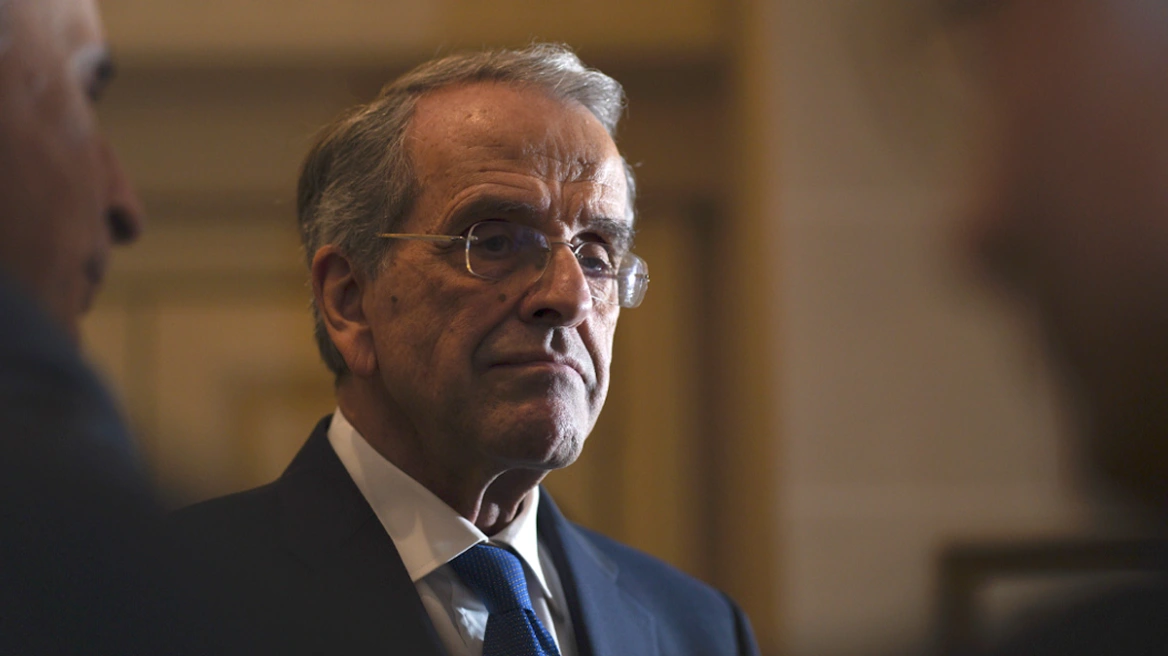
Consistency or rigidity? A stance of responsibility or uncompromising stubbornness? Commitment to his principles or difficulty adapting to a changing world?
At 75 years of age, Antonis Samaras insists that he does not sacrifice his conscience. Respectable.
But life is sceptical toward the passionate intentions of veteran politicians. Those among them who believe that politics loves its survivors. Those old hands of a long political journey who continue, with clichés worn down by time, to pretend that they are conversing with the present. Even when the present appears impatient to move past them.
Before they commit the same old, fatal mistakes of theirs.
Former Prime Minister Antonis Samaras did not appear on TikTok in order to be original. His presence, with grey hair and a white shirt, in a relaxed conversation with his press office director, was not intended to excite the young Gen Z audience that follows this particular digital entertainment platform.
In the two staged videos on his account, he was presented as an old habit. Like a familiar but tired voice returning and demanding to sound forceful, at the very moment when everyone believes the discussion has already moved on to another topic.
According to the more experienced viewers of this particular performance of his on the popular TikTok platform, he aimed to provide a brief assessment of his own political journey, presenting the choices he supports as consistent with the principles of his political faction. However, this display of party loyalty could hardly conceal his desire to set his former party in motion as a vehicle for his own guidance.
In essence, he was demanding to retain strong political influence, to define the measure of continuity and to shape its strategy. He claimed that he had “told the government these things well” and that it not only ignored him, but did the opposite on issues such as same-sex marriage, foreign policy, the cost of living and small and medium-sized businesses.
He overlooked the fact that the governing party has leadership democratically elected by its grassroots, which responsibly formulates policy. He also brushed aside the fact that he himself had been expelled from it, in the style of: “So I was the one to blame for the government going from 40% to 20% in the polls?”
He dismissively attributed the argument that his expulsion was justified because he wanted to create his own party in order to reduce New Democracy’s electoral percentage to delirious reasoning—“where did he get that from?”—reminiscent of the president of Edessaikos.
“Whatever you say, chief!”
In reality, he casually ignored the fundamental principle that politics does not award medals for declared obsession. On the contrary, politics offers political stubbornness an unbearable form of loneliness in the public sphere, something he himself experienced for many years with bitterness and sighs in the past.
The beginning of the wandering
For seven entire years, from 1997 to 2004, he travelled through a “political desert,” as he described his ordeal outside the political spotlight.
This had been preceded by his breakaway and expulsion from New Democracy, the creation of his own political organisation, and his deliberate overthrow of Konstantinos Mitsotakis’s government.
When the initial enthusiastic noise surrounding his party—judged to be chauvinistic and single-issue—subsided, and he spent the following three years outside both Parliament and the European Parliament, the wandering of its leader into political wilderness began.
From that afternoon of 30 June 1993, when he announced the founding of Political Spring from the Ballroom of the “Grande Bretagne” and proclaimed his promises of “transcendence,” only ruins remained.
The party offices at 7 Kanari Street, near Kolonaki Square, were stripped bare.
His close associates scattered and returned to their original party home, while the newcomers returned to the political obscurity from which they had come.
His personality-driven political venture was quickly condemned by the people of his own political faction, whom he had wounded by causing deep internal trauma.
They blamed him for the fall of their own elected New Democracy government, after a decade of PASOK dominance.
The voters proved merciless at the ballot box, punishing the combination of vanity and ingratitude.
At the peak of its momentum, in the 1993 national elections, Political Spring, by hurting New Democracy and contributing to its electoral defeat, won 4.88% of the vote and elected 10 MPs.
Nevertheless, his contact with the Maximos Mansion remained calmly balanced and smoothly manageable. As long as Grigoris Dimitriadis served as the prime minister’s secretary-general, his almost daily requests for various accommodations were handled more than satisfactorily.
Obviously by order of the prime minister. At the Maximos Mansion, the attitude of the Minister of State Stavros Papastavrou toward him was also willingly cooperative; Papastavrou had been a close associate of his. When he too departed from the prime minister’s office on Irodou Attikou Street, the scene of communication changed, became clouded and grew colder. From being approximately acceptably lukewarm, it turned into something frozen in the public eye.
Within the framework of the Karamanlis Institute event in Filothei, the current and former prime ministers from the same political faction kept their distance, as a corridor separated their positions. At the inauguration of the Elytis House, they limited themselves to a formal handshake without conversing. Gradually, Samaras began to leave pointed remarks against the policies implemented by Mitsotakis.
He began criticizing him on a personal level, saying that he was adopting “the positions of To Potami.” He began condemning the transformation, under his leadership, of New Democracy into a “blue SYRIZA” on many issues, such as same-sex marriage. Inevitably, this divergence of views foreshadowed estrangement and heralded a divorce.
Wrong expectations
In any case, Samaras was not just some random MP who grumbled, complained, or in any event disagreed. According to many in New Democracy, he was expected to maintain the stature of a statesman. After all, he had been president of his party for 5.5 years and had served as prime minister under its flag and symbols.
Previously, of course, as leader of the opposition, during the debt crisis period, he had backed anti-memorandum policies, appearing vehemently opposed to the troika at the Zappeia events.
Zappeio 1, Zappeio 2, Zappeio 3: Alexis Tsipras was promising the abolition of the memoranda, while Antonis Samaras was speaking about renegotiating the terms set by the lenders. He spoke of restoring injustices affecting low pensions and reducing taxes on businesses — and when he was asked where he would find the money, he simply replied that he would cut the “generalized waste” in the public sector.
At the moment when the country needed consensus in order to emerge from the crisis as quickly as possible, as had happened, after all, with Ireland and Portugal, he accused the Papandreou government of being unable to negotiate forcefully with the troika.
He had expelled Dora Bakoyannis from the party because she had voted in Parliament for the first memorandum in 2010, while through his opportunistic and populist rhetoric of bidding ever higher, he cultivated false expectations that favored the frenzied anti-memorandum rabble. Some of his interlocutors at the time, who supposedly were “cooking up” the alternative antidote to the “wrong recipe” of the memorandum, one headed toward ANEL and another toward SYRIZA.
Golden Dawn
Later, however, he himself, as an elected prime minister — the 13th in succession since the Restoration of Democracy — faithfully and unwaveringly implemented the memorandum that he had initially opposed. He defended stability and the country’s remaining in the Eurozone by implementing policies that overturned his previous pledges. He also rebuilt the morale of his political faction, since he did not capitulate to the radical Left in the manner attributed to the “silent” Kostas Karamanlis. Furthermore, he is credited with having, through decisive political will, broken the abscess of Golden Dawn.
He launched an investigation that led to prosecutions, pretrial imprisonments, and the trial of the neo-Nazi formation. However, he avoided the ordeal of explaining the contradiction, if not the political tightrope act, involved in his transition from intransigence to pragmatism.
He limited himself to declaring, “no one is without sin.” A phrase that did not constitute an admission of personal guilt or the assumption of individual responsibility. Or, at any rate, an acknowledgment of adapting to the responsibilities of power. It appeared that he used it simply as a convenient escape from political criticism. It was not the first time he had attempted this. His reversals and second chances served, in his mind, a sense of destiny.
Thirty-five years back. At that time, at the beginning of the 1990s, the world was changing rapidly. The divisive Wall of Shame in Berlin had fallen. The Cold War was coming to a hopeful end. The authoritarian “people’s democratic” regimes of Eastern Europe were collapsing. Former Yugoslavia was being fragmented and disintegrating into its constituent parts. The once-mighty Soviet Union was falling apart and would soon become a bleak memory.
The rise and the marriage
During those momentous years, Antonis Samaras, before even turning 40, had begun climbing to the highest government positions. Minister of Finance in the coalition government of Tzannis Tzannetakis and Minister of Foreign Affairs in the ecumenical government of Xenophon Zolotas. He retained the same portfolio in the New Democracy government of Konstantinos Mitsotakis, elected with 47% but also with a fragile parliamentary majority.
He was tall, athletic, a college graduate, an Olympiacos supporter, a graduate of Amherst, a Harvard diploma holder, a descendant of a historic family, and the great-great-grandson of Emmanouil Benakis. His parents, Konstantinos Samaras and Lena Zanna, were people shaped by urban culture, cultural cultivation, scientific contribution, and philanthropy.
Their second-born son (the elder being the architect Alexandros) undoubtedly projected charm. Not in the theatrical sense. Nor because of the prestige of his résumé. He attracted sympathy as a bespectacled young man with an upright bearing, a broad smile, determination, overflowing political ambition, and impatience to govern the country. He had ceased to be considered a sought-after bachelor, as in May 1990 he married Georgia Kritikou. The bride was a qualified civil engineer and the daughter of businessman Akis Kritikou of the Kyknos food industry.
The couple, in love, were united before God in Pylos with thousands of guests. There, in the homeland of his namesake grandfather Antonis — a father of 11 children and a grocer — a two-day wedding celebration was held. For the newlywed couple, Marinella and their best man Manolis Mitsias sang, accompanied by the playing of Giorgos Zampetas. The groom was already elected, not by chance, on the New Democracy ticket in the prefecture of Messinia since 1977. At 26 years old, he had become the youngest member of the Greek Parliament. In his political profile, after all, two family political traditions were combined.
The brother of his father, the distinguished cardiologist, the civil engineer Giorgos Samaras, had served as an MP for Messinia with the pre-dictatorship National Radical Union (ERE). His mother’s brother, from a family of Venizelist beliefs in Thessaloniki, Pavlos Zannas, was an important intellectual, literary figure, and prominent film critic.
He had been a member of the resistance organization Democratic Defense during the seven-year dictatorship of the colonels — he was persecuted and imprisoned by the junta. Also recorded among Antonis Samaras’s accomplishments is that, during his studies in the United States, he worked in a pizzeria, learned to proudly perform traditional Greek dances, and played drums — indeed, he later donated his drums to ONNED, of which he had been a member since its founding and also its president, in 1976.
The Centaurs and the Rangers
Upon returning to the country from his studies in the United States after the Restoration of Democracy, he wanted to become a beekeeper. Politics won him over, although he kept beekeeping as a hobby, despite not being imbued with the collective wisdom of bees in the hive.
His political opponents criticized him for rising from such a young age in the electoral arena of the prefecture where he was elected, indeed, but with all the outdated tools of the old party system.
The “unbeatable” vote-collecting mechanisms of the stubborn clientelist party boss and skilled local favor-giver.
At the beginning of his political career, the young politician aligned himself with the conservative popular Right. To many, this alignment seemed paradoxical for a young man who had grown up in an upper-class apartment on Mourouzi Street in Kolonaki, had as his personal tutor during his school years the academician Konstantinos Tsatsos, studied in Boston where he came into contact with the radical currents of the era in the United States, and frequently invoked verses by Nobel Prize-winning poet Odysseas Elytis.
In Messinia, he was accused of using his parliamentary capacity to cover the sometimes-violent actions of the hard-right youth groups of the Centaurs and the Rangers during the 1980s. He was criticized when he attended the annual memorial services at the Pigada of Meligalas, even when his party officially abstained from them. He was condemned for being willing to risk becoming personally involved in turbulent clashes with PASOK supporters, anarchists, and leftists, as well as for picking macho-style fights with the police authorities in Kalamata. The truth is that he neither fights nor engages in physical violence, although he has guaranteed parliamentary immunity.
Evangelos Averoff
In any case, however, he builds a profile of an uncompromising and robust young man in the toxic climate of the era’s fierce confrontations between blue and green coffeehouses. What is certain is that he recognizes Evangelos Averoff as his political mentor. For his part, the man from Metsovo, although born in Trikala, a politician and writer, is considered to have intended his loyal associate as the party’s future leader.
The promising young politician often accompanies him during the period 1981–1984, when Averoff is president of New Democracy, to the legendary “Brazilian” café on Voukourestiou Street. Beyond the internal party intrigues, they are connected by a faint literary thread. However, the young Messinian will take a long time to absorb the proverb-warning of his veteran political mentor: “The sheep that leaves the flock is eaten by the wolf.”
He has already begun his meteoric rise to the highest positions in the party hierarchy. After all, he is part of the group of Averoff-aligned New Democracy MPs who, in the internal party elections of autumn 1984, supported the election and secured the victory of Konstantinos Mitsotakis as leader of the party. In reality, it is the new president of New Democracy and then leader of the opposition who opens wide horizons for Antonis Samaras’s grand political ambitions.
Their joint appearance at the packed SEF on the night of the EuroBasket 1987 final conveys, to millions of television viewers, an image of leadership continuity within the political faction. However, the price of Konstantinos Mitsotakis’s generous and spectacular gesture would prove costly. The experienced Cretan politician, by then prime minister, would once again entrust him with the post of foreign minister. He would soon discover that his political protégé was opportunistically unfolding his own agenda.
In October 1990, Antonis Samaras visits, in his capacity as minister, accompanied by diplomats and journalists, the Greek villages of Dropull, Dervitsani, and Gorantzi in the Gjirokastër region of a devastated and Third World–poor Albania. He heads to the church of a Northern Epirote village that the now-collapsed communist regime of Enver Hoxha and his successors had converted into a fertilizer warehouse. He lights a candle and calls on the gathered residents of the area, regardless of religious affiliation, “to celebrate free Christmas next year in their ancestral homes.”
The invitation to the Albanians
Indirectly, he announces the “opening of the borders.” At once he gives the green light and sends the signal for the uncontrolled migration of hundreds of thousands of Albanian citizens to Greece. What visas and what borders? It was a full-scale rush across the border. Their mass influx creates countless problems for the domestic authorities and corners the government.
The dead-end policy, however, that he had irresponsibly set in motion, trapping the government and the country, would force him eight months later to declare that “economic fugitives are no longer accepted by Greece and the country is strengthening border protection.” This too was a first, but ineffective, small retreat from his unyielding convictions.
However, his stubbornly defiant stance on what he considers devotion to national issues still has before it other, more difficult chapters. He will pass through them recklessly when he attempts to politically exploit the international circumstances and the domestic nationalist surge, however justified it may have been. In September 1991, the Socialist Republic of Macedonia of Yugoslavia, through a referendum, declares its independence from the once-unified Yugoslavia. It soon submits an application for membership in the UN, calling itself the Republic of Macedonia.
The issue of managing the dissolution of Yugoslavia and recognizing the new states that emerged from it was initially handled by Antonis Samaras, as foreign minister.
At the meeting of the EU foreign ministers in December 1991, he pressures and succeeds in having conditions imposed on Skopje: that it would make changes to its constitution so that it would not be considered to have territorial ambitions toward neighboring states, and also that it would not use a name implying territorial ambitions against a neighboring state.
It was a formulation that satisfied the Greek side, but it did not solve the problem — something that became apparent almost immediately. A few months later, Mitsotakis would accuse Samaras from the floor of Parliament that, on that night, he could have fully resolved the issue by pressuring the German side and had failed to do so: “He is young, he is inexperienced,” he said characteristically.
The rupture with his foreign minister had preceded this. Antonis Samaras proclaimed himself a passionate defender of the national line. Perhaps influenced by his great-grandmother Penelope Delta’s novel In the Secrets of the Swamp, which recounts the harsh struggle of the Greek Macedonian fighters against the Bulgarian komitadjis, he uncompromisingly embodied the steadfast advocate of defending the name of Macedonia.
The reversals on national issues
In this intensely rigid spirit, as foreign minister, he regarded the efforts of diplomatic mediation and negotiations with his European counterparts as “a submissive stance by Greece.” On February 14, 1992, one of the largest rallies in modern history was organized in Thessaloniki with great fanfare against the falsification of history by Skopje.
The organizers’ resolution called on the foreign minister, not the prime minister, “to continue fighting and not accept the recognition of the state of Skopje under a name or designation that would include the word Macedonia.” Samaras was wrapped in the mantle of the uncompromising leader of national demands, a coat tailored to his reckless political ambitions. Within his party, many believed he was exploiting popular sentiment for his own political benefit. The gap between him and the calm Mitsotakis was now more than apparent, but the prime minister, with a majority of only two MPs, did not desire a fierce internal government conflict. The end of their coexistence, however, was predetermined.
On April 13, 1992, at the second meeting of political leaders under the President of the Republic Konstantinos Karamanlis, the founder of New Democracy expelled Samaras from the conference, where he was present in his capacity as foreign minister, with the curt “Karamanlis-style” phrase: “You, go outside!” After the meeting ended, the prime minister announced his decision to dismiss the foreign minister and personally assumed the crucial ministry.
Greece had lost valuable time, while several states were now recognizing the neighboring country simply as Macedonia. Domestic developments were expected to be stormy.
On October 22, 1992, Antonis Samaras resigns from his parliamentary seat. He explains that he is making this move so as not to create a problem for his party and so that it would not lose a valuable seat in Parliament. He does not fail to declare himself a “permanent resident of the political faction” and to emphasize that he will not contribute to the fall of the government, which would remain in power for four years.
Eight months later, he founds Political Spring (POL.AN.). The inspiration for the name of the new party is considered to have come from Odysseas Elytis. The new party appears to have wind in its sails from the poet’s phrase: “Oh yes! It is no small thing to have the Ages on your side.”
However, its leader does not wait a second before revealing his impatience. His supposed commitments for the New Democracy government to complete its four-year term go to waste. Only three months later, on that Monday, September 6, 1993, Samaras changes course. Through statements, he ends his party’s tolerance toward the government. He makes it publicly clear that “Spring and support for the government are two opposing positions that are impossible to coexist.”
Bringing down the government
The following day, New Democracy MP Stefanos-Theodoros Stefanopoulos delivers a letter to the Speaker of Parliament, informing him that he is now becoming an independent MP and is withdrawing his confidence from the government. Through the “salami method,” the thin majority of New Democracy’s parliamentary seats is sliced away, piece by piece.
The government is now supported by only 151 MPs. On the morning of Thursday, September 9, 1993, the final amputation arrives. Almost before dawn, a relatively unknown New Democracy MP from Kilkis, the doctor Giorgos Sympilidis, arrives at the office of Parliament Speaker Athanasios Tsaldaris. He submits the same declaration as the previous MP, leaves New Democracy, and joins Political Spring.
The government is left with 150 MPs and loses its vote of confidence. One thriller ends and a long-standing vendetta begins. Mitsotakis speaks of a stab in the back. He accuses Samaras of “becoming an instrument of our opponents and of the economic interests to which he is beholden, with the aim of striking the political faction that created him.” He immediately calls early elections, acting institutionally as a parliamentary politician.
The ballot boxes of that October return Andreas Papandreou, whose health is shaken, and PASOK to power with an outright majority. Meanwhile, in the heavily charged atmosphere of the era, dark rumors circulate accusing Sympilidis of having been bribed by businessmen in order to bring down the government.
Specifically, they point to a well-known business magnate who was allegedly seeking to prevent the planned privatization of OTE by Finance Minister Stefanos Manos. The businessman was then the main supplier of the telecommunications organization, which had assigned him the installation of 1,000,000 digital connections at a cost of 70 billion drachmas.
The unsubstantiated rumors remained suspended in the air, but they did not disappear. Journalist Giorgis Massavetas brought them back in 1996 in his book Overthrow Mitsotakis — The Backstage of a Political Conspiracy. After a lengthy interview granted to him by Konstantinos Mitsotakis, the journalist published his claim that Sympilidis had received a bag containing 320 million drachmas in cash from unknown businessmen involved in political-economic entanglements.
The author was sentenced by the Three-Member Misdemeanors Court of Athens to 10 months’ imprisonment for defamation following a lawsuit filed by New Democracy MP with POL.AN., Giorgos Sympilidis.
The political consequences of what followed are recorded in the annals of History.
A foreign body
Since then, much water has flowed through the millstones of political history, patiently smoothing even the most solid of them. Not all. Antonis Samaras did not pretend throughout his long political career that he relied on flexible pillars. He never apprenticed himself to the difficult sculptural art of compromise. His stubbornness, obstinacy, and inflexibility remained forever uncarved.
Even as times change, his character remains immovable in whatever he considers a matter of honor. Since the New Democracy congress in May 2022, he had deliberately functioned as a foreign body within the structure of the political faction. He had already distanced himself from it. He did not even attend the event marking the party’s 50th anniversary on Rigillis Street. Through his views, he claimed his own fiefdom in the party’s internal sphere, highlighting issues of ideological nature that he himself considered strategically and politically necessary.
He had chosen to intervene publicly by repeatedly exercising intense criticism with personal attacks against the party leadership and launching extremely fierce attacks against government policies. He continued persistently to deliver, sometimes at an event at the War Museum and sometimes in a speech in Cyprus, lessons in patriotism as he understood it. He demanded the combative role of the solid porter of national burdens, as he saw concessions everywhere, appeasement of Turkish provocations, if not betrayal, while downplaying the largest defense procurement program the country has known under this government.
Setting aside the government’s implementation of international law through the extension of the 12 nautical miles in the Ionian Sea and the historic agreements for the beginning of the first exploratory hydrocarbon drilling operations in Greece at the start of 2027. Ignoring the conclusion of strong defense and strategic agreements between Greece and the United States and France, which upgrade its geopolitical footprint and strengthen its deterrent power.
Forgetting that Prime Minister Kyriakos Mitsotakis has repeatedly described Turkey’s casus belli (cause for war) as a “historical anomaly,” which he has raised at the European level and conveyed to Turkey during the recent NATO Summit.
“Woke agenda”
The other argument he puts forward — resistance to the “woke agenda imposed on us” — does not sound particularly convincing either, nor does the criticism aimed at the government’s passing of a law for same-sex couples, which is in force in most European countries and concerns, ultimately, very few people in our country. Is such a choice of granting a right to a social group truly so significant as to justify the creation of a new party? Is it so painful to his sense of sensitivity that, even if he disagrees — and he is not the only one — primarily with the right of same-sex couples to adopt, he attempts to deprive New Democracy of the opportunity to achieve a parliamentary majority?
To hurt the faction that welcomed him back into its arms and honored him? Is it enough to put forward a perception — someone could say, bordering on homophobia — as the banner of a new political organization, instead of positions, proposals, and ideology?
Samaras is old in politics. Very old. He has served as party leader, prime minister, and MP. And he knows — even if he pretends to ignore it — that through his stance he bypasses an unavoidable reality: the governing party has leadership democratically elected by its base.
A leadership that, since the day it has been represented by Kyriakos Mitsotakis — for ten years now, that is — has led the polls, has won two national elections, and is heading toward a third victory. A streak that no party leader has achieved in the post-dictatorship era. Perhaps Samaras remembers Themistocles and the phrase “I shall not let myself sleep” because of Mitsotakis’s… impending trophy. But that belongs to another realm, not politics.
It is, however, certain that this recorded course of New Democracy is due to a large extent to Mitsotakis himself, who renewed the New Democracy faction in ideas and personnel, dominating the center ground without deviating from the founding principles of Konstantinos Karamanlis, despite everything the former prime minister himself accuses him of.
The old temptation
Deliberately overlooking, with his impulsive temperament, the fact that politics may sometimes admire uncompromising rhetoric, but voters at the ballot box usually choose flexibility and dialogue. Nevertheless, no one from the leadership of New Democracy and the government legitimized with 40.8% attempted to silence what he supposedly felt compelled to express according to his inner compass. Nor did anyone force him to renounce what he believed.
It was judged, however, that he had fallen into the old temptation of politics: confusing the label of the indomitable herald of national values with the pages of History. That interview of his in To Vima tis Kyriakis, with which he pulled the pin, overflowed the cup of internal party patience and tolerance. His stance was assessed as practical undermining of the cohesion of the political faction. He was no newcomer to the political arena.
Under the special privilege of being a former prime minister, he had informally been granted the ability to express himself openly and in various ways. And he turned it into a banner of deviation from the party’s official “red line,” although he knew in advance what developments his tactics would lead to. He knew perfectly well what the outcome of his interventions and provocative recommendations would be. His behavior foreshadowed a conscious escape from the party framework.
In practice, he himself chose the one-way road toward his expulsion. But this did not come as a simple administrative act in accordance with what the party statute stipulates. Nor as an inglorious ritual of oblivion. It arrived as a reminder that interpreted his appeal to his conscience as evidence of a faulty memory. It brought back from the historical records that he himself had also been expelled from his party almost 34 years earlier.
Old stories? Not quite. Collective memory may be malleable, but it remains strict. Especially when every new conflict brings up a previous one, and every appeal to consistency encounters a moment of retreat. All the more so when every act of rupture ends, sooner or later, in a new search for political shelter.
Already, in his office on Dimokritou Street, Antonis Samaras is planning, according to information that he does not deny, a new party of his own. That is his right. But it is not unprecedented. He is the third former prime minister to establish a political organization in the post-dictatorship era.
The irony of History
He was preceded by his old roommate, during their student years at Amherst, George Papandreou. Recently, Alexis Tsipras also brought his own political formation into being. The aim of both was to inflict electoral damage on the parties they had led in the past. Except that the current independent MP for Messinia surpasses them.
Not only because he had established a party years ago, but because by harming his own political faction he contributed to the downfall of its government at the time. The irony is that, driven by his uncompromising temperament — or, according to others, by sheer stubbornness — he is pushed into meeting his younger self. Yet without the drive of his former youth, but only with the egocentric myth of being absolutely politically correct that he has created for himself.
This time, his new party, if it is founded, does not need, as the earlier one did, to invent grand narratives for the country’s future and formulate a comprehensive governing proposal. It is estimated, after all, that it will not have a long political lifespan. It will limit itself to attempting to reduce the governing party’s percentages, significantly influence the balance of forces, and play the role of regulator of political developments. In essence, it aims to challenge Kyriakos Mitsotakis’s dominance in the center-right sphere and prevent him from governing again.
In a way, Antonis Samaras has directed and replayed the same play, with himself once again as the protagonist. Setting aside the fact that political life dislikes repetitions. While History, being more ironic, treats the recycling of events at least as farce.
Ask me anything
Explore related questions




