





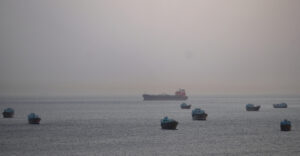
With the Strait of Hormuz already at the centre of the US-Iran conflict for the past five months, the threat posed by the Houthis to block Saudi shipping in the Red Sea is shifting pressure towards the Bab el-Mandeb strait. Riyadh is now being asked to choose between restraint and a return to a war it has spent years trying to extricate itself from.
For almost five months, as the war between the United States and Iran has spread across various parts of the Middle East, Yemen has remained on the sidelines, or nearly so, of the direct conflict. The Houthis, the Iran-aligned movement that controls much of northern Yemen, have voiced support for Tehran and threatened to resume operations in the Red Sea, but have so far stopped short of opening an entirely new front.
That balance shifted on Monday, when the Houthis formally announced a naval blockade of Saudi Arabia, warning shipping companies to stay away from Saudi ports. The warning came with a threat that any vessel violating the ban would be highly likely to be targeted, wherever it is within the range of their forces.
This does not yet amount to an actual, physical blockade of the Saudi coastline. The Houthis do not have a naval fleet capable of conventionally controlling the Red Sea. They do, however, possess missiles, unmanned aerial vehicles, maritime drones, and a proven ability to instil enough fear to push insurance companies and shipping groups into rerouting their vessels.
That is precisely what makes the threat dangerous, and the risk real. To inflict economic damage, they do not need to sink dozens of ships or fully block the Bab el-Mandeb strait. A handful of attacks, the seizure of a merchant ship, or even a credible threat that vessels linked to Saudi Arabia are being targeted would be enough.
From Sana’a airport to Abha airport
The new crisis began with a flight returning to Yemen from Iran. A Houthi delegation had travelled to Tehran for the funeral of Iran’s supreme leader, Ayatollah Ali Khamenei. On its return, authorities from Yemen’s internationally recognised government tried to prevent the Iranian aircraft from landing in Sana’a, claiming there were suspicions it was carrying personnel and dual-use military equipment.
On 13 July, the runway at Sana’a airport was bombed, forcing the aircraft to divert and land in Hodeidah. Yemen’s government claimed political responsibility for the strike, despite lacking a functioning air force and being heavily dependent on Riyadh for military support. The Houthis attributed the strike directly to Saudi Arabia.
The response was immediate. The Houthis launched missiles and drones at the international airport in Abha, in southern Saudi Arabia, marking the most serious direct confrontation between the two sides since the informal ceasefire of 2022, and the first strike on Saudi territory in around four years of relative calm. No casualties were reported, but the political message was clear: the Houthis believe the period in which Riyadh could control Yemen’s airspace at no cost has come to an end.
The movement’s leader, Abdul Malik al-Houthi, then set out the new rules of the conflict: airport for airport, port for port, blockade for blockade. He also warned that Saudi Arabia’s oil and energy facilities could become targets in the event of a new military escalation.
Bab el-Mandeb as a second Strait of Hormuz
The significance of the threat extends far beyond the borders of Yemen and Saudi Arabia. The armed conflict in the Persian Gulf has dramatically restricted shipping through the Strait of Hormuz, prompting Saudi Arabia to increase its use of the East-West pipeline, which carries oil from facilities in the east of the country to the port of Yanbu on the Red Sea.
This route has served as an economic lifeline for the kingdom, allowing it to bypass the Strait of Hormuz and continue exports to Europe, and, via the Suez Canal or by circumnavigating Africa, to other markets. In recent weeks, several million barrels of oil and petroleum products have been transported daily from the Saudi side of the Red Sea.
Bab el-Mandeb, the narrow sea passage between Yemen and the Horn of Africa, forms the southern exit from the Red Sea into the Gulf of Aden and the Indian Ocean. The Houthis do not conventionally control the strait itself, but they hold much of northwestern Yemen and maintain a presence along the Red Sea coast, along with weapons systems capable of striking ships at long range.
A complete closure of Bab el-Mandeb is considered militarily difficult. However, if shipping is severely restricted, the impact on energy flows would be significant. According to estimates cited by Reuters, a complete shutdown could remove from the global market volumes equivalent to up to 7% of world oil supply, at a time when the Gulf conflict has already taken significant volumes off the market.
The threat is therefore twofold. Iran is exerting pressure on the Strait of Hormuz, while the Houthis could destabilise the second key export route for Arab energy production. Saudi Arabia risks being caught between two maritime corridors controlled or threatened by Tehran and its allies.
The Iranian message
There is no public evidence that Tehran directly ordered the blockade. The Houthis have their own leadership, domestic objectives and a significant degree of autonomy. At the same time, their military and political ties to Iran run deep, and have strengthened during the war in Yemen.
The move serves Tehran’s strategic interests directly. It reminds the United States and its allies that Iranian influence is not confined to the Persian Gulf. Even under military pressure in the Strait of Hormuz, Iran can inflict costs elsewhere through an ally based some 2,000 kilometres away.
In effect, the Houthis are turning Bab el-Mandeb into a bargaining chip for the wider pro-Iranian network. The threat to Saudi Arabia goes beyond the bilateral conflict over Yemen; it concerns Tehran’s ability to raise the economic cost of the war and force Washington to protect two critical maritime chokepoints at once.
Saudi Arabia’s dilemma
For Riyadh, a return to open conflict with the Houthis is the worst-case scenario. In 2015, Saudi Arabia launched a major military intervention in Yemen aimed at driving the Houthi movement out of Sana’a and restoring the internationally recognised government. Despite overwhelming superiority in air power and weaponry, it failed to achieve its primary objective. The war descended into a military and political stalemate, caused immense humanitarian devastation, and exposed Saudi Arabia to repeated missile and drone attacks. The 2022 ceasefire did not bring a permanent peace, but it allowed Riyadh to scale back operations and pursue a gradual disengagement. The Saudi leadership now faces two bad options.
If it responds with a new air campaign, it risks reigniting a war it failed to win over the past decade. The Houthis can strike airports, ports, pipelines, refineries and urban centres, undermining both the Vision 2030 economic diversification programme and the image of stability the kingdom is trying to build.
If, instead, it shows restraint, the Houthis may conclude that their threat has succeeded, reinforcing the image of a force capable of dictating terms to a far wealthier and militarily stronger state.
The Saudi-led coalition has warned it will respond immediately and decisively to threats against passing ships. Riyadh’s true intentions, however, will be judged by whether there is an attack on an oil tanker or an energy facility.
The Houthis know where the vulnerability lies
From late 2023 to early 2025, the Houthis attacked more than 100 commercial ships using missiles, drones and armed hijackings. They presented these operations as a means of pressuring Israel and its allies over the war in Gaza, but their impact was global. Major shipping companies avoided the Red Sea, vessels began taking the longer route around Africa, insurance premiums rose and transit times increased.
This precedent explains why even the threat of a blockade is taken seriously. The Houthis know that global shipping operates on risk assessment, not solely on actual losses. Once the cost of insuring a ship rises, or a crew refuses to pass through a dangerous zone, the economic impact has already begun. Their main weapon, therefore, is not the ability to control every ship passing through the Red Sea, but the ability to make every shipowner wonder whether the risk is worth taking.
Yemen once again at the centre of the regional war
The new crisis could unfold in three different ways. In the first scenario, the Houthis’ announcement remains primarily a political threat. Attacks are limited, Riyadh avoids retaliation, and behind-the-scenes contacts through Oman prevent a return to all-out war.
In the second scenario, the Houthis carry out targeted operations against ships directly linked to Saudi ports. Even without a complete closure of Bab el-Mandeb, shipping is disrupted, oil prices rise, and the United States is forced to strengthen its military presence in the Red Sea.
The third and most dangerous scenario begins with an attack that causes heavy casualties or serious damage to a Saudi energy facility. A major response from Riyadh could trigger a new cycle of bombings in Yemen, missile strikes on Saudi Arabia and attacks on commercial ships.
In such a scenario, the US-Iran war would take on a second maritime dimension, with the Strait of Hormuz constraining exports from the Persian Gulf while the Bab el-Mandeb strait constrains alternative routes through the Red Sea.
The Houthis stayed on the sidelines of direct conflict for months. With a single announcement, however, they have reminded the world that they possess one of the most effective weapons of modern warfare: the ability to turn a narrow strip of sea into a pressure point for the entire global economy. They do not need to block the Red Sea completely. It is enough to convince the world that they can.
Ask me anything
Explore related questions




