





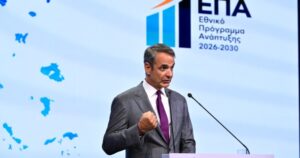
Public investments are acquiring, for the first time, a stable five-year planning and funding framework based on national resources.
With this message, Prime Minister Kyriakos Mitsotakis presented the new National Development Program (NDP) 2026–2030, outlining the framework that will guide government policy after the Recovery Fund. As he stated, the new program will serve as the country’s main national financing tool for the next five years and will establish the foundations of Greece’s development strategy through 2030.
The prime minister described the NDP as the natural continuation of the Recovery Fund, arguing that the country is acquiring a permanent mechanism for planning and financing public investments using national resources.
According to Mr. Mitsotakis, the program’s funding of approximately €23 billion is the result of improved fiscal performance and the progress made by the Greek economy in recent years.
He placed particular emphasis on the government’s deliberate decision to direct more resources toward investment. As he noted, the real convergence of the Greek economy with Europe will depend primarily on public and private investment, as these generate sustainable growth, new jobs, and higher incomes.
Kyriakos Mitsotakis also highlighted the role of Greece’s regions, noting that they will have greater participation in development planning and more resources available for implementing projects. However, he stressed that all initiatives will be integrated into a unified national strategy, with better coordination between central government and local authorities.
At the same time, he referred specifically to the need for long-term planning in critical areas such as infrastructure, water resource management, and regional development, emphasizing that Greece is moving away from fragmented funding practices and adopting a stable planning framework extending to 2030.
Where the €23 billion of the NDP will be allocated
Infrastructure projects, flood prevention works, digital services, civil protection, green investments, and initiatives aimed at strengthening business competitiveness are included in the new National Development Program 2026–2030, through which approximately €23 billion will be allocated over the next five years.
According to announcements by Minister of National Economy and Finance Kyriakos Pierrakakis, the new program will mobilize a total of around €23 billion. Of this amount, €5.8 billion will be allocated to completing projects from the previous programming period, while the remaining funds will finance new investments across the country.
A key objective is the gradual increase of national resources allocated to public investment. As the minister explained, the national resources of the Public Investment Program will rise from €1.8 billion in 2019 to €3.3 billion in 2026 and are expected to reach €4.2 billion by 2030.
The implementation of the NDP will take place through 20 sectoral programs of government ministries, 13 regional programs, and 4 special programs, with the aim of directing resources according to the needs of each region and strengthening regional development.
Funding will cover projects related to social cohesion, infrastructure, transport, civil protection, and climate crisis response, as well as initiatives involving digital transformation, artificial intelligence, green development, innovation, and strengthening business competitiveness.
Mr. Pierrakakis stressed that the new NDP is the tool that will ensure the continuity of public investment after the completion of the Recovery Fund, operating in conjunction with the NSRF (ESPA), new European financing instruments, and Public-Private Partnerships.
The new pillars of the NDP 2026–2030
The new NDP is not focused solely on absorbing funds, but primarily on producing measurable development outcomes.
This was the main message delivered by Deputy Minister of National Economy and Finance Nikos Papathanasis, who noted that the program mobilizes approximately €23 billion, of which €17.1 billion concerns new resources and €5.8 billion relates to the continuation of projects from the previous programming period.
At the same time, he highlighted the program’s new priorities, placing particular emphasis on demographic challenges, housing policy, energy resilience, civil protection, infrastructure, and regional development.
He stressed that the goal is for available resources to be transformed into projects with a measurable development impact, rather than simply achieving high absorption rates.
Ask me anything
Explore related questions




