





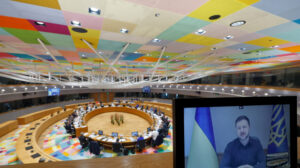
With the energy crisis and the need for additional measures to support households and businesses dominating the agenda, the two-day European Union summit in Brussels begins today, Thursday, 15 October, at 11am Greek time.
The 27 member states are being called on to find common responses to soaring energy costs amid the pressure of the crisis in the Middle East, while significant disagreements remain over the EU’s new seven-year budget for 2028–2034. Discussions, which will conclude on Friday, 16 October, will also cover financial and military support for Ukraine, European defence, migration and EU enlargement.
Energy crisis: Measures European leaders are considering
Tackling high energy prices is the first major test for European leaders, as the impact of the Middle East crisis on international markets intensifies pressure on the European economy. The focus is on the need to provide immediate relief to consumers and businesses without abandoning Europe’s long-term strategy to reduce its dependence on fossil fuels.
In his invitation letter to leaders, European Council President António Costa calls for “immediate action”, urging them to give the European Commission clear guidance on developing “targeted and temporary measures” to limit the impact of rising prices.
However, finding a common solution is not expected to be easy. “There is no magic solution” that can immediately address the problems facing consumers and businesses, a European official said, explaining that the different proposals put forward by member states would have to be assessed both for their effectiveness and for the likelihood of securing the necessary consensus.
Windfall tax, VAT cuts and fiscal flexibility
Among the proposals under consideration is a tax on the windfall profits of energy companies, supported by six member states: Germany, Italy, Spain, Poland, Austria and Portugal.
Meanwhile, Greece and Italy are seeking greater fiscal flexibility so that national governments can fund temporary interventions to address high prices.
The discussions also include tax relief measures, such as reductions in value-added tax (VAT) and excise duties on energy products. Italy and the Czech Republic have additionally proposed temporary amendments to the European Union Emissions Trading System (ETS), with the aim of limiting costs for the economy.
The European Commission, for its part, insists on the need for “fiscal prudence”, warning that interventions should not place further pressure on public finances or undermine market confidence.
The Commission is particularly cautious about introducing an EU-wide tax on windfall profits in the energy sector, arguing that national governments are better placed to decide whether and how to implement such a measure. However, the establishment of a working group has been agreed to examine the issue, facilitate the exchange of best practices and provide support to member states.
According to the draft conclusions, leaders are expected to ask the Commission to consider additional initiatives to tackle rising prices. “The European Council calls on the Commission to examine and, where appropriate, propose further measures to address the rapid increase in energy prices in the short term,” the text states. The final wording will depend on the negotiations.
State aid for industry and changes to natural gas rules
Beyond immediate tax interventions, European leaders are expected to express support for a series of short-term initiatives proposed by the Commission.
These include extending the state aid framework for industries most affected by high energy costs, as well as developing a framework to improve refinery capacity and efficiency. Initiatives to encourage the voluntary pooling of energy demand are also envisaged.
The Commission has also proposed postponing certain obligations arising from the EU’s methane regulation by one year, in order to facilitate imports of natural gas and oil.
In the longer term, the 27 member states are expected to stress that a lasting solution depends on accelerating the energy transition, increasing clean energy production and upgrading energy networks. The goal is to gradually reduce dependence on fossil fuels and bring down energy costs.
At the same time, ahead of the revision of the ETS, leaders are expected to call for rules on emissions that do not undermine the competitiveness of European industry.
2028–2034 budget: Proposal for €141 billion in cuts
One of the most difficult issues at the summit is the negotiation over the EU’s next Multiannual Financial Framework, which will cover the period from 2028 to 2034.
Discussions will be based on a compromise proposal from the Irish Presidency, which envisages reducing the budget by approximately 8%, or €141 billion, compared with the European Commission’s original proposal. Under the revised plan, the total seven-year budget would amount to approximately €1.622 trillion in 2025 prices.
Despite the proposed cuts, significant disagreements remain, as member states have different priorities both for overall spending and for the allocation of funds.
On one side are the so-called “frugal” countries: Germany, Sweden, the Netherlands, Austria, Finland and Denmark. They consider even the revised budget too high and are therefore seeking further cuts, potentially amounting to several hundred billion euros.
On the other side are the 17 countries belonging to the “Friends of Cohesion” group, including Greece, Italy and Spain, which want funding for the Common Agricultural Policy and cohesion policy to be maintained. These countries stress that European funding is crucial to supporting the agricultural sector and developing regional economies.
The European Commission is also dissatisfied with the scale of the cuts included in the Irish proposal, warning that they could jeopardise key European priorities already agreed upon by member states. France, meanwhile, supports the need for an “ambitious” budget, with sufficient funding for meaningful common policies.
New sources of revenue and the timetable for an agreement
In addition to disagreements over spending, the issue of new European Union own resources remains unresolved. These are additional sources of revenue that could be used to finance the common budget.
Reaching a compromise on this issue is considered crucial to the outcome of the negotiations, as it is directly linked to the level of national contributions and the capacity to fund European policies.
Today’s discussion marks the first stage of negotiations among heads of state and government. The Irish Presidency and António Costa are seeking to secure an agreement by the end of 2026, although some member states question whether this timetable is realistic.
After the summit, Costa will take charge of the next phase of negotiations, with the European institutions seeking to complete them before Christmas.
The effort to reach an agreement within the year is also intended to prevent discussions from dragging on into 2027, when several important elections are scheduled in European countries, including the French presidential election.
Ukraine: Zelensky expected in Brussels as 2027 funding remains unresolved
On the second day of the summit, Friday, 16 October, European leaders will focus on Ukraine, with the country’s president, Volodymyr Zelensky, expected in Brussels to brief the 27 member states on his country’s needs.
The discussion comes amid continued Russian attacks on civilians and critical infrastructure, while the EU is seeking to ensure that Ukraine has the resources necessary to withstand military and economic pressure.
Leaders are expected to reaffirm their commitment to continued support for Kyiv and their determination to increase pressure on Russia, with the aim of ending the war and bringing Moscow into meaningful peace negotiations.
A key issue is the EU’s agreement to provide Ukraine with a €90 billion loan for 2026–2027. Of the total, €60 billion is intended for military assistance, while the remaining €30 billion will cover budgetary needs.
However, although funding for 2026 has been identified, financing Ukraine’s needs in 2027 remains unresolved. In the draft conclusions, the European Council reiterates its commitment to helping meet Ukraine’s urgent financing needs in cooperation with international partners.
It is also awaiting an updated assessment of the country’s economic situation and needs from the European Commission and the International Monetary Fund, while calling on international partners to step up their financial and military assistance without delay.
EU displeasure over US–Russia deal on diesel
The agreement between the United States and Russia on diesel is also expected to feature prominently in discussions on Ukraine, having provoked criticism in Brussels.
A European official described the agreement as “regrettable”, noting that it runs counter to the strategy pursued by the United States and the European Union over the past four and a half years to exert pressure on Moscow.
This dissatisfaction is also reflected in the draft conclusions, which state that “the European Council regrets the decision of the United States to temporarily lift sanctions on Russian diesel”.
Beyond financial support for Kyiv, leaders will also examine progress towards European defence readiness, with a focus on countering hybrid attacks attributed to Russia and addressing critical gaps in the military capabilities of member states.
Migration: Returns, external borders and an emergency mechanism
Migration is also on Friday’s agenda, with European leaders set to consider strengthening the protection of external borders, accelerating returns and managing situations involving sudden mass arrivals.
In her letter to leaders, European Commission President Ursula von der Leyen highlights the need to strengthen European migration policy, including through the creation of a new framework for responding to emergencies.
The proposed mechanism would provide greater flexibility in border management, asylum procedures and returns when member states face a sudden increase in migration flows and existing tools are insufficient to address the situation.
The aim is to enable European authorities to respond more quickly to crises while maintaining a common framework for managing migration pressures.
Middle East, maritime security and EU enlargement
Developments in the Middle East will be another major topic at the summit, as the effects of the crisis extend beyond regional security and directly affect international markets and supply chains.
Leaders will examine the latest developments in the region, with particular emphasis on freedom of navigation and maritime security. These issues are directly linked to the smooth transport of energy, fertilisers and food.
Meanwhile, during the working dinner on the first day, leaders will discuss the future enlargement of the European Union and the internal reforms that will be required to ensure the bloc can operate effectively with more member states.
Particular attention is expected to be given to Montenegro’s accession process and progress in the relevant negotiations. European leaders will examine the institutional changes considered necessary ahead of future enlargement, at a time when the EU is being called on to reconcile its ambitions for greater geopolitical influence with mounting economic and fiscal pressures.
Ask me anything
Explore related questions




