





The Republicans’ electoral defeat in the 3 November midterm elections goes beyond losing control of both the House of Representatives and the Senate.
For the first time since Donald Trump returned to the White House, his political dominance within the Republican Party is facing a crisis that cannot be addressed simply by changing the administration’s communications strategy. Heavy defeats for candidates personally backed by Trump, the alienation of key voter groups from MAGA and the loss of traditional Republican strongholds have already opened up the debate over his eventual successor.
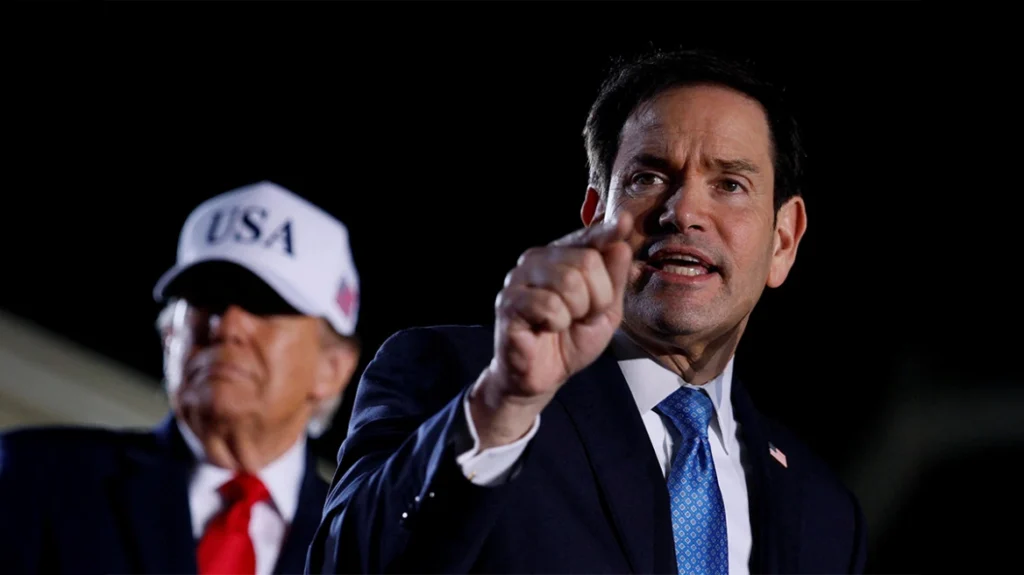
Against this backdrop, reports that Secretary of State Marco Rubio may resign to prepare a presidential bid in 2028 have taken on considerable political significance. A report by the British newspaper The Independent, citing sources within the Republican Party, Washington and the British government, claims that the head of US diplomacy is considering leaving the Trump administration in order to lay the groundwork for a bid for the Republican presidential nomination.
The White House and the State Department have categorically denied the reports. No resignation has been announced so far, nor has Rubio himself publicly confirmed that he is preparing a presidential campaign.
Nevertheless, the publication of these reports just two days after the elections carries its own political significance. The debate within the Republican Party is no longer exclusively about how to deal with the new Democratic majority in Congress. It also concerns whether complete alignment with Trump remains the strongest political asset for anyone aspiring to win the White House in 2028.
The numbers behind a defeat that goes beyond the usual midterm backlash
The scale of the electoral shift explains why the debate over MAGA’s future began so quickly. According to Reuters’ count and analysis, Republicans lost ground in 99% of the approximately 2,200 counties for which sufficient results had been compiled by Wednesday morning. Their average decline was eight percentage points compared with Trump’s performance in the 2024 presidential election.
The Democrats secured control of the Senate, with at least 54 seats against 44 for the Republicans, according to Reuters’ latest count, while recording a net gain of at least 30 seats in the House of Representatives. The final size of their majority was still taking shape, as several contests had yet to be concluded.
In Kansas, a Democrat was elected to the Senate for the first time in 94 years. In Texas, James Talarico was leading Trump-backed candidate Ken Paxton by approximately 12 percentage points. Candidates who had received the President’s personal endorsement also lost in South Carolina and North Carolina.
The shift was particularly pronounced among Hispanic voters. Across 64 majority-Hispanic counties where Senate elections were held, the Republican vote share fell by 14 percentage points compared with the share Trump secured in 2024. In Texas’s Hidalgo County, the decline reached approximately 25 percentage points.
These findings are particularly significant for the Republican Party. Trump’s 2024 electoral victory had been based, in part, on expanding his appeal beyond the traditional conservative base, particularly among Hispanic voters, younger age groups and working-class voters. The losses recorded two years later call into question the stability of this broader electoral coalition.
Trump himself had urged voters to treat the midterm elections as if he were personally on the ballot. The strategy was intended to mobilise his own support base, but it further tied Republican candidates to the record of his presidency.
The result therefore intensified pressure on the President, who had made personal loyalty to him a decisive criterion in selecting candidates. Reuters notes that his preference for politicians with strong ideological alignment and personal allegiance failed to deliver in states where Republicans needed to broaden their electoral appeal.
Iran, the economy and the cost of Trump’s policies
The search for the reasons behind the defeat has already begun within the administration. The war with Iran and its economic consequences are at the centre of the debate, particularly rising energy prices and the cost of living.
Analyses by Reuters and the Associated Press document widespread voter dissatisfaction with inflation, fuel prices and the overall performance of the US economy. According to the electoral data cited by Reuters, nearly nine in ten voters considered the cost of living an important factor in their vote.
The war with Iran has compounded the problem. For a large section of the Republican base, which had supported Trump and his promise to avoid further prolonged military engagements in the Middle East, the conflict has created a difficult political contradiction.
Vice-President JD Vance publicly acknowledged that the war was a decisive factor in the electoral defeat. In remarks following the elections, he attributed the loss of the Republican majorities to the military involvement, effectively calling on the party to discuss the cost of that decision.
His comments carry additional significance because they come from the man who had long been regarded as Trump’s natural political successor. Vance had publicly supported the administration’s policy despite reservations he had expressed in the past about new wars in the Middle East. Following the electoral defeat, he sought to highlight his own assessment of the consequences of that strategy.
The problem is not limited to who will take political responsibility. For MAGA, the war, the rising cost of living and dissatisfaction with economic policy are now linked to a broader question: which parts of Trump’s agenda can be retained, and which need to be revised if Republicans are to regain the trust of voters they have lost.
Rubio and the prospect of the first major departure from the administration
According to the revealing report by David Maddox and Andrew Feinberg in The Independent, Marco Rubio is being closely watched amid speculation that he could resign, as aides and political figures believe he will need to distance himself from the administration to prepare a presidential bid.
The information does not come from a single source. The British newspaper cites senior Republican sources in Washington, individuals close to the Secretary of State and British government officials monitoring his movements.
One of the newspaper’s sources argues that Rubio should distance himself from the war in Iran and leave Trump to bear political responsibility for the conflict. Another source believes that the Secretary of State cannot effectively organise a presidential campaign while remaining tied down by his responsibilities within the administration.
The Independent also reports assessments that four or five administration officials could leave in the aftermath of the elections, ahead of the new Democratic-controlled Congress taking office in January.
The prospect of congressional investigations into administration decisions, the war with Iran and the conduct of US foreign policy creates a new environment for senior officials. Remaining in government means they will have to defend decisions that are now at the centre of political controversy.
However, the same report also presents differing assessments. A source within the administration says Rubio has given no indication that his resignation is imminent, while other interlocutors believe the electoral defeat could lead him to make the opposite choice: staying in office to help maintain stability within the administration.
The administration’s response was immediate. White House spokesman Davis Ingle dismissed the claims as baseless conspiracy theories, assuring reporters that Trump’s team remains united behind the America First agenda. Similarly, State Department official Dylan Johnson rejected the report as fabricated news based on anonymous sources.
Rubio himself said in September that he had no plans to run for president and remained fully committed to his duties.
Consequently, reports of a possible resignation remain, for the time being, a scenario supported by journalistic reporting rather than a confirmed decision.
The battle over MAGA’s political legacy
Rubio’s political trajectory helps explain why his name is at the centre of discussions about the succession.
The former Florida senator was a rival of Trump in the Republican presidential primaries of 2016. A gradual rapprochement followed, culminating in his appointment as Secretary of State and, subsequently, his assumption of the role of National Security Adviser.
Holding these two key positions has made him one of the most powerful figures in the US administration, with direct access to the President and considerable international visibility.
At the same time, however, Rubio has retained political characteristics that distinguish him from the hard core of Trumpism. He has extensive foreign policy experience, ties to the traditional Republican leadership and an international network of contacts that does not depend exclusively on his personal relationship with Trump.
The British report notes that UK government officials hold his abilities in high regard and view him as a potentially strong presidential candidate.
This profile could prove an advantage in a future presidential campaign, but it also creates a political constraint. Rubio cannot easily distance himself from an administration in which he holds two of the most important national security positions. US policy towards Iran, Venezuela and Cuba forms an integral part of his own record in government.
Vance, on the other hand, has a different political relationship with MAGA. His alignment with Trump is more ideological and is rooted in the nationalist, economically protectionist and non-interventionist wing of the Republican Party.
That very close relationship, however, creates difficulties in the wake of the elections. The Vice-President must maintain the support of Trump’s base while also explaining how he intends to address the policy decisions that contributed to the electoral defeat.
Rubio faces the opposite challenge. A potential presidential bid could draw on his experience and his ability to appeal to broader sections of the Republican Party, without alienating voters who continue to regard Trump as their most important political representative.
Neither man has announced a presidential bid for 2028. For now, their rivalry remains at the level of political preparations, public statements and assessments circulating within the party.
Trump retains executive power, but his political system is being put to the test
One of the most significant consequences of the elections is that the challenge to Trump is no longer confined to his traditional opponents.
His former close ally Marjorie Taylor Greene said in an interview with Australia’s ABC that the MAGA movement had effectively collapsed and that Trump himself was responsible. Her statement does not necessarily represent the entire Republican base, but it reflects the public rift that has emerged even among politicians who helped consolidate Trumpism.
This development is significant. For more than a decade, Trump largely dictated the terms of political survival within the Republican Party. His personal endorsement could propel candidates to victory in primary elections, while openly challenging him carried a serious political cost.
The 2026 elections exposed the limits of this mechanism. Loyalty to the President remained a powerful element of the party’s internal identity, but it proved insufficient to secure electoral victories in states where Republicans needed independent voters and sections of the electorate that had supported Trump in 2024.
Even the attempt to redraw electoral districts in an effort to protect the Republican majority in the House failed to deliver the expected results. According to Reuters, Democrats had won or were leading in 12 of the 15 seats that Republicans had sought to influence through the new electoral maps.
The result is creating a new reality within MAGA. Trump’s influence over the party machinery remains strong, but figures planning their political futures beyond 2028 now have greater reason to seek an independent electoral identity.
This trend is not confined to the United States. European figures on the right and in nationalist politics who had sought to associate themselves with the American President now appear more cautious. Marine Le Pen and Jordan Bardella in France, Alice Weidel in Germany and Matteo Salvini in Italy are facing the political consequences of US foreign policy, particularly the war in Iran and the resulting economic strain.
The Republicans’ electoral defeat therefore also raises questions about the international appeal of the Trump model.
2028 begins two years early
The new composition of Congress will fundamentally change the terms of governance in Washington.
Trump will remain President until the end of his term in January 2029, but for the next two years he will have to contend with a House of Representatives and a Senate controlled by Democrats. His legislative agenda will face new obstacles, while congressional committees will have the power to investigate administration decisions and summon senior officials to testify at hearings.
This shift is particularly significant for politicians such as Rubio, who must decide whether to remain in the administration or begin building their political profile ahead of the next presidential contest.
The electoral setback has accelerated a process that would inevitably have begun as 2028 approached. Under the 22nd Amendment to the US Constitution, Trump cannot be elected to a third presidential term. His succession is therefore an established political issue, regardless of how the current crisis within the administration develops.
For Republicans, the challenge is twofold. They need to retain the broad electoral base Trump has built while also winning back the voters who turned away from the party in the midterm elections.
The question is whether both objectives can be achieved through the same political formula.
Rubio and Vance represent different possible answers, although it remains unclear which direction the Republican Party will choose. The former combines the experience of traditional American conservatism with his participation in the Trump administration. The latter represents more directly the continuation of MAGA’s ideological identity.
The discussion surrounding the Secretary of State’s possible resignation carries weight precisely because it has emerged at this particular moment. If confirmed, it would mark one of the first significant moves in the redistribution of political forces following the electoral defeat. If it does not materialise, the debate over the succession and the party’s future political direction will continue.
The Trump presidency has not lost its executive power. However, it has lost the legislative advantage that allowed it to advance its agenda with Republican majorities and, more importantly, has suffered an electoral defeat that raises serious questions about MAGA’s ability to replicate its success without its founder at the top of the ticket.
From Washington, the emerging picture is that of a Republican Party that remains organised around Trump while already beginning to debate what its political future will look like after him.
The reports concerning Rubio are the first indication that this debate could soon have tangible consequences within the administration.
Ask me anything
Explore related questions




