





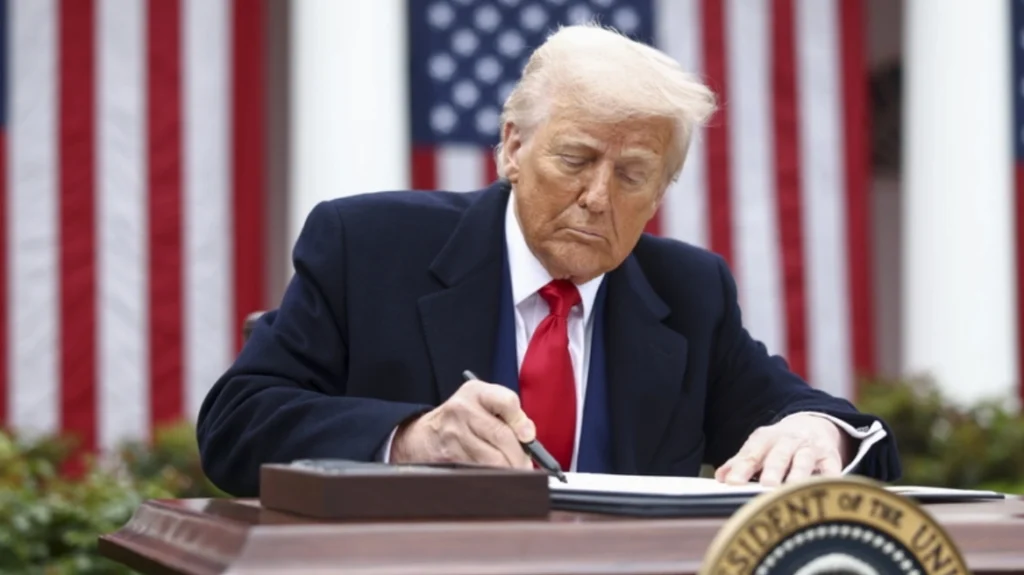
The administration of Donald Trump is opening a new round of trade tensions with major United States trading partners, announcing on Wednesday a plan to impose additional tariffs on imported goods from 14 major trading partners, including the European Union, China, Japan and South Korea.
The highest duties are intended for China, with Washington proposing additional tariffs of 20% on Chinese products, on top of the approximately 25% tariffs imposed during Trump’s first presidential term.
The US government maintains that the measures are aimed at addressing what it calls “structural excess capacity”, accusing some of its largest trading partners of artificially boosting their industrial production and flooding international markets with goods at excessively low prices.
The proposals were announced by the Office of the United States Trade Representative (USTR), following the completion of an eight-month investigation into unfair trade practices under Section 301 of US trade law.
The investigation covered a total of 16 trading partners, including close allies of Washington. Of these, only Mexico and Norway are not included in the current proposal to impose additional tariffs.
The 14 Trading Partners in the Crosshairs
According to a senior US official, the proposal concerns products imported into the United States from China, Bangladesh, Cambodia, the European Union, India, Indonesia, Japan, South Korea, Malaysia, Singapore, Switzerland, Taiwan, Thailand and Vietnam.
The trading partners affected include both emerging Asian economies with strong export activity and traditional allies of the United States.
The inclusion of the European Union, Japan and South Korea demonstrates that the new measures are not limited to Washington’s trade confrontation with Beijing.
The exact tariff rates for each trading partner are expected to be published on Wednesday in the US government’s official journal, the Federal Register.
By contrast, investigations concerning Mexico and Norway are still being reviewed by the USTR, with no timetable announced for their completion.
What Washington Accuses Its Trading Partners Of
The US government maintains that the economies under investigation are implementing policies that boost production beyond levels justified by actual demand and market conditions.
“We have concluded that each of these trading partners creates, maintains or contributes to structural excess capacity and production in manufacturing sectors through various actions, policies and practices that we consider unjustified and that burden or restrict US commerce,” a senior US official said.
According to the definition used by the USTR, structural excess capacity exists when a country promotes production and the expansion of its industrial capacity independently of actual demand and market principles.
Such practices include state industrial policies, subsidies and the use of components or intermediate goods imported from economies that do not operate fully according to free-market principles.
Washington believes these policies can create unfair competitive advantages, putting pressure on American businesses and undermining the competitiveness of domestic industry.
The investigation began in March 2026 and included trading partners that, according to the US side, have large trade surpluses or production capacity exceeding demand.
China in the Spotlight: What the New 20% Tariff Means
China is expected to face the highest combined tariff burden among the 14 trading partners covered by the announcement.
The proposed additional 20% tariff will be added to the approximately 25% tariffs imposed on Chinese products during Trump’s first presidential term.
This means that, for certain products, the duties arising from these specific tariff measures could reach approximately 45% in total, depending on the product and the applicable rates.
However, the new duties will not be added to the 10% or 12.5% tariffs that the Trump administration imposed in July on a broader group of 60 trading partners, citing inadequate enforcement of legislation against forced labour.
A US official also clarified that the new measures would not exceed the tariff limits provided for under the Trump administration’s trade agreements.
These include the 20% ceiling on new tariffs imposed during the US president’s second term, as part of the trade truce with Beijing, which is expected to expire on January 10, 2027.
Washington is also providing for an exemption covering approximately $30 billion worth of Chinese imports, for which tariff reductions are being considered through a bilateral negotiating process known as the Board of Trade.
When Will the New Tariffs Take Effect?
Despite the US government’s announcement, the new tariffs will not be implemented immediately.
The proposals will enter a public consultation process, during which businesses, trade associations and other interested parties will be able to submit their comments.
A public hearing will also take place before final decisions are made.
According to a senior US official, implementation of the new duties could be delayed until January 2027, precisely because of the procedures that need to be completed.
Late on Tuesday evening, the administration informed the relevant congressional committees of the changes, while the countries affected by the measures also received notification.
Ask me anything
Explore related questions




