





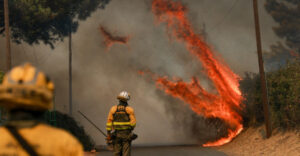
The wildfire in the Madrid, Spain region is “at its peak”, the head of Madrid’s regional emergency management services, Carlos Novillo, said this evening, speaking to reporters at the operational command centre coordinating firefighting efforts. “At this moment, it’s clear the fire is at its peak; it’s impossible for us to put it out,” Mr Novillo said.
One piece of more encouraging news is that the other fire, in Ávila, is moving further north than had been forecast, and authorities hope it will not merge with the front burning in neighbouring Madrid.
The government also announced that the Prime Minister, Pedro Sánchez, will travel to the Madrid fire front tomorrow morning, accompanied by the Interior Minister, Fernando Grande-Marlaska. The prime minister will visit the community of Cenicientos and take part in a meeting there.
The fire has so far burned 6,000 hectares, and 40,000 people have been forced to leave their homes or told to stay indoors and not attempt to flee, according to the government delegate for the Madrid region, Francisco Martín Aguirre, who described the situation as “very complex” because of strong winds. He did not rule out further evacuation orders.
Spain late on Thursday declared a national emergency in the Madrid region and in the province of Avila, near the capital, in the wake of several wildfires burning out of control.
— CGTN Europe (@CGTNEurope) July 24, 2026
More than 10,000 people have been evacuated in recent days from across the Madrid region, where… pic.twitter.com/ZrjUuF2egw
“For an area like this one, with a high concentration of homes and population, it is a disaster,” insisted the President of the Community of Madrid, Isabel Díaz Ayuso.
Conditions improve in Guadalajara
Castilla-La Mancha’s forest fire service, Infocam, believes conditions surrounding the major wildfire in Guadalajara, which has burned 32,000 hectares in a week, are now “favourable” for extinguishing it, and that the fire “is entering a stabilisation phase”.
The wildfire, the largest to have broken out in Spain since the start of the year, has been burning since last Thursday in this arid, sparsely populated part of Castilla-La Mancha.
“Its evolution is favourable,” an Infocam spokeswoman told the French news agency AFP, adding that wind gusts are expected to ease from tomorrow, Saturday, which should help firefighters in their battle against the flames.
The President of Castilla-La Mancha, Emiliano García-Page, announced via the social media platform X that residents of the 14 communities that had been evacuated can return home from today.
Earlier, regional authorities downgraded the fire to “level 1”, meaning it no longer requires emergency assistance from the central government. Even so, more than 200 troops remain on site, along with 20 ground units and two aircraft.
Early in the evening, Mr García-Page, the regional president, said he wanted to “help” the regions of Madrid and Castile and León, where two major wildfires have been raging since yesterday, forcing thousands of people to evacuate their villages.
Southern France at the mercy of the flames
In France, authorities ordered the complete evacuation of the Cap Ferret peninsula, a highly popular tourist destination west of Bordeaux, with hundreds of people being moved out, some even by boat across Arcachon Bay.
According to the Interior Minister, Laurent Nuñez, around 40,000 people have already been evacuated or are in the process of leaving, while the regional prefect of Gironde, Sophie Brocas, described the Gironde fire as an “XXL wildfire”.
The fires, which broke out on Wednesday, have already destroyed around 10,000 hectares of forest. So far, 53 homes and one campsite have burned, while, according to authorities, around 2,000 homes have been saved thanks to firefighters’ efforts.
French authorities have ordered the total evacuation of the Cap Ferret peninsula, as wildfires across Europe continue to rage.
— Channel 4 News (@Channel4News) July 24, 2026
Wildfires are becoming more frequent, more intense and lasting longer, particularly in Europe due to climate change. pic.twitter.com/upkWpC97pw
New fire front and tens of thousands of evacuations
The situation worsened in recent hours as the fire spread rapidly, driven by strong winds, prompting authorities to also order the evacuation of the town of Arès.
At the same time, a second major fire in the Landes region, near the town of Biscarrosse, forced more than 23,000 people to leave their homes, campsites, a care home and a summer camp.
Authorities believe the fire will not be brought under control any time soon, with winds reaching 50 km/h and temperatures ranging between 36 and 37 degrees Celsius.
Since the fires began, two firefighters have lost their lives while battling a blaze near Bordeaux airport.
The President of France, Emmanuel Macron, described the situation as “particularly critical” and announced that the country had requested assistance from the European Union, with firefighting aircraft expected from Croatia, Portugal, Czechia and Slovakia.
Ask me anything
Explore related questions




