





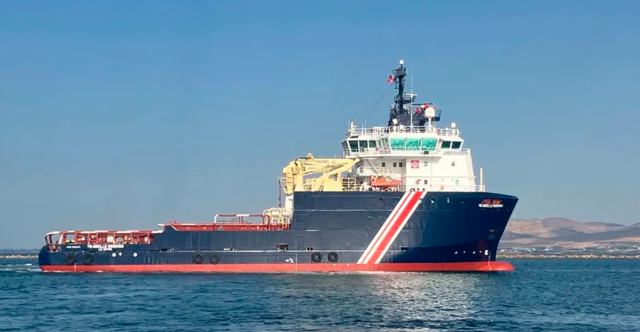
The government is on full alert ahead of the resumption of work on the GS cable, with the departure of the vessel Abeille Marengo from Heraklion towards the waters off Kasos scheduled following yesterday’s issuance of the relevant NAVTEX.
Calm and determination prevail at all levels of government regarding the implementation of this critical project, accompanied by a clear reminder that no permission will be sought for the exercise of Greek sovereign rights. “International maritime law is clear and leaves no room for differing interpretations,” Greek diplomatic sources said last night, in the wake of Turkish reactions, which were nevertheless more forceful in their rhetoric than expected. This confirms that Turkey has not been asked to “grant permission” for the project, as Ankara had incorrectly demanded. Moreover, the Greek side had made it exceptionally clear to the French contractors involved in the project that Turkey’s permission would not be sought in the field.
Athens: International Maritime Law Is Clear
Last night, diplomatic sources in Athens responded in stern terms to a statement by the Turkish Ministry of Foreign Affairs, in which Ankara challenges the NAVTEX notices issued by Greece and Cyprus for the start of surveys by the French vessel VB Abeille Marengo, as part of the electricity interconnection between the two countries. At the same time, a Turkish unmanned aerial vehicle bearing the callsign VATOZ17 was carrying out surveillance flights south of Karpathos, in the area through which the subsea cable is expected to pass.
“The work of the French research vessel VB Abeille Marengo will proceed in accordance with the company’s operational planning, in Greek and Cypriot territorial waters and in areas of the Greek and Cypriot continental shelves,” Greek diplomatic sources stressed in response to what they described as the provocative statement by the Turkish Ministry of Foreign Affairs. The same sources added pointedly that “International maritime law is clear and leaves no room for differing interpretations.”
Turkish UAV Monitors Area South of Karpathos
At the same time, Turkish unmanned aerial vehicles were highly active in the north-eastern and south-eastern Aegean, with flights extending from the area of Keşan to Karpathos.
According to information, a Turkish UAV bearing the callsign VATOZ17 was flying south of Karpathos, carrying out repeated surveillance circuits in the area where the cable for the Greece–Cyprus electricity interconnection is due to be laid.
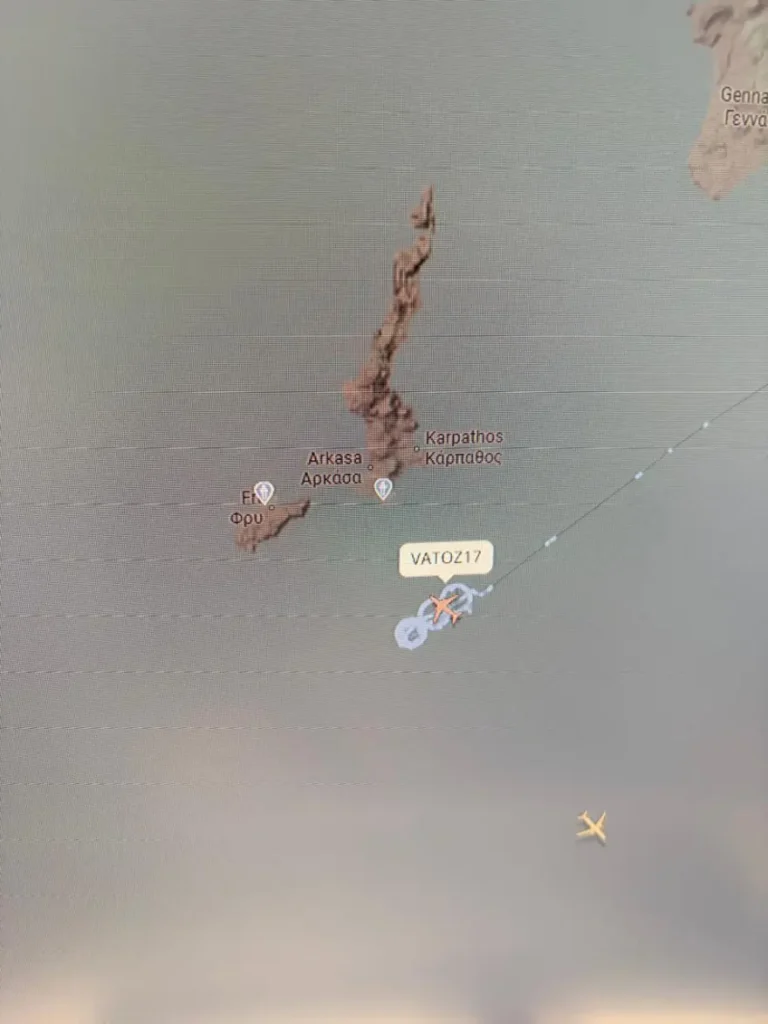
According to the same information, the aircraft is an AKINCI or ANKA-type unmanned aerial vehicle, which took off from the naval base at Dalaman and is carrying out a mission to clarify the surface picture, with the aim of monitoring activity in the specific maritime area.
The UAV appears to switch its tracking transmitter on and off intermittently, meaning that it is not continuously visible on flight-tracking systems.
According to the available information, it is the Turkish unmanned aircraft operating closest to the area of the scheduled works.
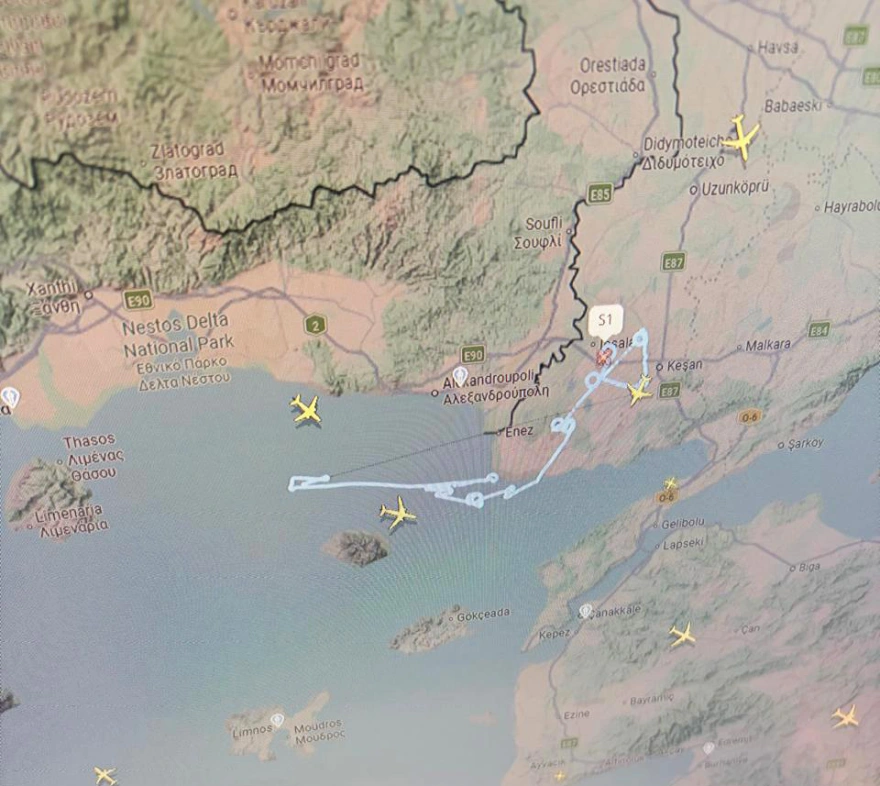
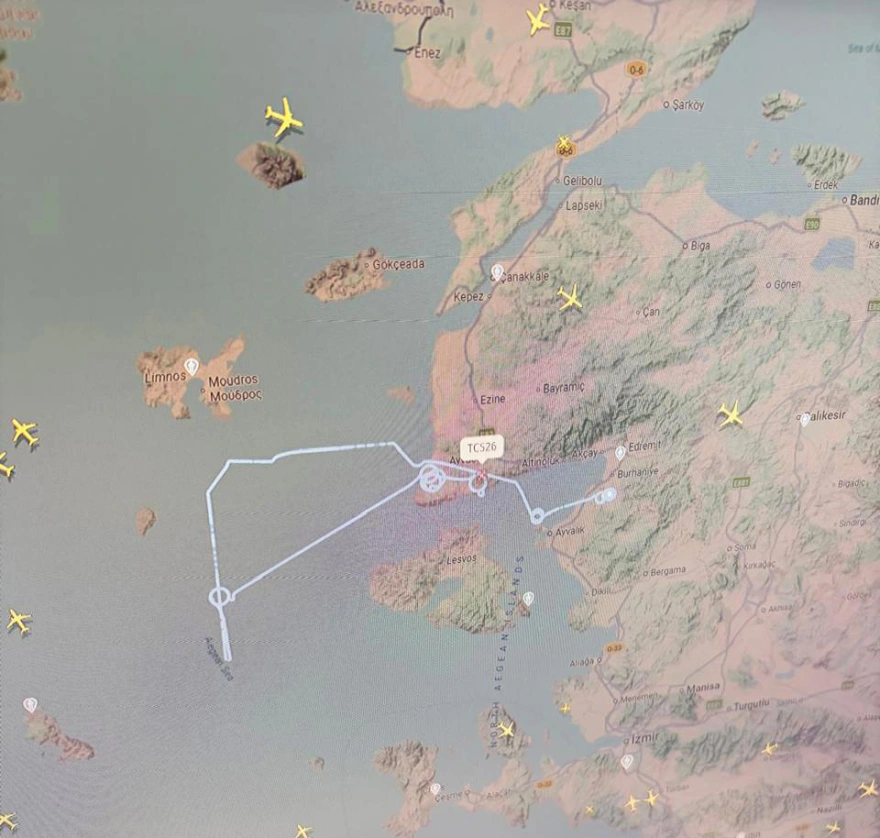
Earlier on Friday, Turkey escalated its pressure through a statement by its Ministry of Foreign Affairs, declaring that it requires an application for authorisation to be submitted to the Turkish authorities for surveys to be carried out in areas of the “Turkish continental shelf” — effectively across the entire Eastern Mediterranean.
The reference by the Turkish Ministry of Foreign Affairs is even more problematic, as Ankara, according to its unilateral submission of the outer limits of its purported Exclusive Economic Zone (EEZ), is attempting to overlap with the area of the Greek EEZ established under the Greece–Egypt agreement.
By declaring that it had cancelled the NAVTEX notices issued by Greece and Cyprus, the Turkish ministry appears to be bargaining until the last moment in an effort to secure a request for permission that would also justify the continuation of the surveys domestically.
It also warns of its “determination to protect our sovereign rights arising from international law”, while stating that it will continue to adopt in the region “an approach based on cooperation, dialogue and coordination”.
In its statement, the Turkish Ministry of Foreign Affairs said:
“It has come to our attention that a vessel flying the French flag attempted to conduct unauthorised marine scientific research for the purpose of installing a subsea cable within our continental shelf, the outer limits of which we notified to the United Nations on 18 March 2020.
“The unauthorised navigational notices issued for this purpose by Greece and the Greek Cypriot Administration of Southern Cyprus [meaning the Republic of Cyprus] have been cancelled by our country.
“For the part of the activities planned by the vessel in question that falls within the limits of our continental shelf, no application for authorisation has been submitted to our country, in accordance with the customary rules of international maritime law.
“Our determination to protect our sovereign rights arising from international law is absolute, and we will continue to adopt in the region an approach based on cooperation, dialogue and coordination.”
The NAVTEX Battle
On Friday afternoon, a brief “battle” took place between the Greek and Cypriot authorities on the one hand and the Turkish authorities on the other, with a series of NAVTEX notices being issued.
The Greek NAVTEX covers the entire route for laying the cable, extending as far as the Cypriot EEZ. Surveys have already been carried out in the sections north of Crete, which also include international waters, including after the Kasos incident. The main section of the remaining surveys concerns the area east of Kasos, up to the boundaries of the Cypriot EEZ.
This followed a telephone conversation between Foreign Minister G. Gerapetritis and his counterpart from the Republic of Cyprus, K. Kombos, as part of the close coordination between the two countries.
Turkey’s Counter-NAVTEX
However, shortly afterwards, Ankara issued a counter-NAVTEX challenging the Greek notice concerning the French research vessel that will carry out work for the Greece–Cyprus electricity interconnection. It claimed that part of the area lies within the Turkish continental shelf and demanded its consent for the surveys to be conducted.
With counter-NAVTEX 1105/26, Ankara once again brought into play the letter it sent to the United Nations on 18 March 2020 (A/74/757), maintaining that part of the survey area lies within the continental shelf it has unilaterally declared.
The next step in Turkey’s challenge is even more telling. Ankara claims that it has not granted permission for the specific surveys, describes the Greek NAVTEX as “unauthorised”, and demands that all research activities in maritime areas which it considers to fall within its jurisdiction be coordinated with the Turkish authorities.
This constitutes a direct challenge to the Greek side’s authority, with Turkey seeking to portray its own consent as a prerequisite for the works, invoking claims that Athens does not recognise. The unilateral submission of coordinates to the United Nations, after all, does not constitute recognition of Turkish claims or a delimitation of the continental shelf.
Ask me anything
Explore related questions




