





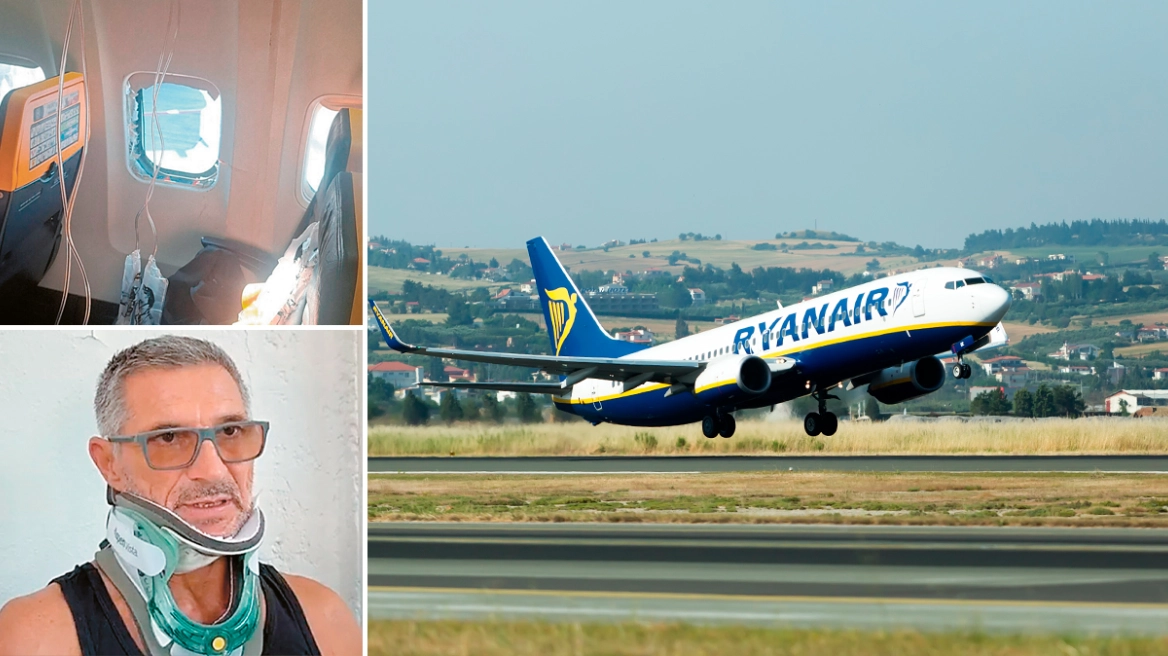
“They won’t let us fly,” says the popular Greek travel-influencer duo Haha Nomads, standing in front of Ryanair’s check-in desk.
Beside them, other travellers are complaining that their cases have been “caught out” by the sizer, the electronic device into which hand luggage is placed to check whether it meets the airline’s cabin-baggage limits.
Grievances over the airline’s alleged excesses are piling up, with passengers accusing Ryanair of issuing fines of 60 to 80 euros for hand luggage that is over the limit by as little as a one-centimetre strap or five grams.
The window
While the sight of passengers trying to prise the wheels off their suitcases to avoid Ryanair’s extra charges is faintly absurd, those complaints pale beside the ordeal of a passenger who was partially sucked through a shattered window during a flight from Thessaloniki to Memmingen, Germany. Ljubisa Karović, 61, a Serbian national, survived after his wife and two fellow passengers pulled him back inside the cabin with superhuman effort.
“Ryanair will be sending the passenger who got sucked out of the window a bill for extra services: 100 euros for use of fresh air and 60 euros for enjoying an unrestricted view,” one social media user joked sardonically.
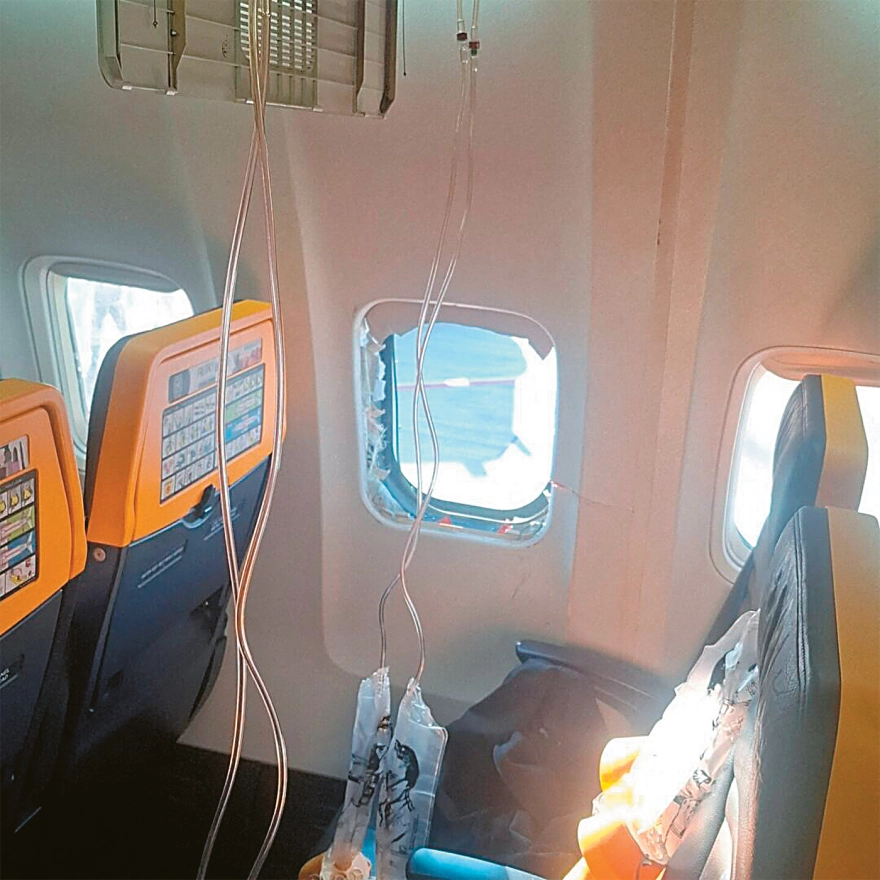
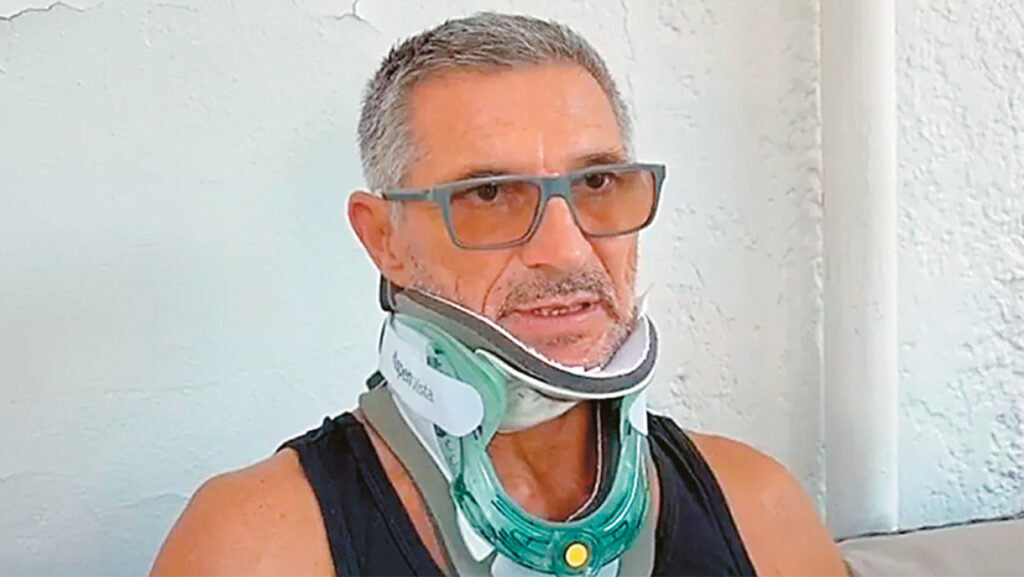
Karović himself finds nothing funny about what happened. He has been left physically and psychologically injured, and says he was struck by the fact that no Ryanair representative visited him in hospital, nor even called to apologise.
Nor does America’s National Transportation Safety Board (NTSB), which investigates aviation and rail accidents, find the matter amusing. The agency has pushed back on claims by Ryanair CEO Michael O’Leary that the window was struck by “foreign object damage” and that the incident was unrelated to the aircraft’s age (18 years) or its maintenance record.
“The NTSB made no such determination,” NTSB chair Jennifer Homendy said pointedly in response to O’Leary, adding that investigators “have not ruled out either age or maintenance issues that may have played a role in the event”.
All of this is proving “too much” for the Irish low-cost carrier, whose shares fell by around 4 percent to 56.23 dollars last Thursday after several days of declines, following disappointing first-quarter results that showed lower profits and revenues below expectations.
Charges
The trouble for Ryanair is that the detachment of the window, struck by debris from a piece of the aircraft’s engine that broke away, and the terrifying moments experienced by passengers, is raising suspicion. Particularly after the rebuke from the NTSB, an agency that rarely rushes to make public statements, many are asking whether Ryanair’s discount pricing model has also extended to cutting corners on safety.
Until the NTSB answers that question, the Irish airline remains in the sights of many passengers, as well as regulatory bodies accusing it of hidden charges. In a twist on the saying that cheap comes at a cost, many customers, who have flooded the airline’s review pages with complaints, are grumbling about exactly such charges.
To be fair, anyone booking with Ryanair should know what they are getting: even a small bottle of water is not free in flight but must be purchased, as is now the case with many airlines. The same goes for online check-in, carried out exactly as the airline specifies, or passengers risk missing their flight or paying an extra fee. It is a low-cost airline, and that comes with fewer included services.
What many passengers do not expect, however, is being charged to sit next to their own children. In the UK, the Competition and Markets Authority (CMA) has opened an investigation into the Irish carrier, saying its terms and conditions require at least one parent to sit with their children, including those with disabilities, while charging around 8 pounds per flight for the privilege.
Ryanair has called the investigation “baseless” and says it intends to “rebut the CMA’s false claims”, insisting it does not charge for children to sit next to an accompanying parent or adult. The CMA, however, has found that parents of children aged 2 to 11 must accompany them in flight through a “mandatory family seat”, which costs between 4.50 and 13.50 euros to book.
Over a centimetre
Many passengers also accuse the airline of hidden charges over cabin baggage. Numerous customers claim that staff deliberately place hand luggage in the sizer looking for any excuse, even a single centimetre or a single gram over the limit, to justify an extra charge, typically 60 euros.
The same 60 euro charge applies to duty-free bags that do not fit inside a passenger’s hand luggage. Shoppers are permitted to buy from airport shops but are not allowed to carry the bags separately onto a Ryanair flight unless they remove something from their hand luggage so the bag no longer protrudes. Otherwise, they pay, and pay dearly.
Careful attention is also needed with fare type, an issue not unique to Ryanair, though the airline is particularly strict about enforcing the terms of its cheapest “light” fares. Many passengers book the lowest fare they can find online without checking exactly what it includes.
On arrival at the airport with their cases, they are often surprised to discover their ticket covers only one piece of hand luggage of a specific size and weight. Any additional bags must be paid for, often at around 10 euros per kilogram.
Ryanair is also among the airlines that charge heavily for checking in at the airport or printing a boarding pass the traditional way. In such cases, the total charge can reach 60 euros.
Others fail to double-check their flight details (date and destination) or the passenger’s name when booking, assuming any necessary changes will not cost much. Charges vary depending on the fare type, but based on the cheapest ticket, changing a flight can cost between 30 and 90 euros on top of any fare difference. If even a single letter in the passenger’s name is entered incorrectly, correcting it at the airport can cost more than 160 euros.
Many passengers also mention Ryanair’s well-known “40-minute rule” for check-in and baggage drop deadlines. Unlike in the past, when passengers could drop bags or check in as late as 40 minutes before scheduled departure, Ryanair has changed this, now requiring bag drop 60 minutes before departure at all airports.
The 40-minute threshold still matters for a couple of specific reasons. There is a “missed flight” window: a passenger who misses their flight can pay a missed-flight fee at the ticket desk, around 100 euros, to be rebooked on the next available flight, but only if they reach the ticket desk within one hour of the originally scheduled departure time. Boarding gates typically close 20 minutes before departure, meaning the window between 40 and 20 minutes is the absolute cut-off for passengers who have already checked in to reach the gate.
Penny-pinching
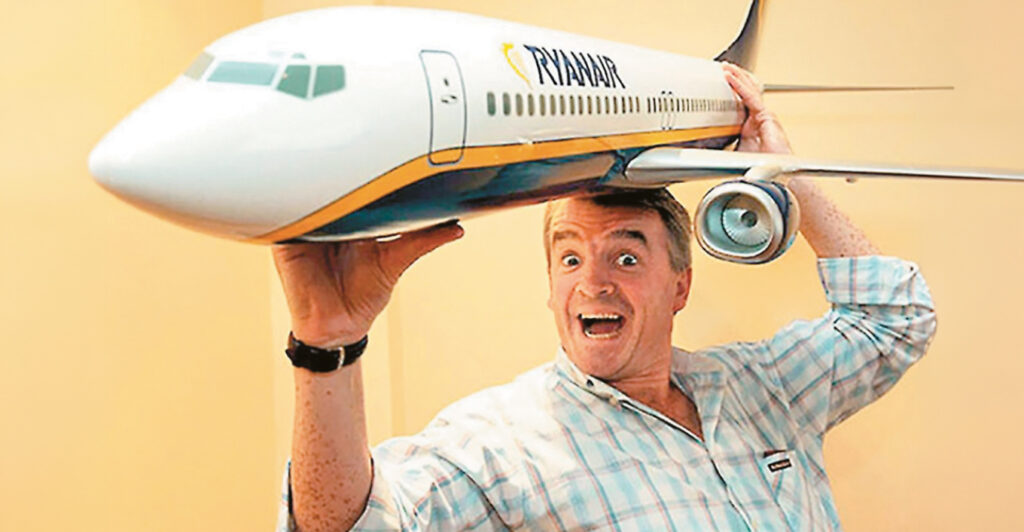
Regardless of all this, Ryanair CEO Michael O’Leary, one of the longest-serving chief executives of any major international company and set to remain in post until 2034, regularly makes international headlines, not only for his dry humour but more often for his outlandish cost-cutting ideas.
Some of these have been so extreme that they have earned him the nickname King of Cheapskates, since if implemented, which they may well be, they would reduce the flight experience with the low-budget carrier to something resembling the intercity coaches of decades past.
For example, O’Leary has seriously proposed charging Ryanair passengers to use the toilet in flight. The Irish chief executive first floated the idea around 20 years ago, and everyone assumed it was one of his usual jokes. He later clarified he was serious and that the plan remains on the table: he wants Ryanair to charge passengers around 1.50 euros to use the toilet on flights of one hour or less.
Overweight passengers
O’Leary caused a genuine storm, however, when he proposed that Ryanair charge overweight passengers extra. Citing a survey in which a third of respondents supported the idea, the Ryanair CEO revealed he had considered introducing a so-called “fat tax”.
The plan, since shelved for now due to conflict with UK discrimination law, would have seen men weighing more than 130 kilograms and women weighing more than 100 kilograms pay an extra amount per additional kilogram, or a flat fee for any passenger whose waist spans two adjacent seats at once.
Ryanair did, however, deny reports that it was working with the Italian manufacturer Aviointeriors to introduce an “ultra-economy” seat in the near future, in which passengers would not sit but instead lean against a narrow, vertically mounted perch resembling a bicycle saddle, in a semi-standing position, much like standing passengers on a city bus. O’Leary had referred to this concept earlier, though it remains unclear whether he was joking or simply staging a PR stunt to draw media attention to himself and the airline.
Ask me anything
Explore related questions




