





The helicopters had taken off from Elefsina military airbase. According to the latest information, two people sustained minor injuries and two were transferred unconscious to the 251 General Air Force Hospital. The survivors are a British pilot and a Greek liaison officer, while those confirmed dead are a Danish pilot and a Greek liaison officer.
Both helicopters were leased by the Fire Service, each with a crew of two.
Four EKAB (National Centre for Emergency Care) ambulances and one mobile unit were dispatched to the scene.
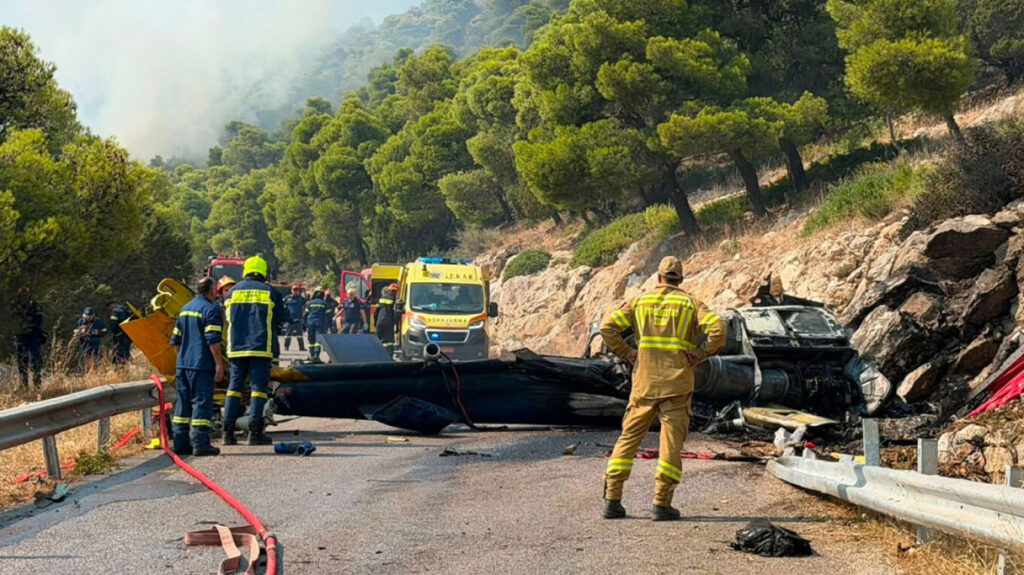
On both helicopters, the pilots were of Romanian origin, while the coordinators are Greek.
Four EKAV ambulances and one mobile unit are at the scene. The injured are being transferred to the 251 Air Force General Hospital.
A search and rescue operation is under way for the crew of the second helicopter, which is being sought in a ravine. Each helicopter carried a two-person crew: a pilot/operator and a coordinator liaising with the operations centre.
See video
How and why the crash occurred
Aeronautical engineer and air accident investigator Faidon Karaiosifidis explains how the flight formation broke apart, how one helicopter’s skids struck the other’s rotor causing an explosion, while stressing all scenarios, including mechanical failure, remain open.
As he notes, the two Bell 214ST helicopters, leased from the Australian company McDermott Aviation, were operating in formation during the aerial firefighting operation, a procedure governed by strict coordination rules and specific operational protocols.
“Aerial firefighting is carried out under strict coordination”
Karaiosifidis explains that aerial firefighting operations are usually led by a Fire Service coordination helicopter, which acts as a “flying control tower”, organising aircraft entering and leaving the fire area.
“The aircraft operate in formations. Aeroplanes and helicopters are not mixed together, and, as a rule, similar aircraft types operate together. That is, the Canadairs operate together, the larger helicopters together, the smaller ones together. Each formation has its leader, who, after coordinating with the coordination helicopter, gives the final instructions on the approach axis and method of approach.”
“The second helicopter struck the first”
Referring to the first available visual evidence, the aeronautical engineer points out that the assessments are based solely on the video that has been made public.
“From what appears in the video, which is not ideal for drawing safe conclusions since there is no other helicopter positioned ahead of the formation, the second helicopter appears to have struck the first, which was leading the formation.”
He stresses that the main focus of the investigation is not only the collision itself but, above all, the reasons that led the two helicopters to end up so close together.
“The critical point is why the two helicopters ended up so close to one another. Why did the formation break up? Why, during the descent, did the second helicopter appear to have a steeper rate of descent and close in on the first? These are the crucial questions the investigation will need to answer.”
According to him, there are several possible scenarios, and none can currently be ruled out.
“Downdraughts, crosswinds, or even some form of mechanical failure could have been a factor. The human element is also never absent from aviation incidents. However, this cannot be investigated remotely, based only on the information available today.”
“The first helicopter effectively ceased to be a helicopter”
Describing the sequence of events, Karaiosifidis assesses that the landing gear of the second helicopter came into contact with the main rotor of the first.
“What appears to have happened is that the skids of the second helicopter struck the rotor of the first. From that moment, the first helicopter effectively ceased to be a helicopter. Following the destruction of the rotor, there was a catastrophic failure of the transmission gearbox beneath the engines, causing an explosion and fire, and what came down was, by that point, simply wreckage.”
By contrast, he notes, the second helicopter, despite the visible damage it sustained, retained its ability to fly. “Although it suffered serious damage, it remained a helicopter. This gave its pilot, provided he was properly trained, the ability to carry out an emergency landing.”
“All scenarios remain open”
The aeronautical engineer avoided pre-empting the causes of the incident, insisting that only the official investigation will provide answers.
“We cannot say at this stage exactly what happened. All scenarios remain open, including that of mechanical failure in one of the two helicopters. Responsibility should not be attributed before the investigation is complete. The cause will only emerge through the official inquiry and the actual evidence.”
Ask me anything
Explore related questions




