





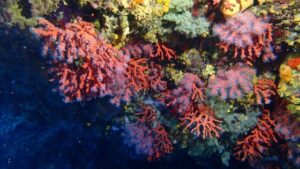
Marine biologist Christos Taklis has told protothema.gr that a destroyed coral area can take centuries to recover, commenting on the case on the Greek island of Skopelos, where authorities uncovered a well organised ring dealing in illegal coral fishing and trafficking.
The operation, carried out by DEOS (the Directorate General of Financial Transaction Control Forces, the financial crime unit under AADE, Greece’s Independent Authority for Public Revenue) in cooperation with the Hellenic Coast Guard, led to the discovery of large quantities of red coral aboard a leisure boat chartered by Italian nationals and sailing off Skopelos. The value of the seized haul is estimated at close to 800,000 euros.
According to reports, the cargo’s final destination was Italy, while investigations are being widened to identify the ring’s recipients and accomplices.
Red gold
At the centre of the case is red coral, dubbed the Mediterranean’s “red gold,” a protected species that has become a target for illegal trafficking networks.
Taklis points out that, beyond the dimension of organised environmental crime, the case highlights the serious ecological threat facing Greece’s coral ecosystems.
“We may not have the vast coral reefs found in other oceans, but the corals in Greek waters are biodiversity hotspots,” he says. “They act as a refuge for many marine species, which use them to reproduce and survive. Red coral, which appears to be at the centre of the Skopelos case, is usually found at depths of between 15 and 300 metres.”
“They grow just a few millimetres a year”
Asked about the impact of illegally removing coral from the seabed, Taklis stresses that natural recovery is extremely slow.
“Red corals grow just a few millimetres a year. That means that when a coral area is destroyed, it can take centuries for it to return to its previous state,” he says. He adds that “each coral habitat is unique, since different species need different conditions of light, seabed and coexistence with other organisms, which makes restoration particularly difficult.”
“From 800,000 euros to… millions”
Taklis explains that red coral is among the most expensive raw materials used in jewellery making.
“Usually in cases like this we’re talking about jewellery and illegal trade. If the raw material here is valued at 800,000 euros, once it’s turned into jewellery its value can reach millions of euros,” he notes.
He adds that coral also sometimes ends up in private aquariums through illegal trade, although red coral is used mainly by the jewellery industry.
No complete mapping
The marine biologist points out that, despite red coral being found in other parts of the country too, Greece still lacks a complete map of its coral ecosystems.
“We find it in other areas as well, but often these are isolated colonies that haven’t yet been properly recorded. In fact, several of these locations shouldn’t be made public until there is adequate protection in place,” he stresses.
Referring to the authorities’ operation, Taklis calls it an unprecedented case. “As far as I know, this is the first time we’ve seen a case like this. It’s an important step for protecting endangered species, because unfortunately many reports up to now haven’t led anywhere,” he says.
He clarifies that collecting coral is not illegal in itself, but it is only permitted under a very strict regulatory framework, requiring special permits from the competent authorities, specific quotas, full recording of the catch, and all the traceability and export documents required under international law.
“There can’t be this kind of uncontrolled removal, which is what appears to have happened in this case,” he stresses.
“We need checks and very heavy fines”
Taklis concludes by arguing that checks need to be strengthened at every stage of the trade in protected species. “We need extremely strict checks from the Coast Guard, customs and all the relevant authorities, as well as full traceability across European countries, so that illegal cargoes can’t be laundered through third countries,” he says.
He also calls for particularly strict penalties for anyone involved in such cases.
“Fines need to be several times the illegal profit. If this cargo is valued at 800,000 euros, the penalty for those responsible should be four or five times that,” he concludes.
Ask me anything
Explore related questions




