





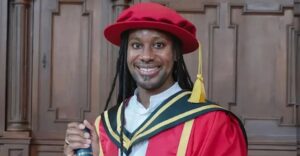
Jason Arday’s story had all the hallmarks of an extraordinary personal triumph, before it began to collapse under the weight of scrutiny. The British academic had been held up as one of the brightest new voices in sociology, race and inequality, becoming, in 2023, at just 37, the youngest Black professor in the history of the University of Cambridge.
His backstory was remarkable. Arday said he had been diagnosed with autism at three, was non-verbal until 11, and unable to read or write until 18. Despite this, he earned a PhD from Liverpool John Moores University (LJMU) in 2015 and went on to publish research widely praised within academia. When Cambridge appointed him, the head of the education faculty is said to have told him he was the best in the world at his field of research.
His academic rise was not the only striking part of his public image. Arday also cultivated a reputation as an elite long-distance runner and a hugely successful charity fundraiser. He said he had once run 600 miles between Edinburgh and London in six days, a feat that would place him among the world’s leading ultra-marathon runners, and claimed to have raised more than £5 million for charity over the years, at times putting the figure as high as £5.5 million. He said he had completed 30 marathons in 35 days, suffering an epileptic seizure and a fractured leg on the 21st before finishing the remaining nine anyway. He also said he had survived a coma lasting several months, and that a brain tumour had been removed just two weeks before his final PhD exam.
The picture began to unravel after British newspapers investigated inconsistencies in his academic record and his biography. A Substack post published last month by Nathan Cofnas, a philosopher at the University of Ghent who had lost a research post at Cambridge’s Emmanuel College in 2024 amid accusations of racism, alleged that Arday’s PhD thesis, on peer monitoring among trainee teachers, closely resembled a doctoral dissertation submitted six years earlier by another researcher, Paula Zwozdiak-Myers of Brunel University London. The Telegraph later reported finding more than 100 similar passages between the two texts. On 1 August, the Guardian published its own investigation examining wider discrepancies in Arday’s claims about his life.
The celebrity Cambridge education professor Jason Arday, whose rags-to-riches memoir from Simon & Schuster lands August 11, has repeatedly lied about his charitable fundraising prowess, 16 years of records reviewed by the Free Beacon show—and the publishing house is stealthily… pic.twitter.com/qXkbAjmCVq
— Washington Free Beacon (@FreeBeacon) August 5, 2026
Those figures have not held up well. The only independently verifiable fundraising record from his early career, a JustGiving page from 2010 still online, shows he raised £6,285, plus £1,045.77 in Gift Aid, for Shelter and the Shooting Star Children’s Hospice through the 30-marathons-in-35-days challenge, a fraction of the multimillion-pound sums later attributed to him. When the Guardian put the £5 million figure to him, Arday said the money had been raised with the help of “many fundraising collectives over a two-decade period.” He later told the Times the funds had come from a syndicate of around 100 people he could not name because of non-disclosure agreements, and has since acknowledged he did not run 600 miles in six days.
Other claims also crumbled. Institutions where Arday said he still held visiting professorships denied he currently held any such position. He was reported to have said he had a book, “Being Young, Black and Male: Challenging the Dominant Discourse,” under contract with the publisher Palgrave Macmillan, which says it only ever received a proposal and never published the work. Meanwhile, colleagues at Cambridge began demanding answers, and students he had supervised asked for their work to be reviewed and remarked. Some who raised concerns about his supervision say they were met with accusations of racism instead of a response to their complaints.
His memoir, “Great and Unfortunate Things,” ghostwritten with Eve Claxton and published by Simon & Schuster for a reported fee of £1.4 million, remained on schedule, released in the United States today and due in Britain on 27 August. Two promotional events, a Royal Geographical Society “fireside chat” set for 2 September and an appearance at an Edinburgh bookshop on 18 September, have been cancelled. Simon & Schuster has said publication will go ahead as planned.
Arday, today widely described as a “serial fabulist” by the media, resigned from Cambridge on 5 August, hours after the university said it was opening a new investigation into his “academic qualifications and honorary appointments.” He did not admit wrongdoing, saying instead that scrutiny had taken “a profound toll on me and on those I love,” and that he needed time to heal before returning. Cambridge itself has described the wider campaign against him as a “vile campaign to undermine his credibility.”
It later emerged that Arday’s record had faced scrutiny before. A reporter at Times Higher Education, the specialist higher-education publication, had spent months investigating similarities between Arday’s thesis and other academic work, but the story was never published after intervention by his lawyers, Carter-Ruck. Separately, Arday reported the same journalist, Jack Grove, to the Metropolitan Police, accusing him of harassment. The force investigated Grove for four months before dropping the case, at one point warning him not to contact Arday over concerns for Arday’s mental health. The Met later admitted the warning was a mistake; commissioner Sir Mark Rowley acknowledged, “we dropped the ball on that one, let’s not beat around the bush.” Broadcaster Andrew Neil and Conservative MP Neil O’Brien were among those who criticised the force’s handling of the case.
LJMU, where Arday completed his doctorate, had already investigated the plagiarism allegations and cleared him, attributing the similarities to what the Guardian described as “honest and reasonable error.” Arday denies having been dishonest. He has acknowledged embellishing some minor personal details, while separate inquiries at other institutions have not upheld every allegation against him. Other reviews remain ongoing.
🇬🇧 Cambridge’s youngest Black professor, Jason Arday, has faced renewed scrutiny after backtracking on a claim that he appeared in the TV series Seven Up, despite being born decades after it first aired.
— Europa.com (@europa) August 3, 2026
Arday later said he had been referring to a “community initiative” rather… pic.twitter.com/OKdKCJloeS
From personal scandal to a weapon in the DEI war
The case has now grown far beyond the professor himself. To his critics, the Arday affair exemplifies a university system so focused on diversity and representation that it loosened traditional standards of academic scrutiny. Britain’s right seized on the story quickly as evidence that diversity, equity and inclusion (DEI) policies may have come at the expense of merit. Defenders of these policies, meanwhile, are wary of using one contested case to condemn an entire institutional and political movement.
The debate is complicated by the fact that “meritocracy” is not a politically neutral concept. Those who argue most forcefully for strict meritocratic standards do not always show the same enthusiasm for scrutinising other forms of advantage, such as wealth, family connections or elite schooling.
Politics professor Eric Kaufmann of the University of Buckingham, who directs its Centre for Heterodox Social Science and is among the most prominent critics of progressive dominance in academic life, argues that conservative students and academics frequently self-censor. He says departments with a left-leaning ideological makeup create an environment in which conservative views are expressed far less openly.
Data from the Foundation for Individual Rights and Expression (FIRE), a US free speech organisation, support the picture of rising self-censorship on both sides of the political spectrum. Its 2026 survey found that 53% of students would not even open a discussion about Israel and Palestine. Left-leaning students voiced fears of arrest or harassment by police or immigration enforcement if they joined protests, while right-leaning students said they worried about the consequences of voicing conservative opinions in front of liberal lecturers. The survey found that 71% of students backed banning certain controversial speakers, while 54% said they would even take action to stop other students attending talks they disagreed with. More troubling still, 34%, a record share according to FIRE, said they considered the use of violence acceptable to stop such a talk from happening.
Kaufmann argues the problem is concentrated in the humanities and social sciences, citing a study by James Manzi that found 90% of policy-related social science articles lean left. In his view, some subjects, such as military history or the sociology of the armed forces and the police, are treated as either off limits or simply unfashionable and academically unappealing. He founded the Heterodox Conference, an annual gathering of academics opposed to what they describe as “woke” dominance in the humanities. At its most recent edition, held in July at the University of Buckingham, sessions included “The Equity-Excellence Tradeoff,” “Rethinking Gender” and “Suicidal Empathy.” Kaufmann has said that when he began speaking more openly about ideological bias in universities, he became less socially accepted among colleagues. In his view, the academic system can function as a mechanism for reproducing the same ideological line, since career progression depends on networks of peers who assess funding applications, promotions and hiring decisions.
This clip shows Jason Arday claiming he was part of 'Seven Up'. But the series began in 1964 and followed the same original 14 children. Arday was born roughly two decades later.
— Jack (@j4ppleby) August 2, 2026
/ht @Steve_Sailer pic.twitter.com/n5Ql0v5NZ9
The Trump factor and the risk of a new ideological imposition
The debate has now crossed from Europe to the United States, where the Trump administration has launched a far more aggressive campaign against universities. Its starting point was similar: the accusation that higher education has become a liberal monoculture, hostile to conservative ideas and overly committed to DEI policies.
In his second term, however, Trump has gone well beyond rhetoric. His administration has used universities’ financial dependence on the federal government, through research grants, student aid, accreditation and immigration policy, to demand institutional change. In April 2025, Trump ordered a review of the academic accreditation system aimed at promoting “intellectual diversity” and screening universities for ideological excess or unlawful discrimination. His administration has also targeted institutions over DEI programmes, admissions policies, transgender rights and the handling of pro-Palestinian protests and antisemitism complaints.
The heaviest pressure has come through funding. In March 2025, the administration cancelled around $400 million in federal grants and contracts to Columbia University, citing its handling of antisemitism complaints during pro-Palestinian demonstrations; the restoration of that funding was later used as a bargaining tool to secure policy changes. Similar pressure has been applied elsewhere, with hundreds of millions of dollars threatened at Brown and billions at Harvard. The US Department of Justice has also recently accused Duke University’s law school of favouring Black and Hispanic students over white and Asian applicants.
At the centre of the dispute lies a real tension. There are genuine questions about whether universities have become too ideologically homogenous, whether conservative students and academics feel pressure to conform, and whether some DEI policies can produce genuine discrimination. But Trump’s campaign is not limited to protecting conservatives from discrimination; it seeks to reshape the universities themselves through federal financial pressure. That raises another question: if the problem is ideological uniformity, is the solution to replace it with a different ideological line imposed from Washington?
Within this wider confrontation, the Jason Arday case has taken on far greater significance than one academic’s personal reckoning. His rapid rise, his public image as a symbol of diversity, and the subsequent unravelling of his biography and record offered ready-made material for a political battle that was already under way. Arday has left Cambridge, but the debate his case ignited looks set to continue for some time, now touching not just one professor’s credibility, but the question of who gets to decide what merit, diversity and freedom mean inside universities.
Ask me anything
Explore related questions




