





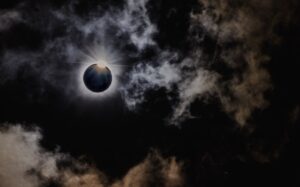
The world is preparing for one of the most significant astronomical phenomena of recent years, Wednesday’s total solar eclipse, the first to be visible from mainland Europe in almost 30 years. The Moon will completely cover the Sun, casting a shadow hundreds of thousands of kilometers long over Earth and briefly plunging part of the planet into darkness.
The main event will begin at approximately 12:08 p.m. U.S. Eastern Time (7:08 p.m. Greek time) over the northernmost part of Russia, after which its path will pass over Greenland, Iceland and the Atlantic Ocean. It will cross northern Spain and a very small part of Portugal, before ending in the Mediterranean Sea.
In the rest of Europe, northwestern Africa and parts of North America, the Moon will cover only part of the Sun.
In Greece, the phenomenon will be barely visible and only as a partial eclipse, mainly in areas in the northwestern part of the country, such as Corfu (2.34% coverage), Igoumenitsa (1.29%), Konitsa, Kastoria and Florina. However, the coverage of the solar disk, occurring almost simultaneously with sunset (around 8:30 p.m.), will be very small and difficult to notice.
The most important thing to remember during a solar eclipse is that it is not safe to look directly at the Sun until the Moon completely covers its surface, during the phase known as totality. During all other phases, the phenomenon must be viewed using special protective equipment for the eyes.
What Is a Total Solar Eclipse?
A total solar eclipse occurs when the Moon passes between Earth and the Sun, temporarily blocking the Sun’s surface from our view. What remains visible in the sky is a black disk surrounded by the faint halo of the Sun’s outer atmosphere, known as the solar corona.
Total solar eclipses are a kind of cosmic coincidence. The Moon is approximately 400 times smaller than the Sun, but it is also approximately 400 times closer to Earth. As a result, the two celestial bodies appear from our planet to be roughly the same size.
For a total solar eclipse to occur, the Sun, Moon and Earth must align precisely in space.
The shadow of the Moon created by this alignment has an inner region called the “umbra,” meaning the full shadow. People located beneath it, within a relatively narrow band across Earth’s surface, experience totality.
Those located beneath the “penumbra,” the partial shadow—the outer portion of the Moon’s shadow—will instead see a partial solar eclipse, during which the Moon covers only part of the Sun’s surface.
What Happens During a Total Eclipse
Along the path of totality, the event will begin with a partial solar eclipse. The Moon will begin to “bite” into the edge of the Sun and will gradually cover more and more of its surface.
This phase will last approximately one hour.
Then comes the most spectacular stage of the eclipse: totality, which lasts only a few moments. During this phase, the solar corona becomes visible and it is safe to look at it with the naked eye.
The Sun then begins to reappear from behind the Moon, creating a second phase of partial eclipse, which gradually subsides as the Moon moves away from the solar disk and the world returns to its usual brightness.
The duration of an eclipse depends on the location from which it is observed. Overall, all the phases of this particular eclipse will last approximately two hours.
What It Is Like to Experience the Total Eclipse
As the eclipse approaches its maximum phase along the path of totality, the air temperature on Earth will begin to fall.
The light will fade, as if someone had suddenly turned down the brightness at a completely inappropriate time of day. Shadows will become more pronounced, and crescent-shaped images will appear within them—tiny projections of the eclipse as it unfolds.
During totality, the sky darkens and takes on the color of a deep twilight, while the temperature drops noticeably. A 360-degree sunset appears along the horizon.
Even animals react to the phenomenon. Researchers have recorded that bees stop buzzing, birds stop singing, and crickets begin to chirp. Even pets may show signs of confusion.
In addition to the solar corona, bright stars and planets will become visible in the darkened sky.
Totality during this particular eclipse will be brief. According to NASA, in most locations it will last less than two minutes.
Its exact duration depends on the observer’s position within the path of totality and how close they are to the central line of the eclipse’s path.
When Does the Total Solar Eclipse Begin and End?
The eclipse begins in the sparsely populated tundra of northern Russia, where the Moon will begin to cover the Sun at approximately 12:08 p.m. (7:08 p.m. Greek time) on Wednesday, U.S. Eastern Time. Observers in that area will be the first to see totality, beginning at 12:58 p.m.
The Moon’s shadow will move over the Arctic Ocean, passing very close to the North Pole.
It will reach land again at 1:13 p.m., crossing a strip of northeastern Greenland, while at approximately 1:43 p.m. it will reach Iceland’s western coast.
The eclipse will then cross the Atlantic Ocean toward the Spanish coast.
From 2:26 p.m., totality will be visible in Spain. The Moon’s shadow will sweep across the Balearic Islands—Mallorca, Menorca and Ibiza—and the last people on land will experience totality at approximately 2:33 p.m.
Those located toward the end of the eclipse’s path will have the opportunity to see a partially covered Sun setting on the horizon.
What Are the Best Places to Watch the Eclipse?
Generally speaking, the best place to watch a total solar eclipse is anywhere within the path of totality.
The path of this particular eclipse is less than 200 miles—approximately 320 kilometers—wide, although its exact width varies depending on the region.
Many points along the path are in remote areas and are difficult to access.
In Greenland, most of totality will occur over an area without permanent residents or infrastructure, and some people choose to watch the phenomenon from the sea.
One of the most popular locations on land is Reykjavik, Iceland, which is close to the central line of the eclipse’s path. Totality in Reykjavik will occur at 5:48 p.m. local time and will last just one minute.
However, those planning to watch the eclipse in Reykjavik and other parts of Iceland may face cloud cover that could obstruct the view.
Several areas of Spain offer better chances of clear skies and warmer temperatures. Among them are Valencia and Ibiza, where totality will occur at 8:32 p.m. local time and will also last approximately one minute.
Quieter areas of the Spanish countryside, such as León and Burgos, are also expecting a large influx of visitors for the event.
Totality will not be visible from the United States, nor from Greece.
What Will Those Outside the Path of Totality See?
Those who are not within the path of totality but are still beneath the outer portion of the Moon’s shadow will have the opportunity to see a partial solar eclipse.
How spectacular the phenomenon will be depends on the distance from the central line of the path of totality. The closer someone is to it, the more spectacular the eclipse will be.
In the United States, the partial eclipse will be most visible in Alaska and the northeastern states. Parts of the Midwest and Mid-Atlantic states will also fall beneath the Moon’s shadow; however, in these areas less than 10% of the Sun’s surface will be covered.
In Canada, the percentage of the Sun covered will range from less than 5% to more than 90%, increasing the farther north one goes.
In Nuuk, the capital of Greenland, nearly 79% of the Sun will be covered.
Cities in mainland Europe where more than 90% of the solar disk will be covered include Lisbon, Barcelona, Madrid, Paris, Milan, London and Dublin.
On the northwestern African coast, Algiers and Casablanca will also experience a very deep partial eclipse.
For those who want to watch the eclipse in its entirety but cannot travel to the path of totality, NASA and other organizations will offer live online broadcasts.
How Can We Safely Watch the Eclipse?
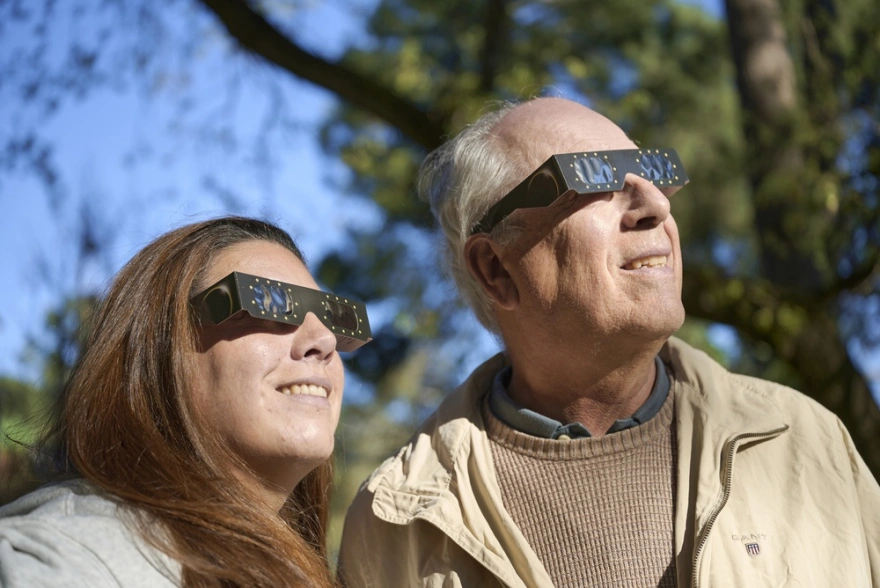
Generally speaking, one should never look directly at the Sun without special eye-protection equipment. Even looking at the Sun with the naked eye for a few seconds can cause permanent damage to vision, such as blurred vision or blind spots in the field of view.
The only time when it is safe to watch a solar eclipse without protective equipment is during the phase of complete totality.
As soon as the Moon begins to move away from the Sun’s surface, the observer must put the special protective glasses back on to avoid eye injury.
According to NASA, it is not safe to look at the Sun through optical devices such as binoculars, cameras or telescopes while merely wearing special paper eclipse glasses or using a simple solar viewer.
When Is the Next Total Solar Eclipse?
The next two years are expected to be particularly interesting for solar-eclipse enthusiasts. On August 2, 2027, the path of totality will pass over North Africa, including parts of Morocco and Egypt.
Another total solar eclipse will cross Australia in mid-2028. Eclipse enthusiasts who travel around the world chasing the path of totality have already begun planning trips for both events.
At the same time, two annular eclipses, also known as “ring of fire” eclipses, are expected: one in February 2027 and one in January 2028. Both will pass over parts of South America and will have long periods of annularity—the equivalent of totality during a total eclipse.
In some areas along the path of the January 2028 eclipse, the annular phase will last more than 10 minutes.
What Will Happen to Europe’s Power Grid?
European electricity grid operators assure that Wednesday’s solar eclipse will not cause problems with electricity supply, despite the temporary and sharp reduction in photovoltaic generation.
The eclipse is expected to affect solar electricity generation. Under clear-sky conditions, solar generation in continental Europe could fall by 9.7 gigawatts, according to ENTSO-E, the European association of high-voltage electricity transmission system operators.
Belgian grid operator Elia announced that the effects are fully predictable and that transmission system operators have prepared in advance. “We are confident. There will be no power outage,” Elia spokeswoman Caroline Poulin said on Monday.
According to Elia, the decline in photovoltaic generation will be offset by increased generation from other sources, such as natural-gas plants and battery energy-storage systems.
At the same time, a small reduction in demand from large industrial consumers is expected.
In this way, electricity supply and demand will be able to remain balanced throughout the phenomenon.
Up to 9.7 Gigawatts of Temporary Loss in Europe
At the European level, grid operators expect that at the peak of the eclipse, approximately 9.7 gigawatts of photovoltaic capacity will temporarily be taken out of production—a quantity equivalent to the output of several large power-generation units.
The initial estimate comes from French transmission system operator RTE and was confirmed by ENTSO-E. In France alone, RTE estimates the loss at approximately 1,800 megawatts.
In Spain, where the Sun will be among the most heavily obscured, grid operator Red Eléctrica estimates that up to 5 gigawatts of solar capacity could be temporarily lost. This figure corresponds to approximately 13% of the maximum demand on a typical Wednesday in August.
In Great Britain, system operator NESO forecasts a reduction in generation of approximately 700 megawatts, although, based on historical models, it considers a drop of up to 1.3 gigawatts possible. According to a NESO representative, up to 95% of the Sun will be covered between 6 p.m. and 8 p.m. local time.
ENTSO-E has convened national experts to assess preparations and the impacts on the energy system. Control centers are on standby to cover the shortfall using other sources of electricity generation.
The Critical Factor Is the Timing, Not Just the Loss of Generation
In this case, the timing of the loss is more important than its overall size.
The eclipse will take place in the early evening, when photovoltaic generation has already begun to decline naturally. A similar event around midday would have much greater consequences.
The four operators of the German transmission system—50Hertz, Amprion, TenneT and TransnetBW—have reached a similar assessment. Under clear-sky conditions, they expect generation to fall by as much as two gigawatts, while Germany’s total installed photovoltaic capacity exceeds 125 gigawatts.
Britain: Appeal Not to Use Washing Machines and Dishwashers
Britain’s largest household electricity supplier, Octopus Energy, is taking a much more proactive approach.
The company is asking its customers to avoid running washing machines and dishwashers between 6 p.m. and 8 p.m. British time—7 p.m. to 9 p.m. Central European Time.
Those participating in the company’s rewards program will receive two hours of free electricity the following weekend in return.
The logic behind the initiative is that if enough households shift their consumption to another time, British system operator NESO will need to bring fewer natural-gas power-generation units online to replace the solar generation that has been lost.
Ask me anything
Explore related questions




