





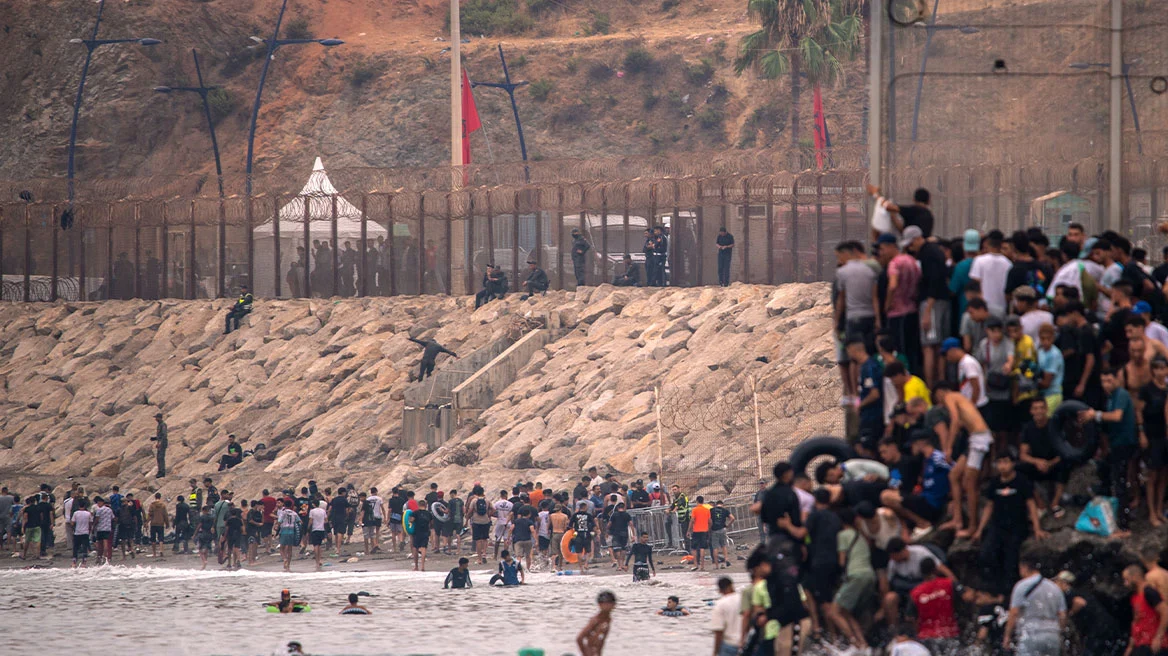
Spanish authorities are investigating serious allegations of sexual assaults against minors in Ceuta, in the aftermath of the mass arrival of illegal immigrants from Morocco in the Spanish enclave in North Africa, according to Euronews.
Medical sources confirmed that Ceuta University Hospital treated at least five girls within a single week, none of them older than 14, for cases suspected to involve rape. All of the minors had arrived in the city from Morocco during the recent mass influx of illegal immigrants.
Among the victims is reportedly a boy, while the same sources estimate that the actual number of cases may be higher, as some victims have not yet come forward to report them.
Overall, more than ten people have so far been examined with findings consistent with sexual assault.
Police Investigation Into the Rape of a Minor
Spain’s National Police have already launched an investigation into the alleged sexual abuse of a minor who entered Ceuta during the mass arrival of migrants from Morocco.
The girl was taken to hospital, where doctors identified injuries consistent with sexual assault.
So far, no arrests have been announced, and the exact circumstances under which the alleged attack took place have not been disclosed. The Spanish authorities’ investigation is ongoing.
Judicial sources also report that local residents managed to prevent several attempted sexual assaults through their intervention. According to the same information, there is evidence of other attempts that were ultimately not completed.
“14-Year-Old Girls Are Living on the Streets”
Susana Ascaso, a doctor in the Emergency Department of Ceuta University Hospital, confirmed that the hospital is treating underage illegal immigrants who have been victims of rape.
As she explained, these are girls under 14 who are essentially living on the streets because there are no available places in facilities for minors.
“It’s not that they don’t want to accommodate them; there simply isn’t any space,” the doctor said.
Ascaso places these incidents within a much broader crisis, which she describes as a “health catastrophe.”
The Emergency Department receives an average of 300 to 400 illegal immigrants per day, without having received additional staff or resources following the mass arrival of people at the end of July. According to her, a significantly larger number of employees is needed to deal with the dramatic increase in cases.
Another serious problem arises after patients are discharged from hospital, as many of them have nowhere to stay.
The doctor also warned of the risk of diseases capable of spreading epidemically, such as tuberculosis and hepatitis, at a time when an Emergency Department does not have the capacity to systematically detect such illnesses.
At the same time, cases of diabetes becoming uncontrolled and epileptic seizures are being recorded among illegal immigrants who have been left without access to the medication they had been taking.
Ascaso has publicly called for the hospital to be immediately reinforced with additional staff, as well as for Ceuta to be recognized as an area facing particularly difficult healthcare conditions.
Girls Arrive in a State of Shock
A similar situation is being described at the makeshift camp in Sidi Embarek, where around 300 people are gathered under difficult conditions.
Abdellah Mustafa, president of the local residents’ association, said that some girls arrive there in a state of shock, alleging that they have been sexually assaulted in the surrounding hills.
According to him, many of the victims do not file official complaints because of their psychological condition. For this reason, local residents arranged for the assistance of a psychologist and a lawyer so that the girls could receive support.
The situation has prompted a response from organizations such as Save the Children, which warns of the risks of human trafficking and sexual exploitation faced by girls and adolescent women, particularly illegal immigrants in Ceuta.
Jennifer Zupiroli, the organization’s specialist on illegal immigration issues, stressed that an adolescent girl who is alone and outside the child-protection system is extremely vulnerable.
In response to the new situation, the National Police have prioritized the identification and protection of girls and children under the age of 13.
The lack of available accommodation, combined with pressure on healthcare services and the presence of unaccompanied minors on the streets, has created an especially dangerous environment.
Ask me anything
Explore related questions




