





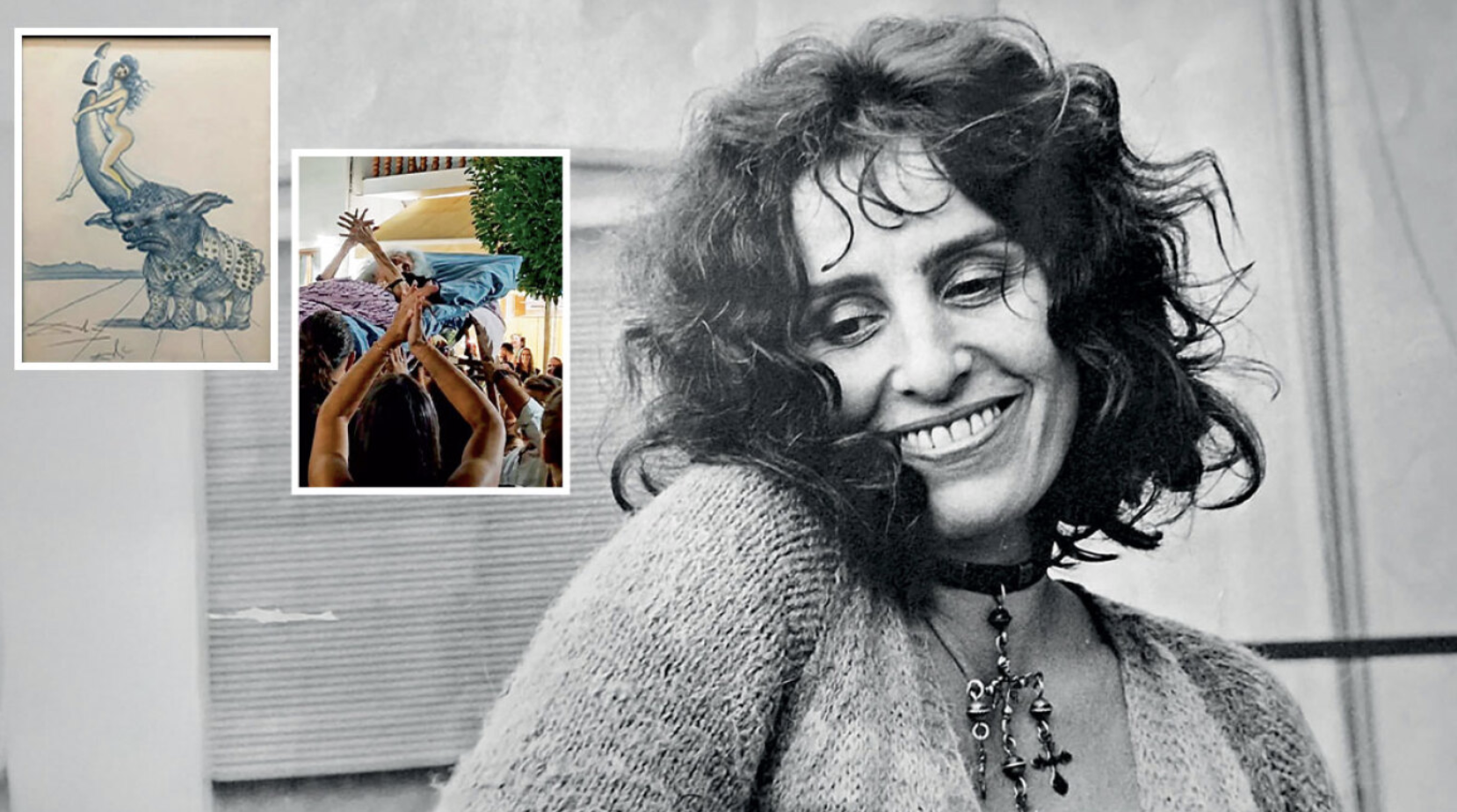
Sometimes an image lasting just a few seconds is enough to open up a story spanning entire decades. At the festival in Margarites, Mylopotamos, in Crete, an elderly woman stands at the center of a group of young people. Her legs can no longer follow the rhythm as they once did, but she wants to dance.
The young people find a way. With the help of a sun lounger, they lift her up and hold her aloft so that she can once again become part of the dance. She smiles, moves her arms to the rhythm of Cretan music, and for a few minutes age seems to have lost its significance.
The image spread across the vast world of the internet because of its tenderness and spontaneity. Behind the face of the 88-year-old woman, however, is not an ordinary visitor to a Cretan festival. She is the German sculptor and visual artist Karina Rech, a woman with an almost novel-like life who, around four decades ago, decided that a part of herself would remain forever connected to Anogeia and Mount Psiloritis. In Crete, she did not remain a stranger for long.
The people who met her in Anogeia gave her their own name. They called her “Skara,” a word that, as older Anogeians explain, referred to the vulture. The nickname suited, in their eyes, both her distinctive appearance and that untamed, free spirit that did not seem easily confined by conventions. Thus she became “Karina Skara,” while the place where she lived at the time was added almost like a second surname: “Karina Skara Savounolaka.”
Over time, however, another form of address prevailed, simpler and much more meaningful: “Karina of Anogeianos.”
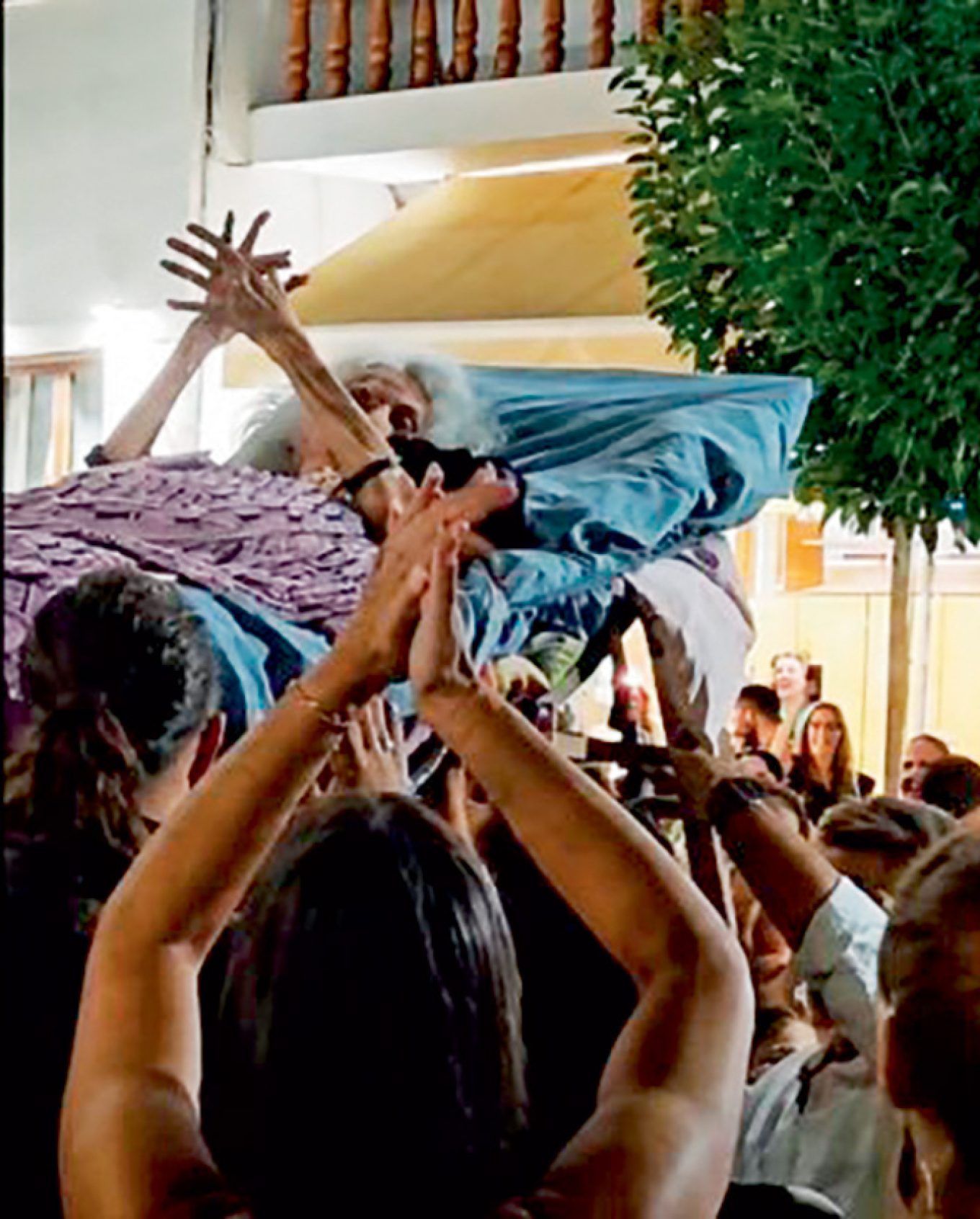
Karina “dances” with the help of her friends at the festival in Margarites, Mylopotamos.
Anti-fascist
Everyone who knew her at the time remembers an impressive woman. Striking beauty, distinctive clothing, an intense gaze, an artistic nature and a constant desire to meet people, discover places and hear stories.
She was deeply political and openly anti-fascist. She did not regard World War II as a distant chapter in European history, but as something that concerned her personally, precisely because she was German.
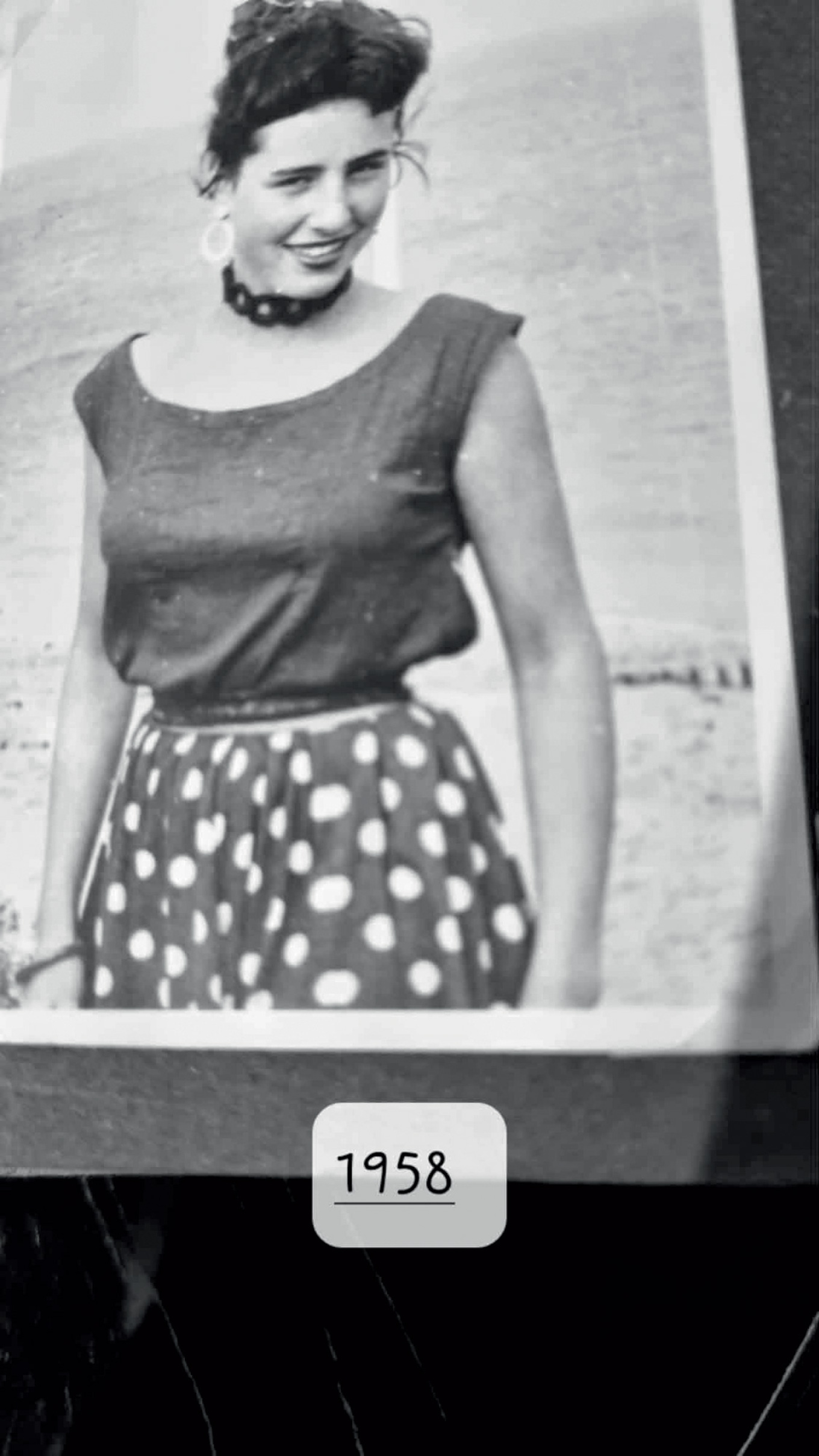
The German sculptor at the age of 20, when she was a model for Dalí.
The former deputy mayor of Anogeia, Vasilis Smpokos, one of the people familiar with the history of her time in the area, remembers a woman who, from the very beginning, did not limit herself to the role of a foreign artist. She asked questions, listened, sought out elderly people who had lived through the Occupation and wanted to learn what had happened to homes, families and the mountains. She did not go to Crete looking for a picturesque refuge. She wanted to understand the place.
According to accounts gathered in the area, her first contact with Anogeia dates to 1985. Mexico had already been part of the great journey of her life, during a period when she also travelled with her husband.
In Crete, however, her journey was personal. She arrived alone in a place very different from the European capitals and artistic circles in which she had moved. Anogeia at that time had nothing in common with a tourist destination for visitors. Mount Psiloritis, the cafés, shepherds, mitata shepherds’ huts, elderly men in black shirts, houses that still carried the memories of the war, music and family stories all formed a world that was both authentic and harsh.
It was the Crete that had fascinated Europeans for decades—not people looking merely for sun and sea, but for a different way of life: community, memory, pride and a close relationship with the land.
For Karina, there was also a man who served as her guide into this world: Psarantonis. She had seen and heard him, and his music deeply moved her. Earlier Cretan publications even reported that a song of his, which she heard in Berlin, was what prompted her to seek out the village he came from. When she eventually arrived in Anogeia, the music had already opened the door, and the history of the place did the rest.
A year later, in 1986, she returned and settled in the area for an extended period. Over the following two years she travelled throughout Crete. She did not follow the routes of a travel guide. She was looking for people and testimonies.
She wanted to delve as deeply as possible into the years of the German Occupation and understand how the violence of that period had marked not just one generation, but Cretan society as a whole.
Anogeia represented one of the darkest chapters in this search. In August 1944, German forces ordered the destruction of the village. Houses were demolished, residents were executed, and an entire community paid the price for its resistance activities.
For Karina, the accounts of the survivors were not simply research material. According to people who knew her, the Nazi atrocities “sat like a knot in her throat.” It was then that the idea began to take shape within her that listening was not enough. She had to leave something behind.
“We have an obligation as Germans to bow our heads and apologize,” was one of the phrases she reportedly repeated during that period. She did not believe she could assume responsibility for a previous generation, but she believed she could take responsibility for remembering.
The “Rebel of Peace”
And so the “Rebel of Peace” was born.
The idea was as simple as it was difficult to realize: a huge sculpture set directly into the landscape of Nida—not placed opposite nature, but made from nature itself.
A human figure, a winged rebel lying across the plateau, so large that its overall form can truly be perceived only from above.
Karina sought funding in Germany and managed to secure support for her project—approximately 150,000 German marks—while the people of Anogeia, particularly residents of the plateau, actively participated in the undertaking. Its construction became a collective effort.
It was no longer the work of a German sculptor who had come to Crete. It was something being created jointly by a German woman and the descendants of people who had experienced the German Occupation.
Approximately 5,000 stones were used to create it. The work is approximately 32 metres long and 9 metres wide.
The most moving aspect, however, is not its size but the origin of its materials. Many of the stones were already scattered across the plateau from the years of the war. Cretans had placed them there to prevent German aircraft and paratroopers from landing.
The stones that had once been used as a defence against the Germans became, decades later, in the hands of a German woman, the material for a monument to reconciliation.
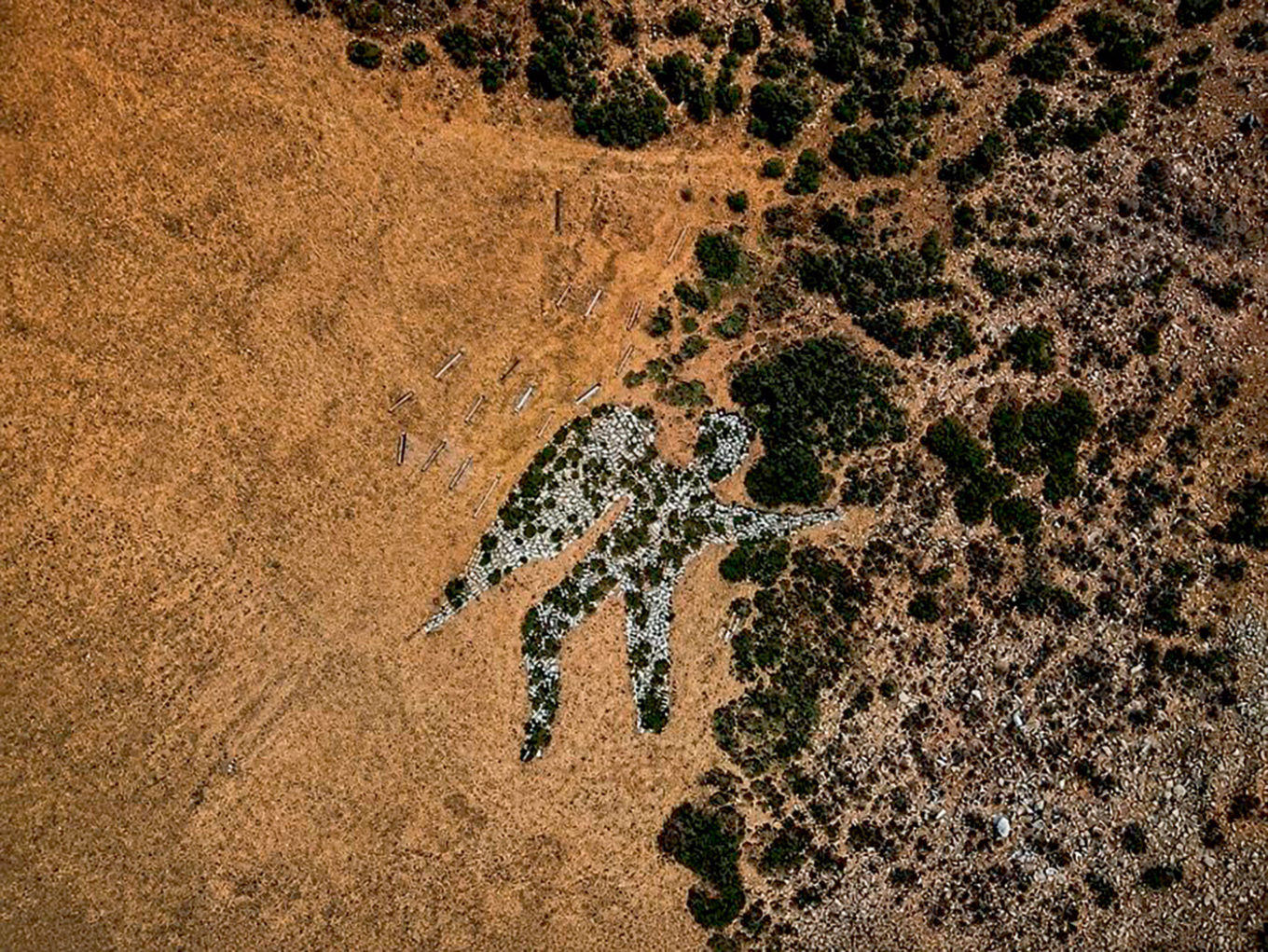
The “Rebel of Peace” seen from above. Approximately 5,000 stones were used to create it. The work is about 32 metres long and 9 metres wide.
This was the deeper meaning of the “Rebel.” It was not an attempt to erase history. Quite the opposite.
Karina Rech insisted that without memory there could be no genuine reconciliation. The “Rebel of Peace” did not ask the Cretans to forget. It asked the Germans to remember.
The creation of the work took approximately two years, and the “Andartis – Monument für den Frieden,” as it is known in German publications, was inaugurated on June 23, 1991, in Nida.
In the bare landscape of Mount Psiloritis, the stone-winged Rebel has remained exposed to time, snow, sun and wind ever since. It is not a sculpture protected behind the doors of a museum.
Gradually, it is returning to the nature from which it was created.
Rech did not stop there. Her many years of research into the Occupation, the Cretan Resistance and the creation of the monument were also documented in the book “Andartis – Monument für den Frieden,” which contains historical texts, documents and testimonies.
In preparing it, she searched both private archives in Crete and German archives, attempting to bring together the two sides of the same historical wound.
By that time, of course, Karina Rech already had a life behind her that was difficult to fit into a single identity.
Born in Berlin on April 8, 1938, she grew up between Berlin, Vienna and Düsseldorf. From 1956 to 1959, she studied acting and expressive dance in Düsseldorf and Hamburg, and subsequently worked on theatrical stages in Lübeck, Hamburg and Düsseldorf.
She later married the sculptor Hannes Esser and began a period of continuous travel. From the early 1960s through the end of that decade, she travelled to France, Spain and Greece, while at the end of 1969 she found herself in Mexico.
Archaeology, mythology, ruins and the relationship between human creations and nature began to become central elements of her art.
During one particularly distinctive period of her life, she and Esser acquired an old wooden sailing boat in Greece and travelled around the Aegean. Greece had already begun to transform from a stop on her travels into a permanent point of reference.
In Germany and France, her name began appearing in exhibitions and major artistic events from the early 1970s.
In 1973 she participated in the Paris Biennale, while her works were exhibited in Aachen, Düsseldorf, Berlin and southern France.
Her art moved between sculpture, installations, photography and land art, often using materials that seemed to have emerged from the earth or from some ancient, imaginary civilization.
In Crete, her biography is also accompanied by two further remarkable claims. Local publications report that in her youth she was a model for Salvador Dalí and that she appeared in a film by Pier Paolo Pasolini, although the title of the film has not yet been publicly established.
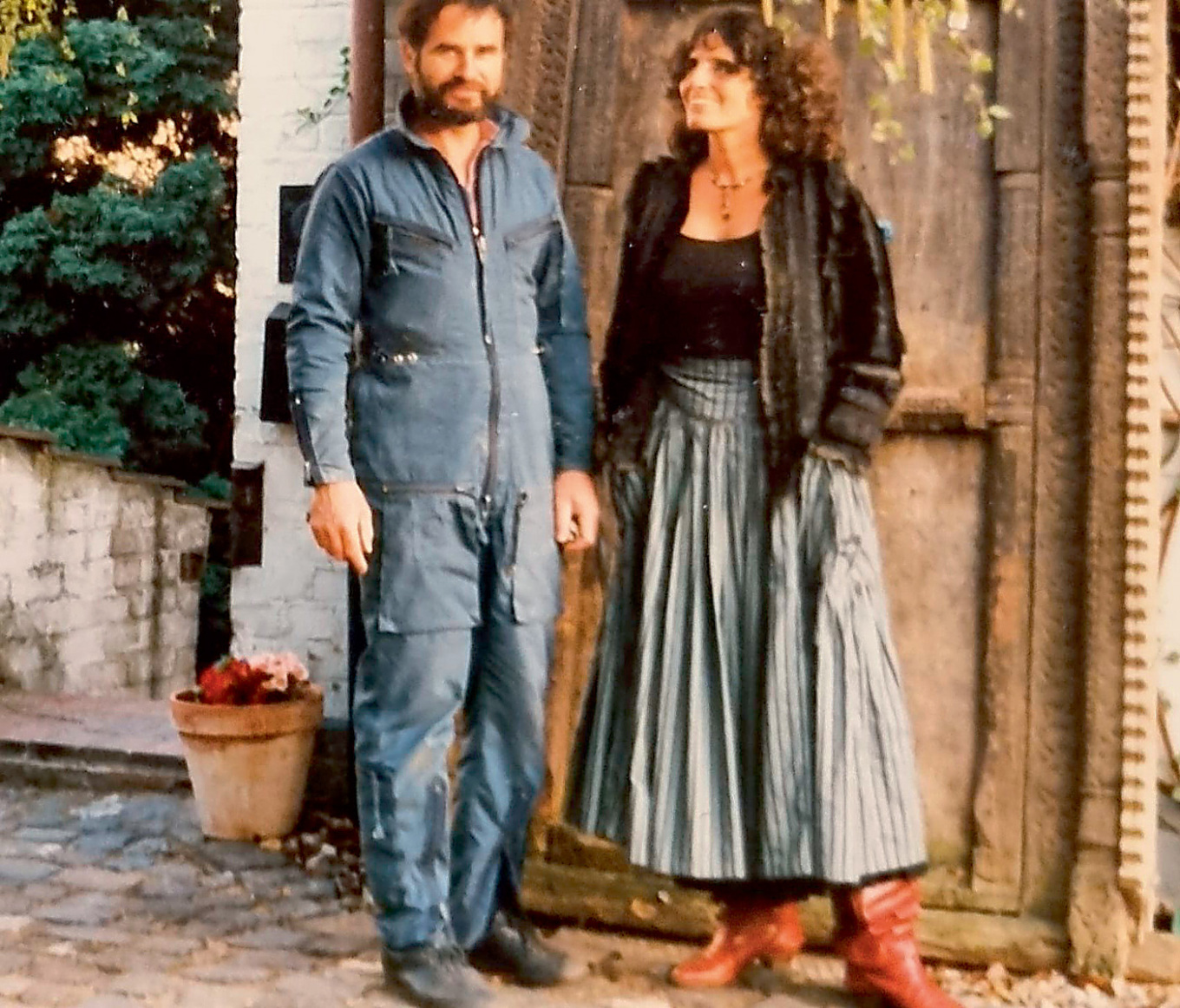
She is also described as an exceptional flamenco dancer, a detail that seems to take on particular meaning today when seeing the elderly Karina still insisting on joining in the dancing at a Cretan festival. Dance has always been part of her relationship with Crete. At festivals, she did not sit on the sidelines as an observer. She danced. She joined the groups, learned the customs and talked with people. In this way, she earned something that is rarely granted to a foreigner simply because they love a place: the acceptance of its people.
The famous painter
An until-now unknown story from Karina Rech’s youth and her encounter with Salvador Dalí was recounted by Giannis Brindalos, who knew her personally during the years she lived in Anogeia.
As he recalls, she once told him about a trip she had taken to northeastern Spain while studying Fine Arts in Germany. She had not chosen the area by chance. She knew that Dalí’s home was there and wanted, by any means, to meet him.
The girl on the rhinoceros horn, by Salvador Dalí, is Karina Rech.
According to what she confided to Brindalos, she had travelled to Spain with a friend and at some point found herself on a beach near the famous painter’s residence. A sudden summer storm then broke out, and the young Karina ran for shelter near the house.
Her presence there gave her the opportunity to attempt what, until that moment, had seemed almost impossible: getting through Dalí’s door.
She knocked, and one of the people guarding the residence appeared. Karina asked to come inside, but she was refused. She did not give up. A little later, she knocked again, this time asking to see Dalí himself. Again, she was turned away.
She persisted, however. She remained outside the house for some time, standing in the rain, until, according to her account, the guard eventually informed the painter that a beautiful young German woman was persistently standing at the entrance and asking to meet him.
Dalí agreed.
Their first meeting, as she described it years later, had an almost cinematic quality. Karina stood before him, soaked from the rain, barefoot and freezing.
Giannis Brindalos remembers that she also told him about the fear she felt at that moment, because for a young Fine Arts student, Dalí was not simply a famous painter but an almost inaccessible figure in the world of art.
As she recounted it, Dalí took her by the hand, helped her warm up and wrapped her in a blanket.
He then offered to show her around his home. Karina described the residence as a strange, bizarre and deeply eccentric place, inseparably connected to the personality of its creator.
The décor, atmosphere and entire architecture of the house, she told him, seemed to be an extension of Dalí himself.
That, however, was where her story ended. Brindalos remembers that when he tried to learn more and asked her what happened next, she ended the conversation with a characteristic phrase:
“That’s where it ends. There’s nothing beyond that.”
Over the years, he came to believe that her acquaintance with Dalí may not have been limited to that one meeting. As he says, he had the impression that Karina spent more time with him and for longer periods, while he had also encountered references suggesting that, at some point, she may even have been the Spanish artist’s muse.
Karina Rech became part of the artistic universe of the great surrealist, as she is the female figure depicted in the work “Girl on Rhinoceros Horn,” created in 1967.
The work was part of the series “Dalí Illustre Casanova,” the lavishly illustrated edition through which Dalí accompanied stories from Giacomo Casanova’s memoirs, translating their eroticism into his own instantly recognizable surrealist language.
In the particular composition, the young Karina appears nude, sitting atop a huge rhinoceros horn, in an image where the human body meets one of the motifs that repeatedly appeared in Dalí’s work.
The rhinoceros, and particularly its horn, fascinated the Spanish artist, who associated them with geometry, spiral forms and the proportions he sought in nature.
Thus, more than half a century later, the work provides a tangible trace of that little-known chapter of Rech’s life: the period when her distinctive beauty caught Dalí’s attention and her figure found a place in one of his creations.
The move
Karina lived for many years in Anogeia, a place with which she formed a deep connection and where she developed strong bonds with the local people.
However, as the years passed, the harsh winters of Mount Psiloritis became increasingly difficult for her. She therefore began looking for a place with a milder climate, without leaving the Crete she had by then chosen as her home.
She turned to her close family friend, Jens Böttger, who, although he lives permanently in Saudi Arabia, maintains strong ties to Margarites in Mylopotamos, where he owns four houses.
In 2018, Jens bought Karina a house in the village, and from that year onward, Margarites became her permanent home.
In the village, she found the warmth and human connection she had been looking for, eventually expressing openly her desire to remain there for the rest of her life, close to the people she now considers her own.
There was, however, another, deeper wish she had confided about two years ago, after suffering an injury in a fall: when she dies, she would like to be buried beside the “Rebel,” the work she created in Anogeia and perhaps the strongest embodiment of her long relationship with the place.
A final bond with the village where she lived for decades and where she left a piece of her own history.
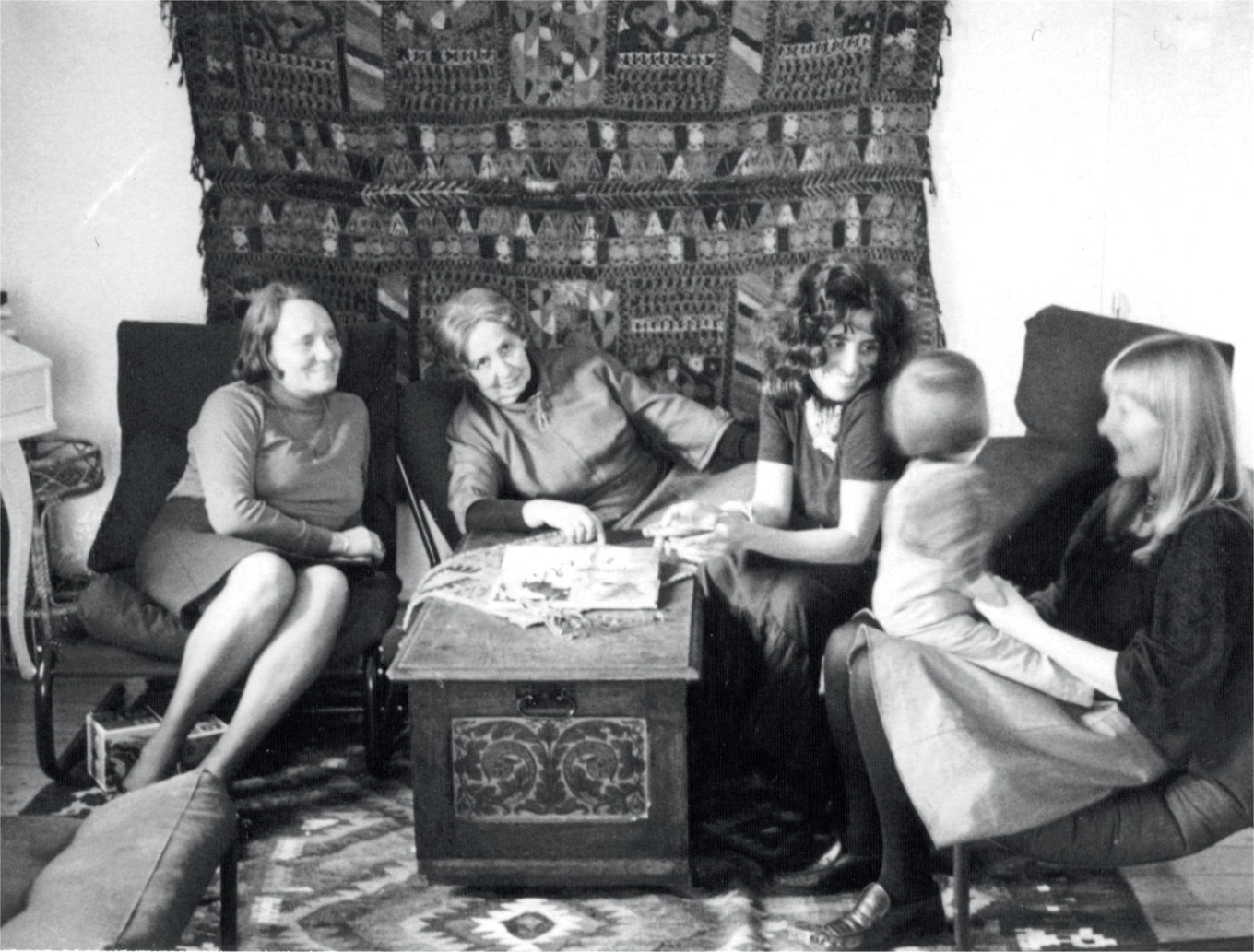
In 2023, when she returned to Anogeia and Nida to see her “Rebel” once again, old acquaintances welcomed her with hugs. Moved, she recognized people and nicknames, still spoke using words she had learned decades earlier, and as she was leaving, she said a phrase that perhaps sums up her relationship with this place better than any biography could:
“I want to die in my village.”
That is why the recent image from Margarites carries greater weight than simply being a touching snapshot from a village festival.
The people who lifted Karina onto the sun lounger so that she could dance may, without realizing it, have been lifting a woman who, forty years ago, arrived alone in this part of Crete.
A German woman who did not ask people to forget what her country had done, but first sat down and listened to them. Who walked through their villages, sought out the stories of their dead, and transformed the stones of an old war into a winged rebel dedicated to peace.
And perhaps that is ultimately why, almost forty years after her first arrival in Anogeia, Karina Rech is not simply a German sculptor to the people there.
She is Karina “Skara,” of Anogia.
Ask me anything
Explore related questions




