





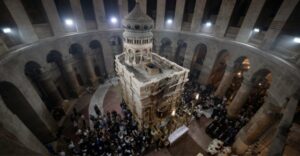
New archaeological finds below the Church of the Holy Sepulchre in Jerusalem show striking similarities to the New Testament’s descriptions of the site where, according to Christian tradition, Jesus Christ was buried. Italian archaeologists have identified traces of an ancient burial landscape, including rock-cut tombs, cultivated land and a garden, though the evidence does not prove that this was in fact the tomb of Jesus.
The preliminary results of the research were published in Liber Annuus, a Jerusalem-based archaeological journal.
“We have found evidence of a burial landscape,” said Francesca Romana Stasola, head of the excavation, from La Sapienza University in Rome, speaking to the Daily Mail.
The researchers were excavating at the Church of the Holy Sepulchre in Jerusalem, the fourth-century church built over the site where, according to Christian tradition, Jesus was crucified, buried and resurrected on Easter Sunday.
The church has since become one of the most important pilgrimage sites in the Christian world, drawing around 4 million pilgrims a year.
Discoveries beneath the Church of the Holy Sepulchre
The excavations began in 2022, as part of works to restore the church’s floor, and during their final phases in 2025 the archaeologists came across a distinctive ancient landscape.
Beneath the church they identified an abandoned quarry, cultivated plots of land, rock-cut tombs and an ancient garden.
The findings are of particular interest because of their similarities to the description in the Gospel of John: “At the place where Jesus was crucified there was a garden, and in the garden a new tomb, in which no one had yet been laid.”
Although no human remains were found in this particular tomb, the archaeologists regard the correspondences between the site’s features and the biblical references as notable.
The Gospel of John also states that the crucifixion took place near Jerusalem, while the Letter to the Hebrews states that Jesus suffered “outside the gate” of the city.
The site of the quarry was indeed outside the walls of Jerusalem at the time of Jesus.
Sections of the quarry were around six metres deep and had been filled in with soil, suggesting the area was later used for cultivation.
Olive trees and vines from the time of Jesus
The agricultural use of the area is reinforced by the discovery of evidence linked to olive trees and vines dating to the period in which Jesus is believed to have died, around 33 AD.
“The Gospel mentions a green area between Golgotha and the tomb, and we have found these cultivated fields,” Stasola told the Times of Israel.
The tombs themselves are also significant. They were cut directly into the rock, demonstrating that the area was indeed used as a burial site.
This feature corresponds with the descriptions in the Gospels of Matthew, Mark and Luke, according to which the tomb of Jesus had been cut into rock.
The Roman structure that “sealed” a tomb
The evidence being examined by the archaeologists is not limited to the correspondences with the biblical texts.
One particular burial chamber had been blocked off by a Roman structure built during the reign of the emperor Hadrian, in the second century AD.
About 200 years later, during the era of the emperor Constantine, builders working in the area demolished the Roman structure and excavated the site, uncovering the tomb once again.
They then separated it from the other burial chambers and created a distinct Christian shrine around it, where the faithful could gather and pray.
What the discovery can, and cannot, prove
The archaeological evidence does not definitively prove that this particular site was indeed the burial place of Jesus. However, the effort to preserve and highlight it from the earliest Christian centuries onward supports the view that knowledge of the site’s significance may have been passed down by the earliest generations of Christians.
For Stasola, the great significance of the excavation is not limited to an attempt to confirm a biblical narrative.
“The real treasure we are uncovering is the story of the people who made this place what it is, expressing their faith here,” she told the Times of Israel.
“Whether or not someone believes in the historicity of the Holy Sepulchre, the fact that generations of people believed in it is objective. The history of this place is the history of Jerusalem and, at least from a certain point onward, it is the history of the worship of Jesus Christ,” she added.
Ask me anything
Explore related questions




