





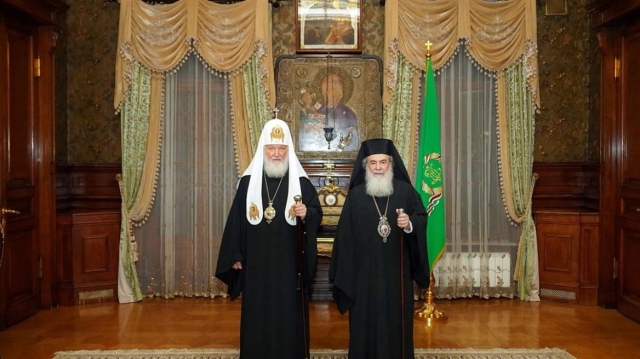
The fragile balance within the Orthodox world, the challenges facing Christian communities in the Middle East, and prospects for closer cooperation between the two Churches were discussed by Patriarch Kirill of Moscow and All Russia and Patriarch Theophilos III of Jerusalem during a meeting in Moscow.
The visit by the head of the Church of Jerusalem to the Russian capital took place at the invitation of Patriarch Kirill and is particularly significant, as relations between the various Orthodox Churches continue to be tested by major disagreements and ecclesiastical disputes.
According to information released by the Moscow Patriarchate, the two Church leaders exchanged views on the difficulties currently affecting relations between the Orthodox Churches, while also examining ways of addressing them. No further details were provided, however, about the specific issues raised during the discussions, and no concrete decisions or agreements were announced.
The shadow of ecclesiastical disputes
The reference to difficulties in relations between the Orthodox Churches is no coincidence. In recent years, Orthodoxy has faced serious internal tensions, most notably, among other issues, over ecclesiastical autocephaly in Ukraine and disagreements about the limits of the respective Patriarchates’ jurisdictions.
In particular, the granting of the Tomos of Autocephaly to the Orthodox Church of Ukraine by the Ecumenical Patriarchate in 2019 provoked a strong reaction from Moscow and led to a break in Eucharistic communion between the Moscow Patriarchate and the Ecumenical Patriarchate.
This development had a wider impact on relations between the various Orthodox Churches, creating a complex landscape of ecclesiastical balances. Against this backdrop, contacts between the Patriarchate of Jerusalem and Moscow carry particular weight, as the Church of Jerusalem is one of the oldest Patriarchates in Orthodoxy and enjoys considerable spiritual and historical prestige.
It should be stressed that the role of the Patriarchate of Jerusalem in maintaining the balance between the Orthodox Churches is of great importance. The Church of Jerusalem is not a peripheral ecclesiastical institution but one of the four ancient Patriarchates of the East, with historical responsibility for the Holy Land and a distinctive place within Orthodoxy.
Concern for Christians in the Middle East
For his part, Patriarch Theophilos briefed his counterpart on the ecclesiastical life and activities of the Patriarchate of Jerusalem, placing particular emphasis on the conditions facing Christian populations in the Middle East. The region continues to grapple with armed conflicts, political instability and humanitarian crises, while Christian communities face serious difficulties.
Protecting historic Christian communities, ensuring the safety of the faithful, maintaining the operation of churches and pilgrimage sites, and enabling Christians to remain in their ancestral homes are ongoing challenges for the Patriarchate of Jerusalem.
Particular reference was also made to the deadly attack on 23 October in Jordan, near the Orthodox Church of St George, in the Hamoud area of Karak Governorate.
Patriarch Kirill once again expressed his condolences to Theophilos over the incident. According to information cited by the Moscow Patriarchate, three armed men attacked a funeral, opening fire and killing nine people, while more than 30 others were injured.
Two millennia since the Baptism of Jesus – preparations in Jordan for 2030
Another issue discussed by the two Patriarchs was the organisation of events planned in Jordan in 2030 to mark the 2,000th anniversary of the Baptism of Jesus Christ. The anniversary is of great importance to the Patriarchate of Jerusalem, as it is connected with the site where, according to Christian tradition, Jesus was baptised by John the Baptist in the River Jordan.
The site of the Baptism, known as Bethany Beyond the Jordan or Al-Maghtas, on the Jordanian side of the river, is one of the most important pilgrimage destinations in the Christian world. It is worth noting that it was added to UNESCO’s World Heritage List in 2015, in recognition of its outstanding historical and religious significance.
Preparations by the Patriarchate of Jerusalem are already under way ahead of the anniversary. Discussions also include the prospect of developing the pilgrimage site and creating a broader framework for an Orthodox presence and cooperation there. The events are expected to constitute a major occasion for Orthodoxy, with international participation and support from the Jordanian authorities.
Finally, alongside preparations for a major religious ceremony, the Patriarchate of Jerusalem is also considering establishing an International Orthodox University at the site of the Baptism, with the aim of making it a meeting point for Churches, peoples and cultures.
Meeting with Putin and Russia’s Order of Friendship
The visit by the Patriarch of Jerusalem to Moscow was not limited to ecclesiastical talks. On the same day, Theophilos III and Patriarch Kirill also met with Russian President Vladimir Putin at the Kremlin.
During the meeting, the Russian president referred to the historic ties between the Russian Orthodox Church and the Patriarchate of Jerusalem, stressing the importance of preserving and developing their relationship. He also awarded Patriarch Theophilos Russia’s Order of Friendship, recognising, according to the Russian side, his contribution to strengthening friendship, cooperation and spiritual ties with Russia.
It should be noted that the award also gives the visit a political dimension, as Moscow seeks to maintain strong ties with the ancient Patriarchates of the East at a time when international developments and ecclesiastical disputes are creating an especially complex environment.
The meeting between the two Church leaders concluded with an exchange of commemorative gifts. Earlier, they had visited the chapel at the Patriarchal residence, which is dedicated to the icon of Our Lady of Vladimir.
The Russian delegation at the talks also included Metropolitan Anthony of Volokolamsk, head of the Moscow Patriarchate’s Department for External Church Relations, as well as other members of the Russian ecclesiastical delegation.
Ask me anything
Explore related questions




