





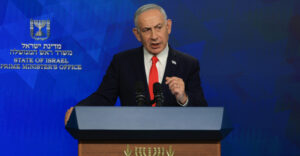
Benjamin Netanyahu issued a new warning to Turkey over its military presence in Syria, further escalating tensions in the Israel-Turkey confrontation. The Israeli prime minister argued that Ankara had been informed of Israel’s “red lines” and directly linked Israeli military actions in Syria to the message he wanted to send to the Turkish side.
The new remarks come after recent statements by Recep Tayyip Erdoğan, who, referring to Israeli attacks in Syria, had said that no one can restrict Turkey.
At the same time, Israel has made clear that it intends to maintain its presence in Syria for security reasons. Yesterday, Israeli fire from the Golan Heights was directed toward the Beit Jinn area, with shells fired toward the strategically important hill overlooking the city.
Netanyahu also referred to Israeli airstrikes against the Abu al-Duhur military airbase in northwestern Syria, explaining Israel’s strategy in the region.
“I decided that we would create a ‘security zone’ in Syria against the possibility of a ‘jihadist invasion’ from Syrian territory. And in northern Syria there is Turkey,” Netanyahu said in an interview, referring to the Israeli airstrikes that struck the Abu al-Duhur military airbase in northwestern Syria.
He then sent a clear message to Ankara regarding the limits of Turkey’s military presence.
As he said, Turkey “has a certain area there. I don’t want to see it coming south. I said this and I conveyed it to the ‘Syrian regime’ as well: don’t come down, don’t let them come south. I conveyed it to the Turks as well.”
The Israeli prime minister argued that there had been an existing status quo in the area which, in his view, an attempt had been made to overturn. At the same time, he said that Israel’s message had been conveyed both through the United States and directly to Syria.
“There was a certain status quo, but they broke it or intended to break it. I sent a message—through the Americans, by other means, but also directly to Syria—that we would not tolerate Turkish military fortification at an airfield south of the area where Turkey is currently located.
“Obviously, that message was not received, and we had to demonstrate it with what we call, in our terminology, kinetic means. So we conveyed it through kinetic means,” he said, referring to the use of military force.
Despite the warnings, Netanyahu argued that his objective is not a direct confrontation, while insisting on the need to maintain military capabilities stronger than those of Israel’s adversaries.
“I’m not seeking confrontation, but I know one thing: you cannot rely only on the intentions of the enemy. If you want to defend the State of Israel, you have to continually build capabilities that are stronger than the capabilities of the enemy—and your enemies,” Netanyahu said.
“Because intentions change. And you know when they change? When you are weak. They attack you when you are weak and they respect you when you are strong. They also make peace with the strong.”
“You don’t make peace alliances with the weak. Therefore, we have to continually increase our strength.”
In closing, the Israeli prime minister referred to the rapid shifts in the regional balance of power, making a pointed remark about Ankara.
“Reality is changing rapidly. One power is collapsing, another power is rising,” he said pointedly, referring to Ankara. “But the most important power that has to rise is our own,” he stressed.
Ask me anything
Explore related questions




