





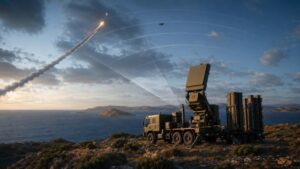
The signatures have been put on paper. “Achilles’ Shield” is now moving from plans to reality. Greece and Israel today signed the final agreement in Tel Aviv for the creation of the Greek “Dome,” officially paving the way for one of the largest and most ambitious defense procurement programs in recent years.
The contracts were signed at a special ceremony by Greece’s General Directorate for Defense Investments and Armaments (GDDIA), headed by Major General Ioannis Bouras, and on the Israeli side by the Directorate of International Defense Cooperation (SIBAT) and MAFAT, the Israeli body responsible for defense technology research and development and the equivalent of Greece’s ELKAK.
After nearly three years of negotiations, technical discussions and successive approvals, the agreement is now activated and entering the implementation phase. The Israeli side will proceed with orders to the companies participating in the program, including IAI, Rafael and ELTA Systems, allowing the individual projects to begin.
“Achilles’ Shield,” worth more than €3 billion, is not simply the procurement of new air-defense and anti-ballistic systems. It is also a major undertaking to reorganize Greece’s air-defense architecture and strengthen the domestic defense industry, as at least 25% of the program has been agreed to have a Greek industrial footprint.
A flagship defense program
As newmoney.gr had reported earlier, “Achilles’ Shield” is one of the most significant defense procurement programs of recent years for the Greek Armed Forces. What sets it apart is its aim to create an integrated, multilayered air-defense and anti-ballistic protection system. In effect, it represents a new approach, moving beyond the fragmented procurement of individual weapons systems that characterized defense planning for many years.
The new architecture is intended to become the backbone of joint operations across the Armed Forces. The country’s advanced weapons systems—from F-35s and upgraded F-16 Vipers to FDI Belharra frigates and modern drones—will need to operate as interconnected elements, exchanging data and operational information through a unified network-centric environment.
“Achilles’ Shield” is also a flagship program for the country’s economy and, above all, for Greece’s defense industry.
The program, worth more than €3 billion, with the down payment estimated at around €600 million, is the first major defense procurement program since the approximately €4 billion Belharra frigates and the roughly €3 billion Rafale fighter jets in which Greece has secured a clear domestic participation share of at least 25%.
This means that a significant portion of the expenditure—around €700 million—will return to the Greek economy through projects awarded to Greek companies, co-production, technology transfers and the development of technological capabilities. Following the decade-long economic crisis and years of efforts to restructure the sector, this development once again puts Greece’s defense industry at the center of major defense procurement programs.
How the deal came together
Today’s signing is the result of a process that began well before the final stage of negotiations. Israel had occupied a distinct position in Greece’s defense planning from an early stage. In fact, one of the first visits by Nikos Dendias as defense minister was to Israel, where he had already set the goal of expanding defense-industrial cooperation and creating in Greece an ecosystem similar to Israel’s, involving the Armed Forces, government ministries, research institutions and companies.
This approach became even more important as Greece sought a new way of organizing its air defense, based not on individual systems but on an integrated network of sensors, radars, missiles and command-and-control capabilities.
In 2024, Greece had already expressed interest in acquiring modern Israeli air-defense and anti-ballistic systems. Developments in Gaza, however, temporarily froze the discussions. The process gradually resumed, and in late 2025 the GDDIA entered the official negotiation phase with Israel’s SIBAT.
On December 15, 2025, formal negotiations between the GDDIA and SIBAT began for the acquisition of the systems that would form the Greek “Dome.” The decision to proceed through a government-to-government (G2G) agreement was considered crucial because it allowed the process to move faster, drawing on experience from previous defense procurement programs with Israel. At the same time, three separate negotiating teams began discussions with Rafael, IAI and ELTA on the technical and operational details.
Over the following months, negotiations proceeded on two fronts: first, over the systems and quantities Greece would acquire, and second, over the program’s industrial footprint. Following discussions with the Israeli companies, the GDDIA sent its official Greek Request for Proposal to SIBAT, while the contractual framework was also being finalized.
As the process advanced, the program was expanded to include additional capabilities, while options such as the LORA ballistic missile were also discussed, with developments expected in the coming period. At the same time, the goal remained to deliver the first systems as quickly as possible, with initial deliveries scheduled to begin before the entire program is completed.
The critical industrial agreement was reached in June. Greek participation was set at a minimum of 25%, covering both production work and technology transfer. According to information from newmoney.gr, the initial plan includes the participation of the Hellenic Defence Systems (EAS), Hellenic Aerospace Industry (EAB), Metlen, Miltech, Scytalys, Akmon, Salamis Shipyards and GEK TERNA, while the list of Greek companies is expected to expand as the program progresses.
The next crucial step was political approval. On July 23, 2026, Greece’s Government Council for Foreign Affairs and Defense (KYSEA) gave the green light to “Achilles’ Shield,” incorporating it into the Armed Forces’ new major cycle of defense procurement programs.
From that point, the countdown to the contracts began. The Greek and Israeli sides completed the final administrative and legal procedures, while at the beginning of August the necessary approval was also granted by Israel’s ministerial Export Committee. This cleared the last significant obstacle to activating the intergovernmental agreement, putting both sides on the final stretch toward today’s signing.
What the “Dome” will consist of
The Greek “Dome” will not be a single weapons system, but rather a network of different capabilities operating as one integrated system. At its core are three main Israeli systems.
IAI’s BARAK MX will form the backbone of the air-defense system, with three different types of interceptors—BARAK MRAD, LRAD and ER—with ranges of approximately 35, 70 and 150 kilometers respectively.
At the sensor level will be ELTA Systems’ EL/M-2084 MMR mobile radars, which will strengthen the Hellenic Air Force’s Air Control System and provide the necessary picture of the country’s airspace.
The third major layer will consist of Rafael’s SPYDER systems, while the David’s Sling system is planned to address long-range ballistic missiles, creating the upper layer of the anti-ballistic defense.
Above all these systems will sit the “brain” of the Dome: the unified Command and Control (C2) system, which will connect the sensors and the various interception systems. It will collect operational data, assess and prioritize threats, and enable the selection of the appropriate response.
And this is where one of the most important challenges for Greece lies. “Achilles’ Shield” is not being designed simply as a purchase of Israeli weapons. The goal is to develop a significant part of the system’s architecture in Greece, with the participation of the domestic defense industry, technology transfer and the development of technological capabilities that will remain in the country.
Thus, when the Greek “Dome” is expected to be fully operational in 35 months, the real question will not simply be how many missiles it has or how many radars have been installed. It will be whether Greece has succeeded in creating an integrated, network-centric air-defense system while simultaneously establishing a new industrial base capable not only of supporting it, but also of participating in the next generation of defense systems.
Ask me anything
Explore related questions




