





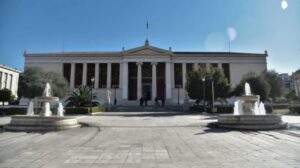
The new academic year 2026–27 begins under particularly symbolic, as well as substantive, circumstances for the National and Kapodistrian University of Athens (NKUA).
The first university of the Greek state is celebrating 190 years since its founding while simultaneously attempting to write the next chapter of its history, with its sights set well beyond Greece’s borders.
This year’s anniversary marks a long historical journey.
NKUA was founded in 1837, just a few years after the creation of the modern Greek state, and became the first university not only in Greece but also in the Balkans and the wider Eastern Mediterranean region. It began operating with four academic departments and just 52 students.
Today, it has 42 departments, more than 200 postgraduate programs, and a university community of approximately 100,000 undergraduate and postgraduate students and PhD candidates.
From the University of King Otto to Greece’s largest university
The University of Athens was inaugurated on May 3, 1837, and was initially named the “Othonian University,” after Greece’s first king, Otto. Its first premises were located in a building that today houses the History Museum of the University of Athens.
For more than a century, the institution’s development ran almost parallel to that of the Greek state. Generations of scientists, educators, lawyers, doctors, politicians, and intellectuals passed through its classrooms, while its scientific and intellectual activity became intertwined with important periods of modern Greek history.
From a small university with four departments, NKUA evolved into a multidisciplinary institution with a presence in the humanities and social sciences, natural sciences, health sciences, law, education, and a broad range of modern scientific fields.
Today, according to figures presented by the university itself, it has approximately 100,000 undergraduate and postgraduate students and PhD candidates, 4,000 international students across all levels, and 3,000 academic and administrative staff members.
International rankings and the push for greater international outreach
NKUA’s current profile is not limited to its size. In recent years, the university has invested significantly in strengthening its international presence, resulting in notable performances in international evaluations.
According to the university, it now ranks among the world’s leading universities in international rankings, while Rector Gerasimos Siasos has linked his administration to the institution’s significant rise in international rankings.
The current QS World University Rankings 2026 placed NKUA at 390th worldwide, while in the QS 2027 edition it ranks 402nd. NKUA’s references to its presence among the world’s top 200 universities concern its broader international advancement in other rankings and under different evaluation methodologies.
The key point, therefore, is the overall trend: research output, international partnerships, presence in subject-specific rankings, attracting international students, and developing joint academic initiatives.
Harvard, Yale, Sorbonne, Columbia and the international network
As part of this strategy, NKUA has developed partnerships and joint initiatives with leading universities abroad.
Its international strategy includes collaborations and academic links with institutions such as Harvard, Yale, the Sorbonne, and Columbia, while particular importance is also attached to the university’s participation in European academic alliances and networks such as CIVIS.
Internationalization is not limited to student and faculty mobility. It includes joint degree programs, research collaborations, international postgraduate programs, joint scientific initiatives, and the possibility of developing academic activity outside Greece.
The Cyprus branch: from international cooperation to a physical presence
The establishment and operation of NKUA’s branch in Cyprus is perhaps the clearest example of its new internationalization strategy.
The branch in Nicosia is the first branch of a Greek public university abroad and represents a different approach to internationalization: Greece’s public university system is no longer limited to attracting students to Greece but is establishing an educational presence in another country.
The official event marking the establishment and operation of the branch took place in Athens in February 2026, in the presence of Greek President Konstantinos Tasoulas, Cypriot President Nikos Christodoulides, and Archbishop Ieronymos of Athens and All Greece and Archbishop Georgios of New Justiniana and All Cyprus.
The expansion into Cyprus is not merely symbolic. For the 2026–27 academic year, new undergraduate programs are being promoted, while the School of Medicine is already operating. The new phase of development includes, among other programs, Nursing and Business and Organizational Administration.
Indeed, the branch itself announced in late August an extension of the deadline for submitting expressions of interest for enrollment in its study programs for the 2026–27 academic year, indicating that its educational activities are now entering the phase of regular operation.
For NKUA, Cyprus represents at the same time a natural geographical extension, a historical and cultural space for cooperation, and a gateway to the wider Eastern Mediterranean region.
Research as a key pillar
In addition to teaching, research output is a crucial factor in a university’s international presence.
NKUA has laboratories, clinics, university research institutes, centers of excellence, a university research and innovation center, as well as structures supporting research funding and research ethics.
The production of new knowledge spans fields ranging from biomedical sciences and artificial intelligence to the environment, humanities, law, economics, and social sciences.
A characteristic example is the international research activity of NKUA laboratories in cutting-edge fields. University research teams have participated in major European programs, including LIFE APEX, which focuses on the biomonitoring of chemical compounds and their effects on the environment and human health.
At the same time, new postgraduate programs continue to be developed. For the 2026–27 academic year alone, programs have been announced in fields including global health and disaster medicine, epidemiology, geology, philosophy and management, business administration, and economics and finance.
Gerasimos Siasos takes the Presidency of the Rectors’ Conference
The anniversary year carries even greater institutional significance for NKUA, as its Rector, Professor of Cardiology Gerasimos Siasos, has assumed the Presidency of the Conference of Rectors of Greek Public Universities.
The decision was taken by the Conference’s plenary session, which met in Samos on July 2 and 3, 2026.
The position gives NKUA a broader institutional role, as the rector of Greece’s largest university is no longer representing only his own institution but is also participating, from a position of responsibility, in the national dialogue on public higher education as a whole.
The challenges are numerous: university funding, student welfare and housing, staffing, internationalization, research competitiveness, infrastructure, digital transformation, artificial intelligence, and the relationship between universities, the economy, and society.
It is worth noting that the 112th Conference of Rectors, held in Samos, highlighted issues including student welfare, academic advancement, and equality, reflecting the breadth of the agenda that the new Presidency is expected to address.
Ask me anything
Explore related questions




