





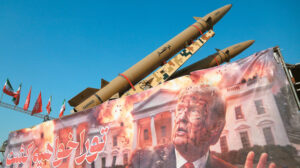
After roughly a month of relative calm, and as Washington had shifted much of its focus toward an “economic war” against Tehran, hostilities between the United States and Iran have reignited. U.S. forces struck missile launchers in the strategically important Strait of Hormuz, Iran responded with attacks on American facilities, and Donald Trump warned that Washington’s next retaliation would be forceful.
For the first time since late July, the U.S. military announced that it had carried out strikes against two missile launchers on Larak Island, in the Strait of Hormuz.
Tehran responded with missiles and attack drones targeting U.S. facilities in Jordan and the United Arab Emirates, while Iranian President Masoud Pezeshkian said that his country does not want the war to continue.
Trump: “There will be retaliation — We will hit them hard”
Donald Trump warned that Iran’s latest attacks would not go unanswered.
“There will be retaliation” and “we will hit them hard,” the U.S. president said, signaling another response from Washington.
Earlier, however, Pezeshkian argued that continuing the war was “not in the interest” of Iran “or anyone else” in the region, stressing that he was still “working to find an agreement.”
The Iranian president was in Kyrgyzstan for the Shanghai Cooperation Organisation summit, where he met Pakistani Prime Minister Shehbaz Sharif, whose country has taken on a mediating role. Chinese President Xi Jinping and Russian President Vladimir Putin also attended the summit, among others.
Why the U.S. struck Larak Island
According to the U.S. Central Command (CENTCOM), the strikes on Larak took place after forces from Iran’s Islamic Revolutionary Guard Corps were detected preparing to launch missiles loaded with naval mines into the Strait of Hormuz.
Iranian media reported that three people were killed and seven others injured in the U.S. strikes.
The resumption of direct military operations comes as the war enters its seventh month, while diplomatic efforts to end the conflict remain deadlocked.
Jordan intercepted eight Iranian missiles
Jordan, which was among the targets of Iran’s retaliation, said it had intercepted eight missiles after they entered the airspace of the Hashemite Kingdom.
The United Arab Emirates, meanwhile, said it had detected an Iranian drone over its territorial waters and condemned what it described as a “dangerous escalation.”
Iran’s armed forces also warned neighboring countries that a “much stronger retaliation” could follow if U.S. forces launched another attack from their territory.
The Revolutionary Guards additionally claimed to have shot down two U.S. drones over the Strait of Hormuz.
Tanker hit in the Strait of Hormuz
Another incident involving a commercial vessel in the area is causing fresh concern.
In the early hours, the British maritime security agency UKMTO announced that a tanker had been hit by three “unknown projectiles” while sailing toward the exit of the Strait of Hormuz.
The region had experienced relative calm in recent weeks, although sporadic exchanges of fire had not stopped completely, particularly around the strategically important waterway.
The Strait of Hormuz, through which roughly one-fifth of the world’s hydrocarbons consumed before the war passed, is now at the heart of the conflict.
Iran has effectively closed the strait since the beginning of the war, which erupted following the U.S.-Israeli attack on the Islamic Republic on February 28.
Brent rises above $90
The new escalation immediately affected international markets, as fears of even greater disruptions to oil supplies returned.
The price of North Sea Brent, the international benchmark crude, once again broke above the symbolic threshold of $90 a barrel.
The importance of Hormuz to global energy markets means that any renewed military escalation in the area puts immediate upward pressure on prices.
The battle for “free passage” through Hormuz
In retaliation for the closure of the strait, the United States has imposed a blockade on Iranian ports in the Gulf and says it is prepared to “protect the free flow of commerce.”
CENTCOM has announced that it completed mine-clearing operations along the “international shipping lanes.”
The Revolutionary Guards, however, claimed that a very large tanker attempting to cross the strait “illegally” struck two naval mines.
The U.S. Central Command rejected the claim, describing it as “misinformation.”
Negotiations remain deadlocked
Despite repeated mediation efforts, negotiations to end the war remain effectively frozen.
The so-called Islamabad memorandum of understanding, signed by the two countries’ presidents in mid-June, collapsed less than a month after it was signed.
Iranian Foreign Minister Abbas Araghchi maintains that the path forward remains clear.
“The solution is clear and simple: the U.S. must honor the commitments it made” when the agreement was signed, he has said, adding that “everything will return to normal” once that happens.
Washington’s “economic war”
The Trump administration had shifted a significant portion of its pressure from the military to the economic front in recent weeks, intensifying sanctions against Tehran.
The move is also linked to the fact that the war remains highly unpopular in the United States as the midterm congressional elections approach.
Iran was already facing extensive U.S. and international sanctions, but Washington has announced new measures aimed at increasing economic pressure even further.
“We will continue to apply pressure” on Tehran, U.S. Treasury Secretary Scott Bessent said as he began a series of meetings in the United States with G20 counterparts.
The return of direct military strikes after a month of relative de-escalation, however, has renewed fears that the conflict could enter an even more dangerous phase.
Ask me anything
Explore related questions




