





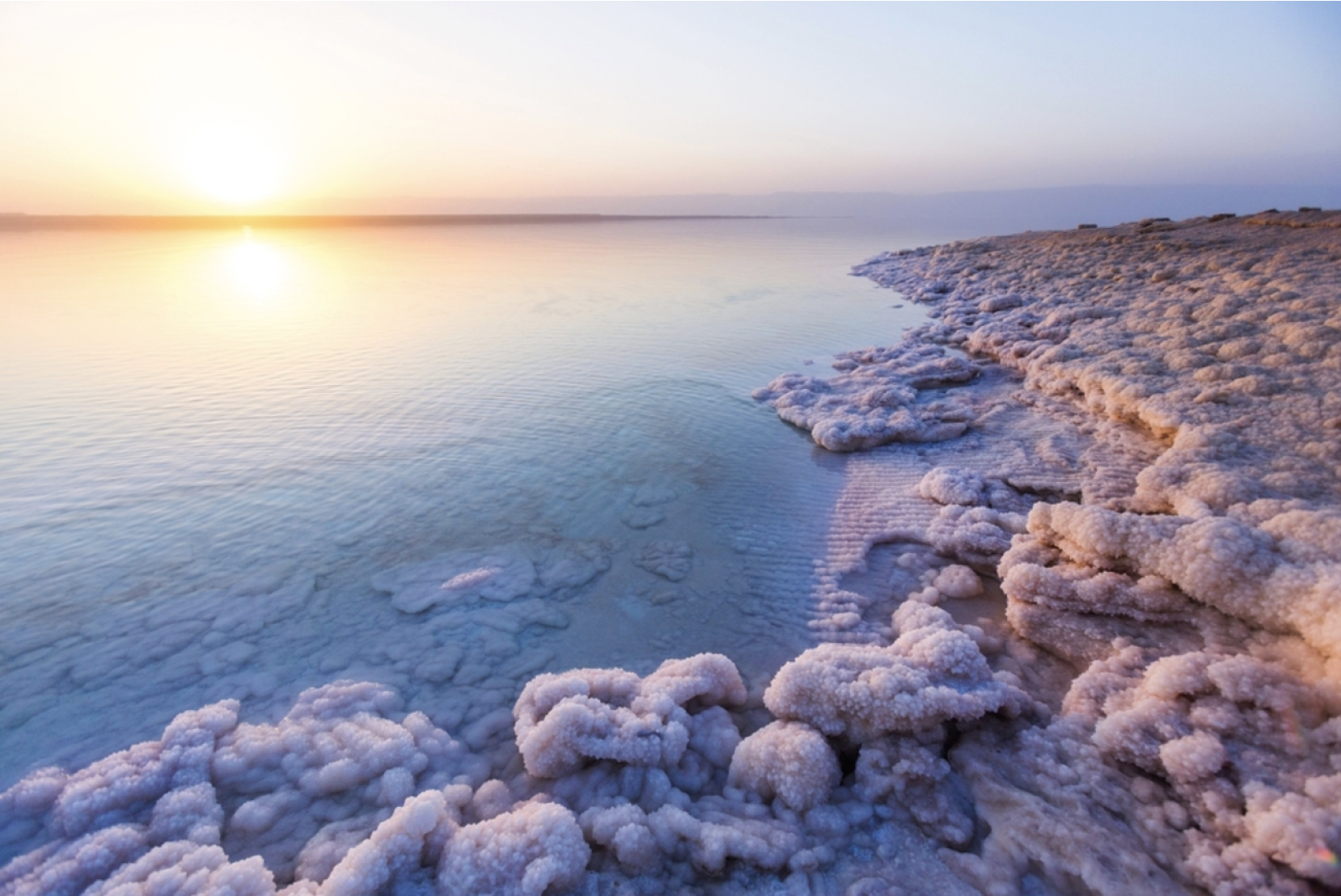
Few questions sound as simple — yet have answers as complex — as “Why is the sea salty?” As British geologist and oceanographer Dorrik Stow explains in his book Oceans: A Very Short Introduction, water is far more than the substance covering most of our planet. It is what made life possible, helped regulate Earth’s climate, shaped the continents, and continues to sustain the delicate balance of the planet today.
Seen from space, Earth is unmistakably the “blue planet.” Oceans and seas cover around 71% of its surface, forming one vast, interconnected system. Ocean currents transport enormous amounts of heat from the Equator toward the poles, influencing temperatures, weather patterns and ecosystems around the globe.
The answer to the question of why the sea is salty begins with the fundamental properties of water itself. A water molecule consists of two hydrogen atoms and one oxygen atom, but its distinctive structure makes it one of nature’s most powerful solvents. Water is therefore often described as the “universal solvent.”
Most of the salts found in the oceans today originate from the slow but relentless weathering of rocks on land. Rainwater, made slightly acidic by carbon dioxide absorbed from the atmosphere, gradually breaks down rocks and releases ions. Rivers then carry these dissolved materials into the oceans.
At the same time, cracks in the ocean floor allow seawater to interact with hot magma below. The resulting hydrothermal fluids are rich in metals such as iron, copper and zinc, adding further elements to the oceans’ chemical makeup. Underwater volcanic eruptions also play a role, although a smaller one, releasing inorganic elements directly into the marine environment.
Scientists estimate that rivers deliver roughly three billion tons of dissolved chemicals to the oceans every year. The total salt reservoir contained in the world’s oceans is estimated at around 50 quadrillion tons (5 × 10¹⁶) — a quantity almost impossible to comprehend on a human scale.
And yet, despite this constant influx, the salinity of the oceans has remained remarkably stable for hundreds of millions of years.
The reason is that the oceans are not simply a vast “storage tank” for salt. They are an extraordinarily dynamic system in which chemical elements are continuously added, removed and recycled. Marine organisms absorb many of these elements to build shells and skeletons. Others settle onto the seafloor and become sediments, while some are eventually returned to the geological cycle through tectonic activity. Together, these processes help keep average ocean salinity remarkably stable over geological timescales.
The average salinity of seawater is around 3.5%, meaning that there are approximately 35 grams of dissolved salts in every liter of water. Around 85% of these salts consist of just two ions — chloride and sodium — which combine to form ordinary table salt, or sodium chloride. The remainder is made up largely of magnesium, sulfates, calcium and potassium. Scientists have also detected tiny concentrations of almost 100 different chemical elements in seawater, including traces of gold.
If all the water in the oceans were to evaporate, the salt left behind would form a layer approximately 45 meters thick across the entire surface of the Earth.
Salinity, however, is far from uniform. It varies according to evaporation, rainfall, freshwater input from rivers and the melting of ice. Salinity tends to be higher in subtropical regions, where evaporation is intense, and lower near the poles and around the mouths of major rivers, where freshwater dilutes the concentration of dissolved salts.
But the importance of the oceans extends far beyond their chemistry. They absorb vast quantities of carbon dioxide from the atmosphere, act as a natural regulator of temperature and help moderate extreme fluctuations in the climate. Without the oceans, temperature differences between tropical and polar regions would be far greater, while the global climate would be considerably more unstable.
Modern oceanography can even use microscopic marine organisms to reconstruct Earth’s climatic past. The shells of planktonic organisms such as foraminifera preserve chemical signatures that contain clues about ocean temperatures and composition hundreds of thousands — and in some cases millions — of years ago. By studying these microscopic records, scientists can reconstruct past ice ages, periods of warming and the evolution of Earth’s climate over time.
The question “Why is the sea salty?” ultimately points to a much bigger truth: water is not merely a natural resource. It is one of the fundamental forces that has shaped the Earth we know today.
From the formation of the first oceans to the emergence and persistence of life, and from the shaping of continents to the regulation of the global climate, water is at the heart of an uninterrupted planetary cycle that has been unfolding for billions of years.
* This article draws on scientific data and explanations from Dorrik Stow’s Oceans: A Very Short Introduction (Oxford University Press), supplemented by additional scientific research and journalistic reporting.
Ask me anything
Explore related questions




