





A new natural-gas transportation route from Greece to the Western Balkans is beginning to take shape, with the signing tomorrow, Friday, in Thessaloniki of a Memorandum of Cooperation to bring Serbia and North Macedonia into the Vertical Corridor.
The agreement will be signed by representatives of the Natural Gas Transmission System Operators of the countries participating in the initiative, together with their counterparts from Skopje and Belgrade.
The agreement follows a meeting held in Athens in July, during which a technical and commercial working group was established to examine interconnection capacity, market prospects, and the projects required to make the new route commercially attractive.
The expansion toward the Western Balkans adds a new branch to the Vertical Corridor. Beyond the main route, which connects Greece with Bulgaria, Romania, Moldova, and Ukraine, a second axis is being developed through North Macedonia and Serbia, with the potential to provide access to Hungary and Austria.
From Agreements to Infrastructure Projects
Tomorrow’s agreement is particularly significant because it coincides with the acceleration of the projects needed to make the new route operational in practice.
The Greece–North Macedonia interconnector is already under construction, with commercial operation targeted for before the end of 2027. At the same time, North Macedonia recently signed the contract for the design and construction of its section of the new pipeline that will connect it with Serbia.
The contractor for the project is Rapid Build, which is also constructing the Greece–North Macedonia pipeline section. The fact that the contract was signed just days before the Thessaloniki Memorandum indicates that the expansion of the Vertical Corridor is no longer limited to political declarations but is beginning to acquire physical infrastructure as well.
The North Macedonia–Serbia pipeline is expected to be completed toward the end of 2028, approximately one year after the Greece–North Macedonia interconnection. On the Serbian side, however, planning is progressing more slowly, as a contractor for the section to be built on Serbian territory has not yet been announced.
Once the two interconnections are completed, North Macedonia will cease to be merely a final destination for natural gas and will become a transit country. Serbia, in turn, will gain an alternative supply gateway from the south, reducing its heavy dependence on Russian gas.
Alexandroupoli at the Center
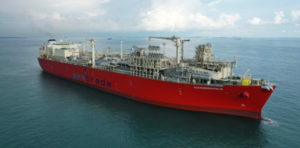
The Alexandroupoli FSRU will play a central role in the new strategy. Through the new route, LNG cargoes arriving in Greece—primarily of US origin—can be transported to northern markets, alongside Azerbaijani natural gas delivered through the TAP pipeline.
North Macedonia has already booked four time slots at the floating terminal, while Serbia’s Srbijagas has secured annual capacity of 300 million cubic meters for the next decade.
These moves demonstrate concrete commercial interest in using Greek infrastructure and gaining access to alternative sources of supply.
The strategy also ties into today’s visit by Environment and Energy Minister Stavros Papastavrou to Evros and the Gastrade facilities at the port of Alexandroupoli, before he travels to Thessaloniki, where the government’s center of activity is shifting ahead of the Thessaloniki International Fair.
The minister had already announced in July the planned expansion of the Vertical Corridor toward Serbia and North Macedonia.
The planned capacity of the North Macedonia–Serbia pipeline is estimated at between 3 and 6 billion cubic meters per year, a volume large enough to create meaningful competition for Russian gas supplies that continue to serve the region.
At the same time, the new route fits into the broader US strategy of increasing LNG exports to the Balkans and Central Europe, strengthening the role of Greek infrastructure as a gateway for alternative natural-gas supplies.
Ask me anything
Explore related questions




