





The Alternative for Germany is three seats short of the absolute majority required in the Saxony-Anhalt state parliament — at least that is what the first exit poll indicates.
Until the results are finalized, something that should not take long because the state is relatively small, there are many scenarios, leading to governments of different compositions. There are also many scenarios for the day after, given the prospect of an AfD government.
The AfD’s federal co-chair, Alice Weidel, in statements to the RTL/ntv network, made an overture to the CDU. After speaking of a historic defeat for the Christian Democrats, she extended a hand of cooperation in the event that her own party is unable to secure an outright majority. The other co-chair, Tino Chrupalla, said that if the AfD ultimately fails to secure an absolute majority, it is open to talks, while implying that the other parties might tolerate a minority government led by his party.
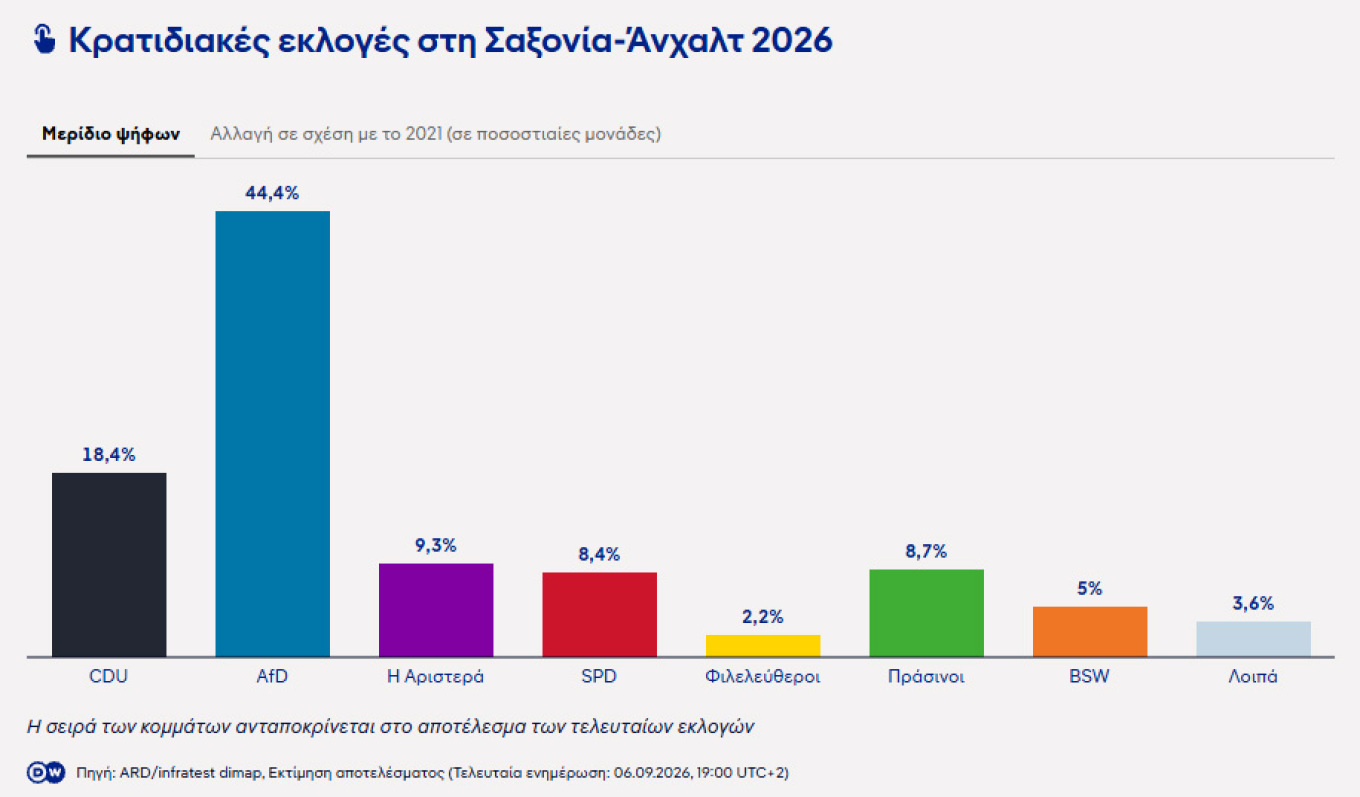
The first projection from the ARD exit poll gives the AfD 39 of the parliament’s 83 seats, while 42 are needed for a majority. The second projection from the ARD exit poll, with minimal deviations from the first, puts the Alternative for Germany (AfD) at 44.4%. The CDU follows with just 18.4%, having lost half of its strength compared with the 2021 election; this is the party’s historic low in the state, something that did not escape the attention of the German press.
Below 10% are the Left Party (9.3%), the Greens (8.7%) and the SPD (8.4%), with relatively small fluctuations.
The figures for the BSW (Sahra Wagenknecht Alliance) are on the borderline, securing 5%, but it is not ruled out that it may remain outside the state parliament. The result will determine whether the AfD will manage to form a government on its own.
As for the seats, and based on the same exit poll, the AfD is estimated to secure 39, the CDU 16 seats, the Left Party 8 seats as do the Greens, the SPD 7 seats and the BSW 5 seats.
Given that no other center-left or center-right party wants to cooperate with it, the AfD could find itself in the position of having won a triumphant victory but remaining outside the corridors of government.
Nevertheless, Ulrich Siegmund of the AfD says that his party will reach out to all forces that wish “to implement better policies.”
“We extend our hand to all democratic forces that wish to pursue better policies,” he said, but made clear that issues such as migration and internal security are not negotiable.
If the small BSW (Sahra Wagenknecht Alliance) fails to pass the 5% threshold and remains outside parliament, the seats it would have won — five seats for a result of around 5% — will be distributed among the other parties. If this happens, it will provide a small boost that could prove crucial for the AfD and give it an outright majority.
Meanwhile, the BSW’s lead candidate, Kristin Wiittich, said on ARD television that there are specific “projects” — energy, for example — on which her party could envisage cooperation with the AfD. On other issues, however, the two sides do not have much in common.
The BSW, she clarified, will decide on a case-by-case basis and according to the substance of each proposal whether it will cooperate with the AfD.
Her remark that, given the result achieved by the AfD, “it would be completely undemocratic not to involve them in some way in the government” was particularly interesting. She rejected the possibility of either Siegmund or Sven Schulze, the outgoing CDU minister-president, serving as premier: “We want a non-partisan minister-president,” she stressed.
On the other hand, the parties that now make up the opposition — CDU, SPD, Greens, and Left Party — are called upon to find common ground, above all for a coalition government.
The Left Party’s lead candidate, Eva von Angern, has already said that, depending on the final election result, she is prepared even to vote for a CDU minister-president.
“The Left Party wanted from the outset to prevent the election of an AfD minister-president,” she said on ARD television. At the same time, she accused the CDU of contributing to the AfD’s strengthening by adopting issues from the far-right party’s agenda and planning cuts to social spending.
For his part, the Social Democrats’ Secretary-General, Tim Klüssendorf, admits that the political arithmetic is complicated,” he said on ZDF. According to him, the SPD could emerge from the election “with a relatively positive feeling, but also with confidence,” as in recent weeks it had managed to persuade several more voters to support it.
He added that the Social Democrats want to contribute to the formation of a democratic majority against the AfD, but admitted that the AfD’s result is “truly dramatic.”
Ask me anything
Explore related questions




