





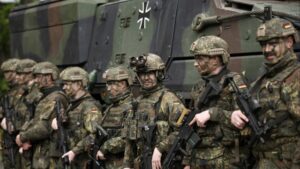
Germany is preparing to send up to 1,000 active-duty soldiers to serve in its permanent German brigade in Lithuania this autumn, as European NATO members strengthen the defense of the alliance’s eastern flank against the threat of a possible Russian attack.
According to a report by the newspaper Bild, German Defense Minister Boris Pistorius has approved mandatory personnel assignments after the Bundeswehr failed to attract enough volunteers for the unit based in Lithuania.
The first mandatory transfers could begin as early as this autumn and involve fewer than 1,000 soldiers, according to several independent sources cited by the newspaper.
The German Defense Ministry was expected to brief senior members of the Bundestag’s Defense Committee on Monday about the decision.
The measure does not constitute a general mobilization, nor does it involve compulsory enlistment of civilians. Rather, it concerns active-duty Bundeswehr personnel who may be assigned to Lithuania even if they have not volunteered for the deployment.
So far, only around 60% of the positions required for the brigade have been filled on a voluntary basis. The biggest shortages are in IT specialists, logistics personnel, cooks and enlisted soldiers.
According to Bild, mandatory assignments could currently affect up to 20% of the brigade’s positions. The Bundeswehr hopes to reduce that proportion to around 10% by the end of September by attracting more volunteers.
The German military has already conducted recruitment campaigns and offered familiarization trips to Lithuania for soldiers and their families.
However, decisions regarding the remaining positions must be made soon, as the soldiers affected will have to be formally notified, given the opportunity to legally challenge their assignments, and provided with sufficient time to organize a possible relocation.
“Voluntary participation remains the basic principle,” Bild reported. “However, in order to ensure the brigade’s operational readiness, mandatory assignments can no longer be avoided.”
Germany strengthens NATO’s eastern flank
Germany plans to permanently station 4,800 soldiers and around 200 civilian employees in Lithuania by the end of 2027.
The unit, officially known as the 45th Armored Brigade Lithuania, will be the first German combat brigade to be permanently based outside Germany since the Bundeswehr was established in 1955.
According to the Bundeswehr, the heavy mechanized brigade of approximately 5,000 personnel is tasked with protecting NATO’s eastern flank following Russia’s 2022 invasion of Ukraine.
Once fully operational, the brigade will include thousands of soldiers and approximately 2,000 military vehicles, according to NATO.
Lithuania borders Belarus and Russia’s Kaliningrad exclave and is also close to the Suwalki Corridor, a narrow strip of land connecting Poland with the Baltic states. NATO considers the corridor particularly vulnerable in the event of a potential conflict with Russia.
Pistorius had previously insisted that the brigade should be staffed primarily by volunteers. During a visit to Lithuania in June, however, he acknowledged that mandatory assignments might be necessary, estimating at the time that fewer than 1,000 soldiers could be affected.
Tusk: Russian escalation could reach NATO
Germany’s decision comes as Poland is also strengthening its security measures following Russian attacks near its border.
On Sunday, September 13, a Russian drone struck the engine of a passenger train operating on the Kyiv–Warsaw route at the Yahodyn railway station in Ukraine’s Volyn region, near the Polish border.
Poland scrambled fighter jets during the attack, while Prime Minister Donald Tusk convened an emergency meeting with ministers, senior military commanders and intelligence chiefs.
“The coming weeks and months will be a period of very intense activity on the Russian side and, unfortunately, we cannot rule out the possibility that this escalation will also affect our territory,” Tusk warned.
The Polish prime minister said that Russia’s escalating actions are becoming a direct security issue for NATO member states bordering Ukraine, reinforcing calls for greater military readiness across Europe.
Ask me anything
Explore related questions




