





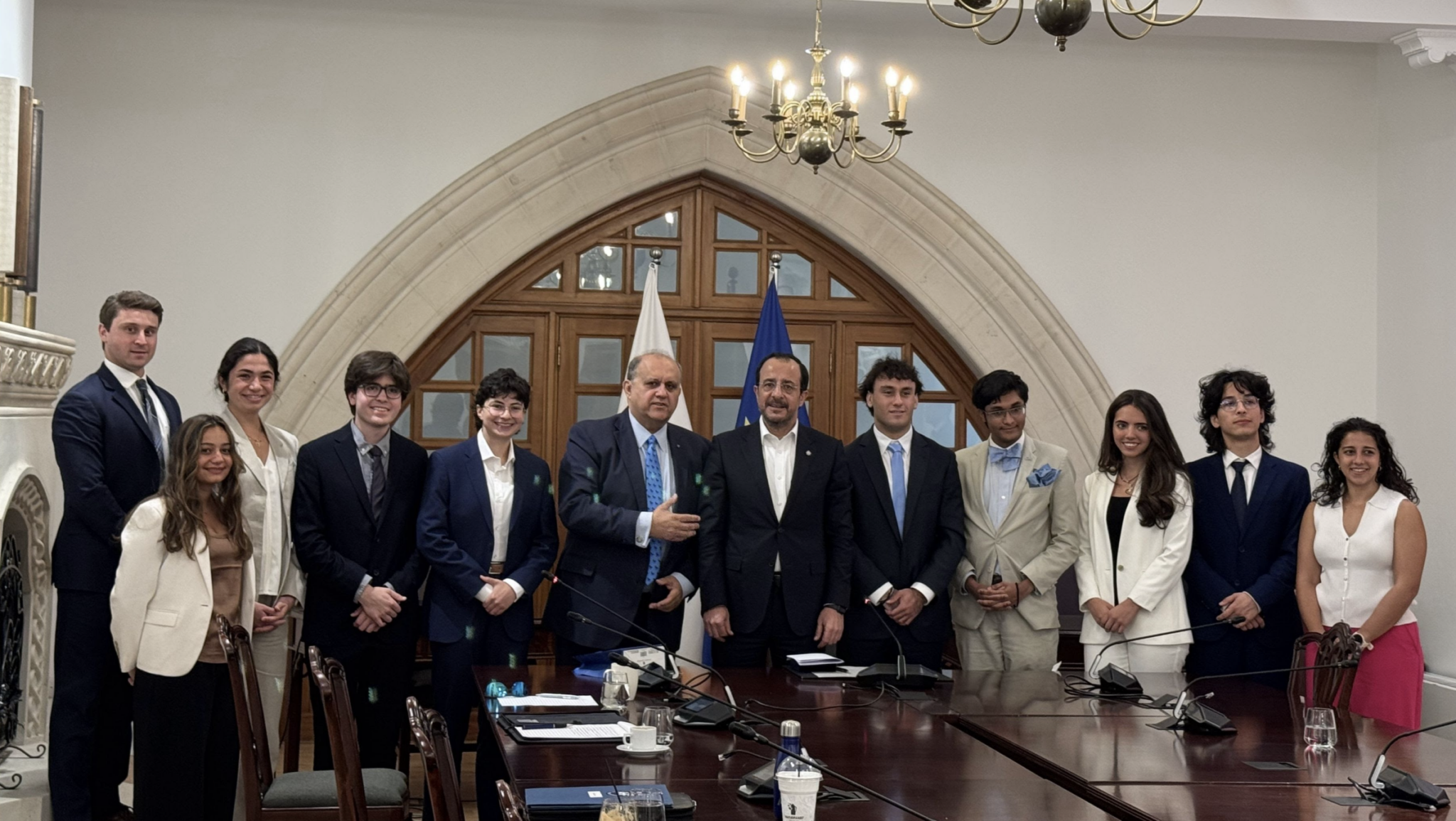
College students participating in the American Hellenic Institute Foundation’s (AHIF) 2026 College Student Foreign Policy Trip gained firsthand insight into Cyprus’ political and security challenges, its 52-year occupation and its growing strategic importance to the United States.
Held June 25-July 1, the Cyprus portion of the program included meetings with senior political, diplomatic and defense officials, as well as visits to historical, religious and cultural sites.
“Students often hear about the Cyprus issue in their communities, but witnessing the consequences of Turkey’s invasion and continuing occupation and speaking directly with Cyprus’ leaders provide an entirely different level of understanding,” AHI President Nick Larigakis said. “The program also allowed students to see how the Republic of Cyprus has emerged as a reliable and increasingly important strategic partner of the United States.”
Meeting Cyprus’ Leadership
A highlight of the visit came June 29, when President of the Republic of Cyprus Nikos Christodoulides welcomed the delegation to the Presidential Palace. The students discussed the Cyprus issue, regional developments and Cyprus’ role in strengthening security and cooperation in the Eastern Mediterranean.
The delegation also met with officials including Haris Chrysostomou, head of the America Department at the Ministry of Foreign Affairs; Michael Damianos, Minister of Energy, Commerce and Industry; Aristos Damianou, Chairman of the Standing Committee on Internal Affairs of the House of Representatives; and Dr. Daniel Mangis, chargé d’affaires at the U.S. Embassy in Cyprus.
Students also met with Constantinos Kollias, Ambassador of Greece to Cyprus, who hosted the delegation for dinner and a reception.
Witnessing the Impact of the Occupation
The program included a briefing on the history of Cyprus and Turkey’s 1974 invasion, followed by a meeting with Leonidas Pantelides, the Greek Cypriot member of the Committee on Missing Persons in Cyprus.
On June 27, students visited the Turkish-occupied areas of Cyprus, seeing firsthand the impact of the continuing division on communities, cultural heritage and religious sites, including the area of Varosha and the Church of St. Barnabas.
“The opportunity to witness the Turkish-occupied area of Cyprus was instrumental in teaching us the complexities and importance of the Cyprus Question,” Maria Kyriacou, a junior at the University of Virginia, said.
The delegation also visited the Makedonitissa Tomb, where students participated in a wreath-laying ceremony honoring those who died defending the Republic of Cyprus.
Cyprus’ Defense and Regional Role
Students received briefings on Cyprus’ defense and emergency-response capabilities, visiting the Cyprus Joint Rescue Coordination Center in Larnaca and the Cyprus Centre for Land, Open Seas and Port Security (CYCLOPS).
They also met with Lt. Gen. Emmanuel Theodorou, Chief of the Cypriot National Guard, for a briefing and luncheon.
“I gained an appreciation for Greek Cypriots’ continued resilience in the face of illegal occupation, while also learning about how Cyprus and Greece are increasing their regional leverage through military strength, natural resources and economic diversification,” said Lukas Koutsoukos, a senior at Yale University.
The trip also included meetings with His Beatitude Archbishop Georgios of Cyprus and a visit to Kykkos Monastery, alongside cultural visits to sites including the Leventis Gallery and Larnaca.
Ask me anything
Explore related questions




