





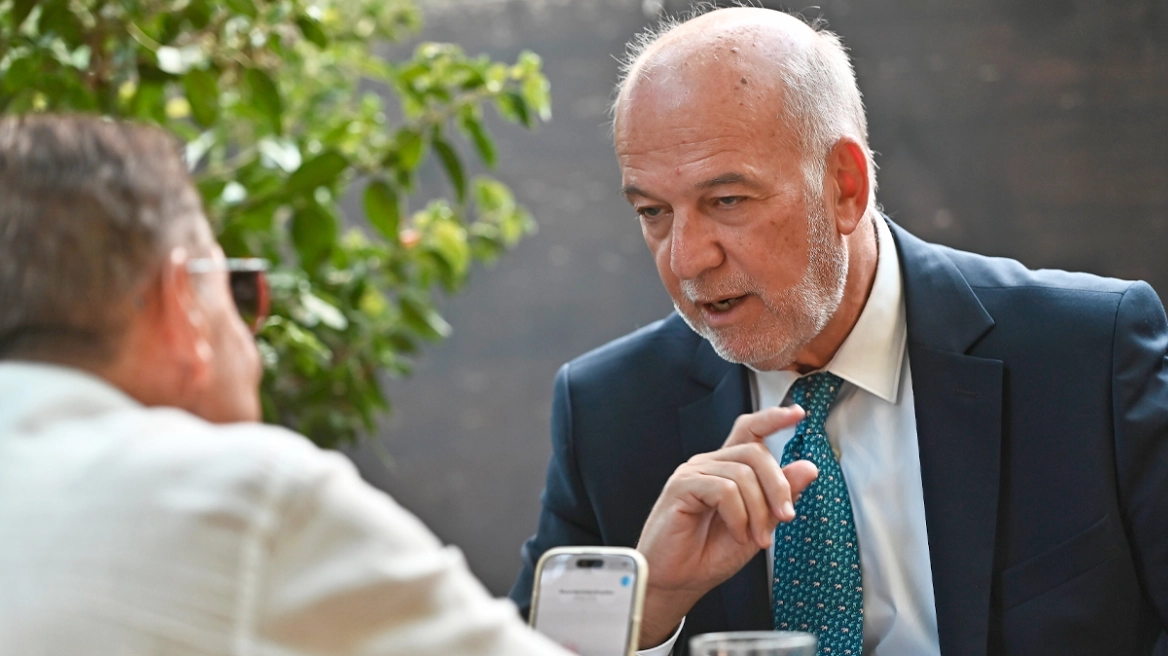
If! I insist on the if. If, then, everything Giorgos Floridis, the Justice Minister, told me is true. And if the rest of the measures are implemented, then “the Greek judiciary will be among the five best in Europe”!
And yet, the prevailing mood in society is unpleasant. And often categorical: that the judiciary is dependent on whichever government is in power. And that quite a few judicial officials are corrupt. The minister has arguments to make. Such as in the case of the Tempi tragedy. At the time, Panos Routsis was on hunger strike, rightly demanding the exhumation of his child. The result? “Although permission was granted, Panos Routsis did not proceed with the exhumation of his child.”
Shall I go on? No need. Read it and decide. You, the readers; you, the judges, prosecutors and jurors.
Scene 1: On Sifis Valyrakis
DIMITRIS DANIKAS: It took five and a half years for the prosecutor to reach a decision on the two fishermen who killed Valyrakis. What is going on?
GIORGOS FLORIDIS: It was a very difficult case as far as the investigation was concerned. An extensive investigation was carried out. I don’t know whether we have a conviction in the end; we simply have a prosecutor’s recommendation, don’t we?
D.D.: What happened before that? The police officers who investigated it? All of them?
G.F.: Evidence that was disputed, experts, again and again. And let’s not forget that the trial has been under way for some time; it did not start now. We shouldn’t blame the Greek judiciary; we are doing it an injustice. It is moving very quickly.
D.D.: Yes, but according to the evidence, the Greek judiciary ranks much lower — even than Albania — when it comes to dependence on the state.
G.F.: That is no longer the case. The rankings concerning Greece are based on data from before 2024. The changes we made began to be implemented in the second half of 2024 and the figures are impressive. Take, for example, what is known as the judicial map. That is, the abolition of Magistrates’ Courts and magistrates and the merger of the first-instance level, where the major delays were occurring. The prime example is the Athens Court of First Instance, where 60% of cases are heard. Before these changes, if you filed a lawsuit today, you would be given a date for your case to be heard four years later. And then you would wait roughly another year for the judgment to be issued. Where are we today? Today, you file a lawsuit and get a hearing date in seven or eight months instead of four years, and the judgment will be issued within a year and a half instead of five years. The same applies in the regions.
Scene 2: “The electronic case file does not exist anywhere in the world”
D.D.: What does the electronic case file contain?
G.F.: The electronic case file for court proceedings that we have now introduced in Greece does not exist anywhere in the world. For example, a lawyer prepares a lawsuit from their office. They send it electronically to the court. The court automatically gives them a hearing date — automatically — and in fact gives them a choice of dates. On the day of the hearing in civil cases, they submit their pleadings electronically. Any additions and responses, as we call them, are also submitted electronically. The judge issues the judgment and publishes it electronically. An appeal is lodged electronically in the same file. Everything is electronic, all the way to the Supreme Court. And the system is interoperable with other state services.
D.D.: Why was the Magistrates’ Court an obstacle?
G.F.: Because at first instance we had Magistrates’ Courts and Courts of First Instance. The result was that we had 1,000 magistrates, who heard up to 20,000 cases. Now that the rank of magistrate has been abolished and all of them have become judges of the Court of First Instance, they hear all the cases of the Court of First Instance. In reality, we gained 1,000 judges in one go. That was the huge success. And they are now delivering. And the courts, which numbered 217 in Greece, we reduced to 110 at first instance. These changes were made now, in 2024–25.
Scene 3: A Law degree opens many doors
D.D.: How many prosecutors are there?
G.F.: Five hundred and something. We need at least another 150 so that we can hold speedy criminal trials, where people are suffering and becoming frustrated. We are doing extremely well in civil cases; we have achieved excellent rates. We have an issue with criminal cases. However, I believe that within a year to a year and a half from now, we will have achieved faster rates there too.
D.D.: Why are there so many lawyers? Why is it so easy for them, when in England they struggle to get through?
G.F.: Unfortunately, that is the system for obtaining a lawyer’s licence in Greece. If you get a Law degree, it is certain that you will become a lawyer. Now, in consultation and cooperation with the plenary of the Bar Associations, we are agreeing on a new Code of Lawyers, in which we are changing the entire system of training to become a lawyer and the examinations. I hope we will pass it by the end of the year.
D.D.: Why would someone want to become a lawyer? What is the incentive to go to Law School when there are so many lawyers?
G.F.: They believe that legal science offers many career paths. A Law degree can lead you into various professions. For example, you can become a notary, judge, court bailiff, a civil servant with good career prospects, a diplomat…
Scene 4: “Although permission was granted, Panos Routsis did not carry out the exhumation”
D.D.: People have the impression that the judiciary is dependent on political power — whichever government is in office; I am not referring only to the current one. Why is that?
G.F.: In all the years I have followed the country’s political life, whenever politicians cannot resolve their own problems among themselves, they pass them on to the judiciary. Every so often we see that a particular politician or leader or particular MPs have visited the Prosecutor of the Supreme Court and filed a complaint about an issue. So the judiciary is often called upon to resolve — although that is not its mission, and it does not do so — disputes between politicians. And depending on the decisions the judiciary makes, it receives either applause or condemnation. As far as its institutional standing is concerned, the judiciary came under relentless attack in the case of the Tempi tragedy, which caused pain to every Greek, because many political forces wanted to exploit this tragedy to gain party-political benefits. And there, although a model investigation was conducted…
D.D.: Konstantopoulou says otherwise.
G.F.: Yes, because Ms Konstantopoulou made a huge effort to ensure that the trial never began. Why? Because everything becomes visible at trial. As long as the case is under investigation and the investigation is confidential, those who have access to the case file take the evidence and use it as they please. Now that the trial has begun, they are all speaking there, and the evidence is in the open and the Greek people can see and hear it. And they can see the deception that had been set up. Because it is no coincidence that some people, including Ms Konstantopoulou, went to extraordinary lengths to prevent this trial from ever beginning. Let us not forget that the last major attempt to prevent the trial from beginning was a man’s hunger strike in Syntagma Square over the exhumations. The judiciary found a solution to that too. Did anyone ask why the exhumations were not going ahead? That was not their objective. From a certain point onwards, they do not care. Pressure was put on the judiciary to reopen the investigation that had been closed. And if the investigation had been reopened, it would never have been closed, which means that the trial would never have begun and this exploitation would have continued. The last attempt they made to obstruct the trial was when, at its beginning, people who had nothing to do with the case entered the courtroom.
Scene 5: “I come from a farming family”
D.D.: When do we expect the results?
G.F.: We cannot know that, because the evidentiary material is enormous. I would simply remind you that 250 lawyers have declared that they will represent parties in the proceedings. They are lawyers representing the victims. There are not only the 57 dead; there are also the injured — and, of course, there are the defence lawyers as well. There are more than 30 defendants. Each of them may have two or three lawyers; the same, of course, applies to the other side.
D.D.: Let’s take the case of Mati, where 104 people were burned to death. Almost nothing happened there.
G.F.: Referrals were made for the trials that took place, the courts reached their decisions and, as far as I know, some people were sent to prison.
D.D.: Yes, but so many people were burned to death. What kind of sentences were those?
G.F.: The court reached its decision on the basis of the indictment before it. The indictment before it specified those sentences.
D.D.: So, in your view, all the courts are doing their jobs properly. Judges are not corrupt; there is no corruption in the judiciary. People have the impression that there is.
G.F.: People have many impressions, but that does not mean they are right about everything they think. There are these thousands of judges. The overwhelming majority of them do their jobs in an exemplary manner and work under particularly demanding conditions. My family are judges; I know what goes on.
D.D.: Apart from your brother, who else is a judge?
G.F.: My wife is a judge, my son is a prosecutor. I am a lawyer, and my other son is also a lawyer.
D.D.: Your family — your father?
G.F.: They were farmers, poor farmers.
D.D.: Pontians?
G.F.: We are Thracians, that is, refugees.
D.D.: How many children were there?
G.F.: Four, three boys and one girl. And they all went on to study. And my village, which was very poor — Stavrochori in Kilkis — is now the most organised industrial area in Greece.
Scene 6: “Sixty judges left the profession as corrupt”
D.D.: Have you ever identified, dismissed or referred corrupt members of the judiciary?
G.F.: The minister does not refer them, but at least over the last six or seven years that I have known about, quite a few have left the judiciary following action by the leadership of the Supreme Court and the Supreme Judicial Council. Fifty, 60 judges — and many of them senior judges.
D.D.: People believe that if I am very rich, I will go to the judge, give him a million and the decision will be in my favour.
G.F.: That is not true. At least as far as the overwhelming majority of Greek judges are concerned, I would stake my life on it.
D.D.: So the figures saying that Greece ranks below Albania in terms of judicial dependence are wrong?
G.F.: Let us look at the issue of dependence because it is very important. The Greek Constitution provides the strongest guarantees of judicial independence in the world. Let’s start from the beginning: How does someone become a judge in Greece? After sitting the toughest and most rigorous examinations there are, they enter the School of Judges. Then, how are they appointed to a court? Exclusively by decision of the Supreme Judicial Council of the Supreme Court or the Council of State or the Administrative Service.
Scene 7: “The judiciary is not the political system’s referee”
D.D.: In the past, did the government choose the leadership of the judiciary? And under SYRIZA?
G.F.: Of course; Mitsotakis changed that. Let someone show me a system for selecting members of the judiciary anywhere in the world that has the constitutional guarantee enjoyed by Greek judges. Now, if there are corrupt judges, those bodies deal with them again. So whatever blows the judiciary suffers come from the political system, which transfers its disputes there and demands that the judiciary resolve them. The judiciary is not the referee of the political system.
Scene 8: “Life sentences are 30 years”
D.D.: Will Koukfontinas be released?
G.F.: There is legislation providing for a 25-year limit — although this is not mandatory. But that will be decided by the judicial councils.
D.D.: With all the violence that exists today, and when we say life imprisonment we do not mean life imprisonment, we mean 20 years, some people are calling for the return of the death penalty. I hear it with my own ears.
G.F.: That will never happen. There is the Council of Europe’s Convention on Human Rights.
D.D.: Yes, but what will happen with this leniency towards monsters, beasts? There is a dark spot in the justice system.
G.F.: Let me remind you of something. Before SYRIZA, a life sentence allowed you, after 25 years, to submit an application to be released. SYRIZA reduced it to 20 years. I made it 30 years.
D.D.: And again, 30 years is too little for a monster, for a beast.
G.F.: Let us not forget that in 2024 this government brought about a new criminal justice system in Greece, with changes to the criminal codes. I said: “We have looked enough at the rights of criminals, which are fully safeguarded; let us take a look at the rights of victims.” That was the phrase that defined the Criminal Code. The result of this new Criminal Code, which has now been in force for two years, is as follows: Until it was implemented, Greek prisons had an average of 9,000–10,000 inmates. Today they have 15,000. This means that things have become more difficult for those who break the law. Mainly in relation to everyday crime. Judges can now, when they see people who need rehabilitation but do not need to be destroyed, say: “Look, I am giving you a one-year prison sentence, but you will serve three months inside.” And that is where you deal with so-called everyday crime, from the neighbourhood thug, the bully, the person who causes disturbances in apartment blocks, the person who steals. Before the changes, these people did not even go to court, because they knew that even if they were given up to five years, they would receive a suspended sentence.
D.D.: PASOK today?
G.F.: PASOK cannot rebuild itself because it apparently cannot communicate with the needs of Greek society, that is, the contemporary problems facing the Greek people. It cannot identify them correctly and express them correctly. It had an opportunity over these years, when there was no other serious party in the centre-left space, to rebuild itself into a party that could evolve into a potential party of government. It did not do so because it chose to become an echo of extreme voices in Parliament, such as Konstantopoulou or Velopoulos, accepting conspiracy theories about Tempi, the wood shavings, the missing carriages. PASOK, in other words, failed to convince people that it could be a party capable of providing an alternative to Mitsotakis. As a result, Tsipras returned in the way he has now. He is stagnant too, of course, not much to speak of, but in reality both these parties have become stuck at low percentages.
D.D.: And what about the story with Samaras?
G.F.: I said recently that this discussion is closed; it makes absolutely no sense, because we are dealing with something that does not exist. And we are keeping something from the past on the surface. Greece is moving forward, Greek society has major problems, and the geopolitical upheavals in our region are staggering. We must develop alliances and equip ourselves so that we can acquire significant defence capabilities. Because Greece does not border Luxembourg, nor the Netherlands or Denmark. We face a permanent national threat.
Scene 9: “If Samaras wants to, let him form a party”
D.D.: What does Samaras want now?
G.F.: I don’t know and I am not interested. In reality, there is one issue: Do you want to form a party? Do it. Here is your chance. Do it so we can see you, measure your support and get it over with. What is the point of dealing with something that does not exist now and with something someone is trying to say from the past?
D.D.: And do you hope for a single-party majority?
G.F.: Yes, and I will tell you why. There are two issues. First, Greece cannot remain without a government for even one day. Because a country that is under permanent national risk faces the danger of suffering something momentous when there is no government to give orders. The second is that…
D.D.: …there is no one better than Kyriakos.
G.F.: Not by any stretch of the imagination. There is no alternative proposal for government. Let someone come forward and say, “I can put the economy in better order and distribute a better social dividend,” or that “I can run the state better.”
Epilogue: “I feel that I belong to the Ephorate of Modern Monuments”
D.D.: Don’t you regret anything you have done? Any mistake? Is everything perfect?
G.F.: Let me tell you something. One day, when I was speaking at the Cabinet, I said: “I feel that I belong more to the Ephorate of Modern Monuments than to the Ministry of Justice.” Why? Let me tell you about the fundamental changes we have made, so you can see what is happening. I am not saying that I do everything perfectly, but let me tell you the basics. This change I described to you earlier concerning the judicial map, the activation of the first instance, had been pending for 112 years. The change to the procedure of the Council of State, which changed its flow, is a law from 1929. That is also a century old. The change to inheritance law: the committee established by Eleftherios Venizelos to reform inheritance law was created in 1930. And there is almost a century there too. Now I am changing the entire system of property ownership in Greece. The system of horizontal property ownership, apartment blocks. Flats, co-ownerships, vertical property ownership, properties that are effectively trapped because of co-ownership, which cannot be moved. Which law am I changing? Eleftherios Venizelos’ law from 1929. At that time Athens had two- and three-storey houses; now the whole of Greece is full of apartment blocks.
D.D.: What is changing now?
G.F.: The way decisions will be taken by apartment-block assemblies, the percentages, the operating regulations, what will be permitted in each apartment block and how that decision is made — all the things that cause so much trouble. The committee will deliver the draft law to us by the end of November. I want it to become law in January. Essentially, despite the intermediate changes made during this century, the reality is that this government is either modernising Eleftherios Venizelos’ legislation or doing what Eleftherios Venizelos did not have time to do. So what am I now? (laughter) And yet, these are fundamental matters and I believe they lay the foundations for a different justice system in the next century. What I told you — that in two or three years the Greek judiciary will be among the five best in Europe in terms of technological infrastructure and speed — nobody believes it. But I hope we will be well enough to see it.
Do you think it will happen? Not even in our wildest dreams!
Ask me anything
Explore related questions




