





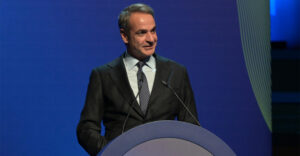
The new support package for energy costs announced last night by Prime Minister Kyriakos Mitsotakis from the podium of the SEV general assembly, following marathon negotiations, is estimated to provide Greek industry with relief of €20 to €25 per megawatt-hour.
According to government and industry sources, the benefit from the subsidy is estimated at these levels, with the final support for each beneficiary depending on the terms under which the mechanism will be implemented, which may be announced as early as today.
As the prime minister said, the new intervention will remove €95 million in costs from the energy bill of Greek industry, arguing that this winter could prove much more difficult than initially anticipated. The support, which will make use of the European CISAF and METSAF state-aid frameworks, covers two categories: companies outside the mechanism for compensating emissions costs, and energy-intensive industries that already receive compensation but will receive additional support as a practical recognition of the deterioration in the international energy environment. Kyriakos Mitsotakis specifically referred yesterday to sectors such as cement, food, paper products and plastics, describing an intervention that makes use of the room provided by the European state-aid framework.
How the money will be distributed
Based on the first approximate allocation provided by relevant sources, around two-thirds of the budget — approximately €63 million — is intended for industries covered by the compensation mechanism, while one-third — approximately €32 million — is intended for beneficiaries outside the mechanism. The exact allocation will be set out in the detailed framework, as the figures cited so far are estimates rather than finalized amounts for each category.
It should be noted that major industrial sectors are also outside the compensation mechanism, such as cement producers with significant electricity needs, and they are included in the new intervention.
The compensation mechanism reimburses eligible energy-intensive industries for part of the cost of CO₂ emission allowances, which electricity producers pass on to the price of electricity. Through this mechanism, the state covers part of the additional burden in order to preserve companies’ competitiveness and limit the risk of production being relocated outside the EU.
Different retroactive periods
The distinction between the two categories of beneficiaries also determines the period covered by the subsidy. For eligible companies outside the compensation mechanism, with annual consumption of approximately 1–1.5 terawatt-hours — a category that also covers a large portion of industry, with EVIKEN putting the number at 600 supply connections — the plan provides for retroactive application for the whole of 2026. By contrast, for those included in the compensation mechanism — 70 meters with annual consumption of 6.5 to 7 terawatt-hours — the additional support is expected to cover the period from August onward.
This differentiation means that the final amount each company will receive will depend both on eligible consumption and on the number of months covered. That is why the estimate of €20–25 per megawatt-hour reflects the expected relief, without yet constituting an announced, uniform subsidy amount for all beneficiaries.
Price floor and budget ceiling
Beyond eligible consumption and the months covered, the level of support will also be determined by the limits of the mechanism. According to sources familiar with the design, the price threshold, the so-called floor price, is set at €50 per megawatt-hour. This is the level below which the price cannot fall after the support is applied to eligible consumption; it is not a guaranteed €50 tariff for all the electricity a company consumes.
At the same time, there will be a ceiling so that expenditure remains within the available budget. The message from the government side is clear and indicates that the €95 million constitutes the fiscal ceiling of the intervention. Even in the event of renewed tensions and increased energy requirements in the electricity market, the plan does not provide for an automatic increase in the overall amount of the support.
How the subsidy works
For the electricity subsidy, the government plans to make use of the two European support mechanisms for industry, CISAF and METSAF, which allow member states to provide aid to reduce energy costs.
CISAF is the European state-aid framework for clean industry. Among other things, it allows electricity-cost subsidies for energy-intensive businesses under specific conditions. It is in force until the end of 2030 and provides for support corresponding to a reduction of up to 50% of the average annual wholesale price, for up to 50% of the beneficiary’s annual consumption.
METSAF is the emergency support framework introduced because of the crisis in the Middle East. Among other things, it allows the maximum subsidy rate to be increased from 50% to 70% of the average annual wholesale price for eligible consumption, while maintaining the other restrictions. Its planned validity expires at the end of 2026, with a prospect of extension, as the European Commission announced yesterday.
Both frameworks establish the rules under which states can grant national aid, subject to approval by the European Commission. They do not automatically provide European funding, meaning that their use is also linked to the national resources made available to support businesses.
However, the announcement of the subsidy does not mean that the amounts will be received immediately. Market sources estimated yesterday that, because of the necessary approvals from the EU, payments are expected to take place in 2027, for eligible consumption in 2026.
The next step in Brussels
Preparatory work and discussions with the European Commission have already taken place in order to activate the measure. Sources at the Ministry of Environment and Energy clarify that communication has already begun — indicating that the discussion is not starting from scratch — without, however, confirming that an official pre-notification has been completed or providing a specific submission date.
According to the same sources, the Greek plan draws on the experience of similar schemes approved in four European countries. The differences between them mainly concern the ceilings and the method used to calculate the reference price.
What industry is saying
According to EVIKEN, which represents 27 domestic energy-intensive industries, including cement, steel, non-ferrous metals, paper and fertilizers, the prime minister’s announcement of the support measures is a positive step.
“This development confirms that maintaining the competitiveness of European and Greek industry has now become a central priority. The recent announcement by the president of the European Commission regarding the continuation/extension of the industry support tools shows that Europe recognizes the need to address the high energy costs that continue to burden production.
EVIKEN considers it particularly important that Greece appears to be taking advantage of the opportunities provided by the new European framework, following initiatives already being implemented in other member states to support industrial competitiveness. We await the detailed specification of the measures and their implementation terms, so that their effectiveness and the ability of all eligible industrial consumers to access them can be assessed.
In any case, the announcement constitutes a positive first step in the right direction. Reducing energy costs and ensuring a level playing field with the other European countries remain necessary conditions for maintaining production, investment and jobs in Greece.”
Ask me anything
Explore related questions




