





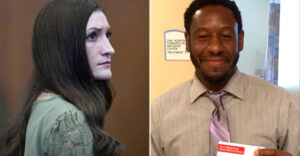
The juror who refused to find Lindsay Clancy not guilty by reason of insanity in Massachusetts, leading to a mistrial, has spoken publicly for the first time, defending his position against those who accused him of refusing to change his mind despite the doubts he had expressed.
During the trial and afterwards, Clancy received a wave of support from feminists across the US, which shocked the public.
Michael P. Desronvil, 48, was the only one of the 12 jurors who courageously refused to agree that Clancy should be found not guilty by reason of insanity for the murder of her three young children. His disagreement led to the jury deadlocking after a six-week trial and placed him at the center of an intense public dispute.
In a statement to NewsNation, Desronvil rejected claims that he had doubts about Clancy’s guilt and then simply refused to back down. ‘I did not have doubts. When I was trying to explain different possible theories during the jury deliberations, I was interrupted as though that meant I had doubts based on the evidence that was available,’ he said. ‘Based on all the evidence, the key witnesses and what the prosecution presented, I believed there was enough evidence that she knew exactly what she was doing and had planned it,’ he added.
It should be recalled that, under US law, a defendant can be convicted or acquitted only if the jurors unanimously believe that their guilt or innocence, respectively, has been established ‘beyond a reasonable doubt’.
The case that shook Massachusetts
Lindsay Clancy, 36, had admitted to killing her three children at her home in Duxbury in 2023 and then attempting to take her own life.
Her defence argued that, at the time of her actions, she was suffering from severe post-partum depression and a mental breakdown, which had been exacerbated by the medication she was taking in an effort to treat her condition. The prosecution, however, argued that Clancy was aware of her actions and that they were the result of planning.
Desronvil was the only juror who rejected the defence’s argument of mental incapacity, meaning that there was no unanimous verdict and a mistrial was declared.
Religion and the juror’s past come under scrutiny
In an effort to discredit Desronvil, the feminist movement has embarked on a ‘safari’ to find anything that could tarnish his integrity. Some argued that he had been influenced by his deeply held Catholic faith, as the prosecution referred during the trial to the concept of ‘mortal sin’ in relation to the killings and suicide. His own brother, however, rejected that interpretation, saying that he did not believe religion had anything to do with his decision.
Desronvil comes from a family of Haitian immigrants who settled in Massachusetts in 1982. He was about four years old when he arrived in the United States. People from his family and social circle described him as a member of an educated and respectable family, while until recently he worked in pest control.
The disclosure of his identity triggered a fresh wave of reactions, followed by reports about previous allegations against him. According to US media reports, he was arrested in 2021 following a complaint over an alleged domestic violence incident, during which he was said to have assaulted his then wife. The charges were ultimately dropped because the woman did not testify, according to reports, due to fears related to child custody. In 2025, he was also accused of assaulting his nephew, leading to a restraining order being issued against him. These reports raised questions about the process for selecting jurors in a trial involving a domestic violence case.
The tension surrounding Desronvil led the judge in the case, William Sullivan, to block the release of the jurors’ names in an effort to limit their exposure. However, according to US media, Desronvil had already left the area with his new wife. An auto repair shop owner who said he knew the family said that his wife had recently visited the shop and requested work on her car. ‘She said there was media madness going on and that they would keep a low profile for a while,’ he said.
Ask me anything
Explore related questions




