





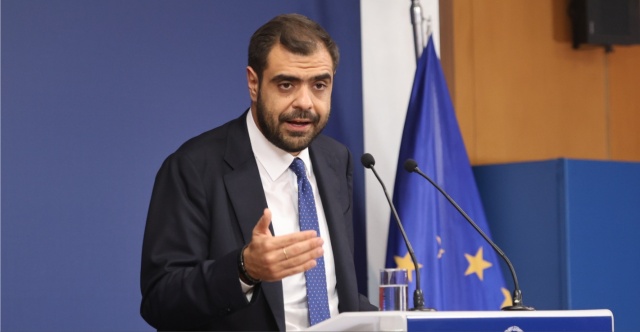
“The Mitsotakis government has done more to manage private debt and support vulnerable borrowers, as well as those who consistently meet their loan obligations, than all previous governments combined over the years, particularly during the crisis. All these measures are the best response to the opposition parties’ vague statements, outdated slogans and, above all, cost-free and uncosted promises,” Deputy Minister to the Prime Minister and Government Spokesperson Pavlos Marinakis said during a briefing for political correspondents, responding to questions about non-performing loans and the parliamentary inquiry committee.
“We were the ones who introduced favourable interest rate calculations, as ruled by the Supreme Court (Areios Pagos), for all borrowers who comply with the arrangements under the Katseli Law. We also made this measure retroactive. We increased the amount protected from seizure to €1,600 for debts owed to the state and banks, providing approximately 1.7 million individuals with an additional €350 in monthly disposable income.
“We legislated for the lifting of bank account freezes, provided that the debtor repays 25% of their outstanding debt. We also introduced the possibility of repaying older debts in 72 instalments.
“We expanded eligibility for the out-of-court debt settlement mechanism by lowering the minimum debt threshold from €10,000 to €5,000, allowing more citizens with smaller debts to benefit. We legislated for the protection of primary residences through an automatic and objective process under the out-of-court debt settlement mechanism.
“We introduced a fair and realistic solution for Swiss franc-denominated loans. We also activated the acquisition and re-leasing body, allowing vulnerable debtors who are unable to make any payments towards their loans to remain in their homes as tenants, with the option of buying them back.”
According to Eurostat, Greece’s private debt-to-GDP ratio stood at 96.6% in 2025, compared with an average of 119.3% across the 27 EU member states. Greece ranks 15th among EU countries when measured in descending order on this indicator.
Since 2018, the ratio of overdue private debt to total private debt has fallen by 14 percentage points, from 70.8% to 56.7% in the first quarter of 2026.
“All these figures reflect the improvement. As regards financial institutions, banks and loan servicers, non-performing loans have fallen from €99.7 billion when we took office to €72.34 billion today,” Marinakis said.
“Even more revealing is the evolution of the ratio of non-performing to performing loans. It has fallen from 101.3% in 2018 to 39.7% today. In 2018, performing and non-performing loans stood at almost the same level. Today, performing loans are more than twice the volume of non-performing loans, while non-performing loans have also fallen significantly in absolute terms. Greece has an average private debt ratio of 96%, I repeat, compared with 119.3% in Europe,” the government spokesperson said.
He also noted that private debt was an extremely important issue and that the government was doing everything possible to give vulnerable borrowers the opportunity to restructure their debts and have another chance, as this was what they wanted and should be able to access through as many available instruments as possible.
However, he stressed that such measures must always respect public finances and those who consistently meet their financial obligations.
“We must not forget this, because a government has a duty to respect and serve society as a whole,” he stressed.
Marinakis on the Turkey-Libya memorandum and Egypt’s intervention at the UN
Referring to reports about the Turkey-Libya maritime memorandum and Egypt’s intervention at the United Nations, Mr Marinakis said:
“From time to time, we see headlines in newspapers and on websites that are not merely misleading, but completely at odds with reality, particularly on foreign policy issues. All these reports disregard Greece’s official actions and distort the content and substance of Egypt’s longstanding positions in this particular case.
“On 22 October 2026, before Egypt submitted its verbal note on 5 November, Greece had already sent a letter to the UN Secretary-General, rejecting the illegal Turkey-Libya memorandum in its entirety and making clear that its purported ratification by the Libyan House of Representatives does not give it any legal validity.
“We subsequently saw all sides vindicate our positions, which are not merely Greece’s positions, but are also dictated by international law of the sea.
“Through its own diplomatic note, Egypt not only refuses to recognise the illegal Turkey-Libya memorandum, but explicitly reaffirms that it considers it null and void and devoid of any legal effect. At the same time, it reiterates its commitment to international law of the sea in the delimitation of maritime zones, reaffirming the complete alignment between Athens and Cairo in rejecting the illegal Turkey-Libya memorandum. This is yet another vindication of our positions.”
What he said about the parliamentary inquiry committee and New Democracy’s ‘present’ vote
Asked about the parliamentary inquiry committee, Mr Marinakis said that the final list of proposed witnesses would be decided by the parliamentary group, its leader and Prime Minister Kyriakos Mitsotakis.
“I do not currently have the final list of proposed witnesses,” he noted, adding:
“I repeat that, for us, this discussion represents a major opportunity. Because, provided that the relevant issues are brought to light, we will ensure, through the people who will be called to testify – the competent officials who have implemented and continue to implement these policies – that the following becomes clear: unlike those who failed to act, or those who took the opposite course, namely the parties behind the slogan ‘no home in the hands of bankers’, parties that have learned to conduct politics solely through outdated slogans but, when in government, implement policies that contradict what they had previously advocated, we have moved from slogans to policies that protect both vulnerable and responsible borrowers.
“We also respect those who consistently meet their obligations. I have outlined a series of measures and presented figures that expose the hollowness of the opposition, particularly on this issue.
“People deserve to see the statistics on non-performing loans, both in absolute terms and comparatively, from the time the Mitsotakis government took office until today, as well as Greece’s figures compared with those of the European Union,” he said.
“Those accusing us, with Mr Tsipras foremost among them, were the ones who proposed this inquiry. And rightly so, Mr Tsipras was the leader of SYRIZA when all these things happened. He subsequently left SYRIZA, various developments followed, and he formed another party – but that is of little relevance to the answer, so I will not elaborate.
“They were the ones who transferred loans to funds, legislated for and initiated the first securitisations, abolished primary residence protection and introduced electronic auctions. All these things happened under Alexis Tsipras and SYRIZA,” he said.
Explaining New Democracy’s decision to vote ‘present’, he said:
“An inquiry committee can be established by the parliamentary minority from 2019 onwards, following the constitutional changes we introduced, which were also approved by MPs from other parties and incorporated into the Constitution.
“Let us not forget that. Previous governments, which portrayed themselves as more democratic than us – the supposedly bad government and regime, as they call us – had not granted the parliamentary minority this possibility.
“Under this so-called ‘authoritarian government’, the minority has rightly been given the ability to establish an inquiry committee. And this will be the second such committee.
“Why did we vote ‘present’? Because the parliamentary minority can initiate up to two inquiry committees. Had we voted ‘yes’, we would have been accused – as we have been accused of everything and its opposite – of deliberately depriving the opposition, as the minority, of the opportunity to launch another inquiry into any other matter.
“We therefore voted ‘present’, making clear that we will participate and seek to provide as much information as possible to shed light on this very important and serious issue. We welcome the proposal and the debate surrounding it.”
Ask me anything
Explore related questions




