





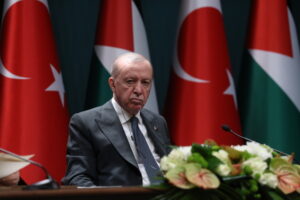
Turkey’s position in an international environment that, as he argues, is undergoing radical change was outlined by Recep Tayyip Erdogan in an interview with Newsweek, in which he referred, among other things, to Ankara’s relations with NATO, Russia, the US, Iran, as well as the defence agreement between Greece and Israel.
The Turkish president argued, among other things, that Turkey should not be forced to choose between the West and the East, stressing that Ankara will continue to maintain its position in NATO while simultaneously strengthening its relations with countries such as China and organisations outside the Western framework.
“We do not believe it is right to impose on Turkey a choice between ‘West or East’,” he said characteristically.
The Greece–Israel defence agreement
At the same time, he stressed that Turkey is closely monitoring actions that could endanger the country’s national security, rights and interests, commenting on the defence agreement between Greece and Israel.
“The relationships that Greece or any other country develops with third countries are a matter of their own choice. Turkey does not consider every bilateral relationship to be a threat directed against it,” he said. However, he added that Ankara is closely monitoring actions which, as he said, could endanger “its national security, legitimate rights and interests”.
Referring to the Eastern Mediterranean as a whole, the Turkish president argued that security in the region should be based on an approach that reduces tensions and strengthens cooperation.
Regarding Israel, he rejected the view that conflict between the two countries is inevitable. At the same time, he reacted to the Israeli perspective that presents Turkey as the next potential threat after Iran, while stating that Ankara will closely monitor actions that affect its security.
‘Risk of the Russia–Ukraine war spreading’
Erdogan defended Turkey’s ability to maintain open channels of communication both with the West and with countries that are in confrontation with it. “The United States is our ally in NATO. Iran is our neighbour,” he said, noting that Ankara seeks to use its contacts to de-escalate crises.
Regarding the war in Ukraine, he stressed that he sees no contradiction in the fact that Turkey is a NATO member while maintaining direct communication with Vladimir Putin. “To mediate, you have to be able to speak with both sides of a conflict,” he said.
He also added: “We are not ignoring the risk of the Russia–Ukraine war spreading to a wider region,” as he put it, noting that sabotage and hybrid activities in Europe are also increasing the fragility of the current security environment.
The new defence pact with Saudi Arabia and Pakistan
The Turkish president also referred to Turkey’s new defence agreement with Saudi Arabia and Pakistan, arguing that it is not an alliance against any particular country.
As he said, the agreement provides that an armed attack against any one of the three states will be considered an attack against all of them. According to Erdogan, support may include intelligence sharing, logistical assistance and ammunition, while in the event of a serious threat, “more advanced military support” could also be considered.
‘The center of gravity of the world is shifting’
Recep Tayyip Erdogan reiterated that the global center of power is shifting and that new centers of influence are emerging.
“The center of gravity of the world is shifting,” he said, while also calling for reform of the UN Security Council so that, as he put it, it better reflects the new balance of power. At the same time, he stressed that Turkey’s geographical position between Europe, Asia and the Middle East is an advantage rather than a problem.
“Turkey will continue on its course as a strong country that acts according to its own will, strengthens stability in its region, has a voice and assumes responsibility in global affairs,” he said.
Ask me anything
Explore related questions




