





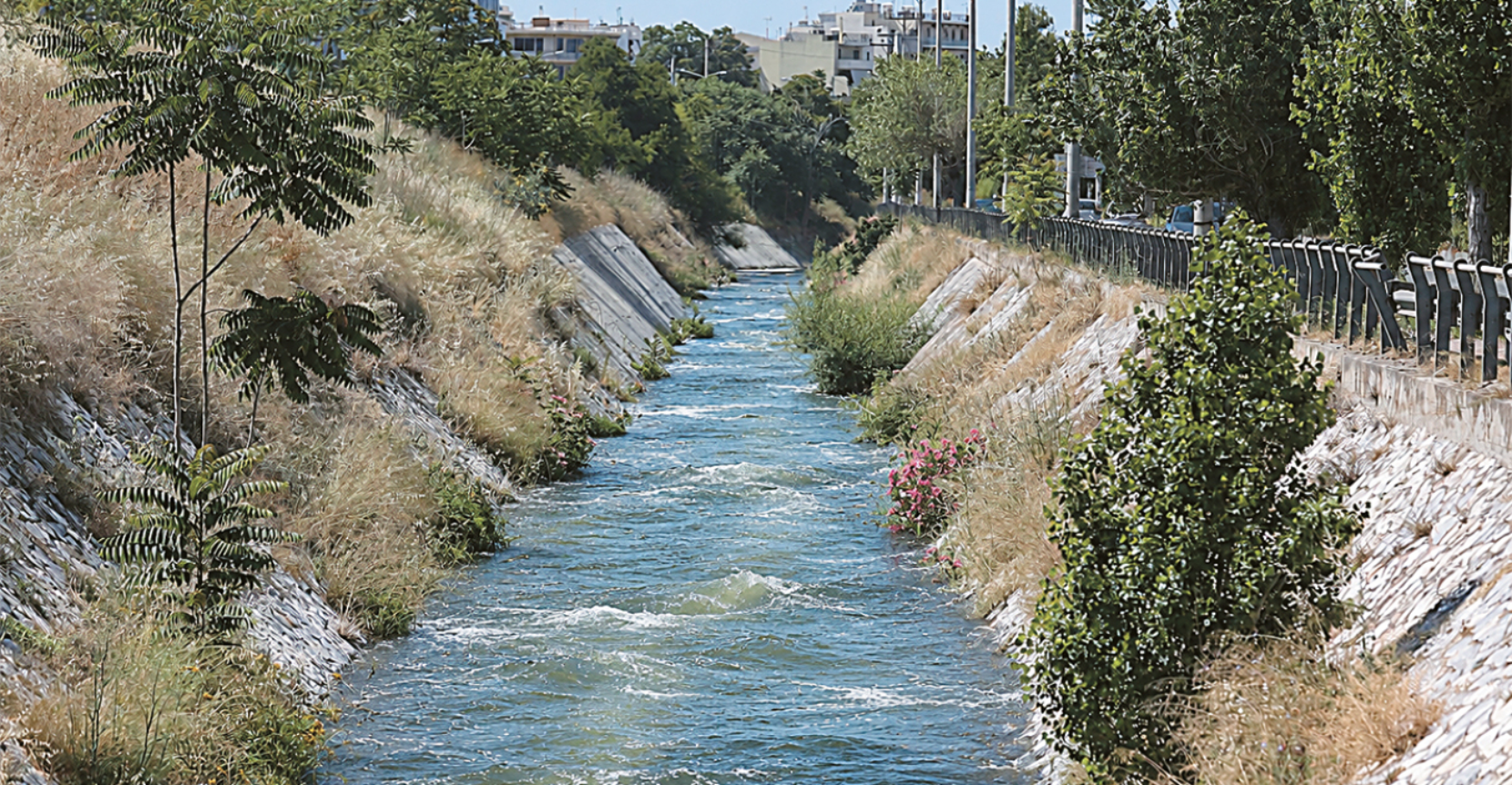
Tons of hazardous waste, including extremely toxic substances such as phosphorus, end up every year in the Kifisos River. The case involving the discharge of industrial wastewater from the Papadopoulou biscuit factory earlier this week has once again brought to the surface the enormous problem of the degradation of the country’s rivers, which are treated as “conduits” through which huge volumes of wastewater eventually disappear into the sea or groundwater, without those producing it bearing the cost of managing it.
Scientific studies, including those by the General Directorate for Water and the Hellenic Centre for Marine Research (HCMR), describe a terrifying situation in the country’s rivers due to pollution.
In the Kifisos, nitrogen and phosphorus, among other pollutants, are present, while pollution in the Pineios persists due to the enormous quantities of agrochemicals, pesticides and urban waste carried by “Daniel”. In the Axios, Aliakmonas and elsewhere, increased concentrations of herbicides and insecticides, as well as nitrate pollution, have also been detected.
Research on the Kifisos
Research by scientists on the Kifisos shows that electrical conductivity and pH readings are reaching “red” levels. pH indicates acidity, such as that caused by the illegal discharge of industrial acids, while conductivity indicates the presence of dissolved salts and chemicals.
Meanwhile, dissolved oxygen (the most critical indicator of life) reaches zero whenever COD and nitrogen peak after rainfall. When it falls to zero, fish die from suffocation. COD and nitrogen indicate urban wastewater and chemical waste. In short, the Kifisos changed composition and filled with dead fish every time it rained.
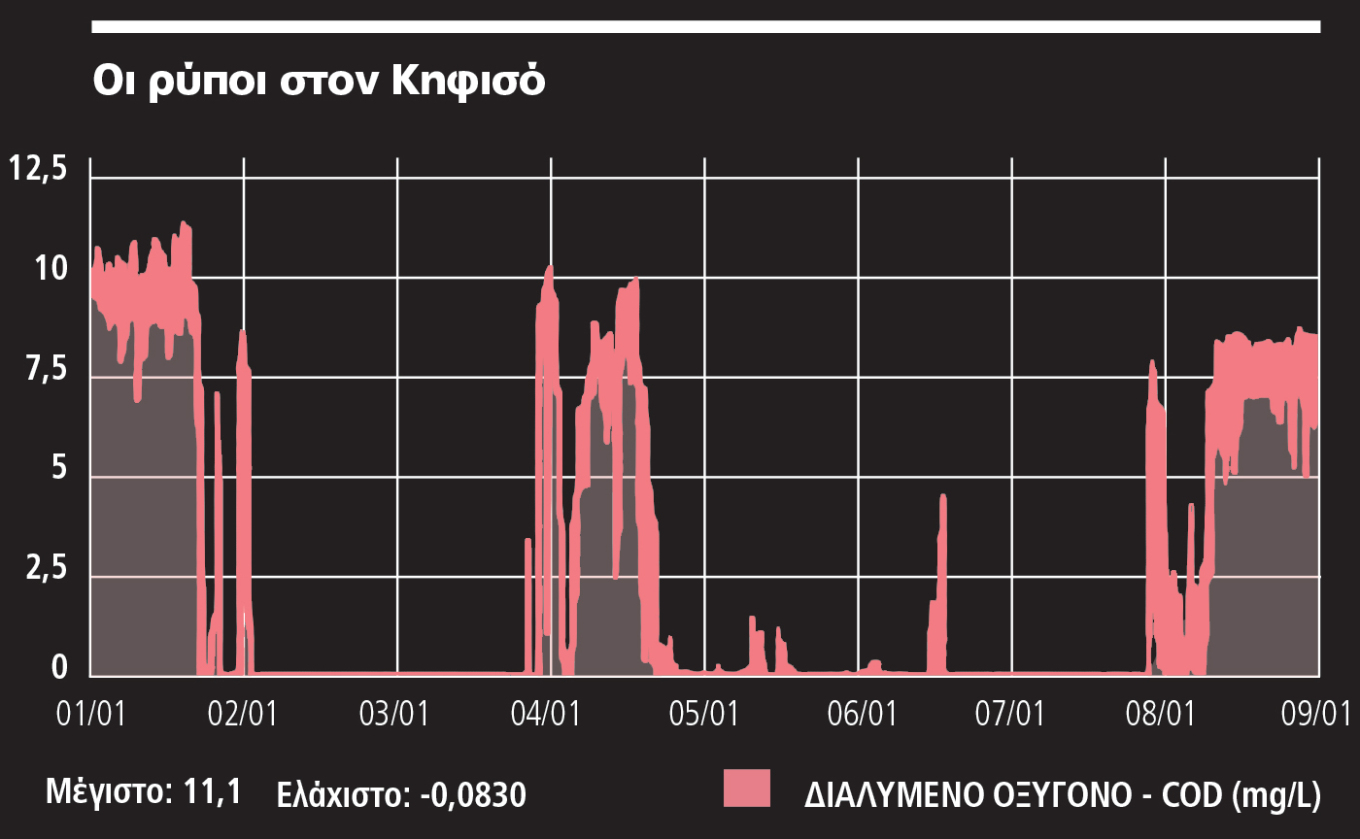
Sharp fluctuations in dissolved oxygen (COD) levels in the Kifisos’ water bodies. When COD and nitrogen reach zero, fish die from suffocation.
The Institute of Marine Biological Resources of HCMR carried out monthly sampling from April 2021 to October 2022 at five stations, from the river’s sources to its mouth.
The result: water quality in terms of nitrates is officially classified as “poor” under the European Water Framework Directive, while ammonium levels range from moderate to poor. Nitrate concentrations ranged from 1.7 to 18.7 mg/L, with an average of 7.6. The peak was recorded at the Podoniftis station, with an average of 9.5 mg/L compared with 6.2 in the upper section of the river. Dissolved oxygen fell to as low as 3.6 mg/L.
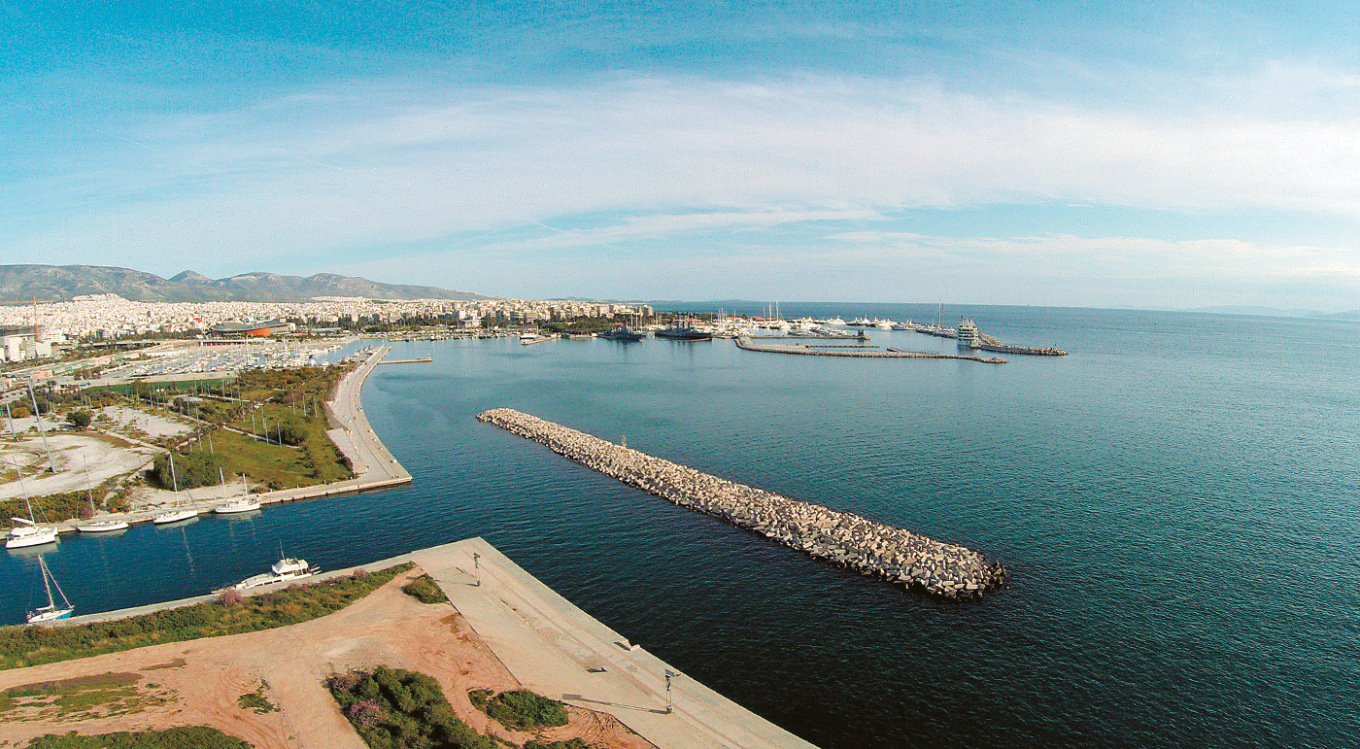
The Kifisos estuary at Faliro. All pollutants end up in the Saronic Gulf.
Live Monitoring
The HCMR scientists did not stop at those measurements. Instead, they installed state-of-the-art digital stations at two points along the Kifisos (and other rivers across the country), receiving live data that is updated every hour. The stations of HCMR’s Hydro Stations network operate as “digital eyes” on the river.
Specialised digital sensors are submerged in the water and take measurements every 30 or 60 minutes. The data is automatically transmitted, via the mobile phone network, to HCMR’s central facilities. From there, it is uploaded in real time to an open platform for the public and relevant authorities.
At key locations, such as Kokkinos Milos, the system has a mechanism that automatically collects a physical water sample when a sudden change is detected, such as an abrupt pollution event, so that it can be analysed in the laboratory. In addition to the equipment, HCMR scientists examine macroinvertebrates, small insects and larvae that live on the riverbed.
Because chemicals can quickly be carried away by the flow, these organisms act as a “living memory”: if the water is frequently polluted, only highly resilient species capable of surviving without oxygen remain. In the Kifisos, therefore, the results are disappointing.
Researchers note that the highest concentrations of pollutants occur during the summer due to low flow rates and explicitly refer to uncontrolled discharges of industrial waste, urban wastewater, and damage or leaks in the sewage network.
Elias Dimitriou, an HCMR researcher specialising in inland waters, described an urban river that has been degraded for decades, with water quality below good, usually moderate and often poor. He added that some people discharge wastewater either at night or through manholes, something that is particularly well known in the open section at Kokkinos Milos.
Pollution as Part of Everyday Life
Those who frequently pass by the Kifisos, and especially those who live alongside the river, do not need studies to understand what is happening. Chrysanthi Georgiou, president of the “Roi” Citizens’ Association for the Protection of Streams, described a characteristic scene she recorded in Nea Filadelfeia. Fish desperately approach the edges of the riverbank, where the heavy pollution has not yet “reached” the water, and gradually die.
As she explains, the river carries soaps and changes colour. The volume of water increases twentyfold within an hour, and this cannot be caused by “a small-scale activity”. Pollution, she says, is not a rare occurrence but part of everyday life, and has intensified over the past five to six years. She also points out that the danger does not stop with the fish.
The river, she explains, releases pollutants into the atmosphere, pollution passes into the groundwater and the food chain, and residents are forced to live beside a “moving cesspit”. Dimosthenis Sarigiannis, professor of Environmental Engineering at the Aristotle University of Thessaloniki, points out that the Kifisos is already burdened with increased concentrations of metals such as lead, arsenic, mercury and nickel, with a documented risk to groundwater and public health.
The association files complaints once or twice a month, always accompanied by photographs and videos. Inspections, Ms. Georgiou says, are always carried out after the fact, demonstrating the usually slow response of the state apparatus. A team arrives two or three days later, when the waste has already been washed out towards the sea. The process has become routine: complaint, registration number, a response stating that “recommendations were made”, and filing.
The Shocking Study in the Hands of the Ministry
Government agencies that designed interventions found that the problem was enormous. The picture reached by the Ministry of Environment itself is alarming: the most recent Strategic Environmental Impact Assessment of the second revision of the Attica River Basin Management Plan (the latest available data dates from June 2023) assesses 15 river water bodies. Only four are found to be in good overall condition. Eight are in moderate condition, one, the Rafina stream, is in poor condition, while data for two are insufficient.
Even more alarming are the findings of scientists regarding the subsoil and groundwater: the Kifisos basin’s groundwater body is in poor chemical condition, with exceedances in nitrates, chlorides, sulphates and metals. Why?
It appears that the illegal loads discharged into water bodies and ultimately mixing with the waters of Attica are enormous. The River Basin Management Plan estimates them at approximately 4,839 tonnes of biochemical oxygen demand (BOD), 5,643 tonnes of nitrogen and 1,204 tonnes of phosphorus per year.
The most shocking aspect, of course, is who produces them, since no one can seriously believe that pollutants… fall from the sky. Point sources, meaning specific discharge points such as industrial facilities, treatment plants and pipelines, are responsible for 4,869 of the 5,643 tonnes of nitrogen and 1,005 of the 1,204 tonnes of phosphorus.
As polluters, researchers and activists point to industries producing huge volumes of waste, which they are required to send to treatment facilities. They also point to tanker trucks that “never make it” to legal waste treatment facilities, but instead connect illegally to pipelines.
Septic Tanks and Other Wastewater
But it is not only industry. The second front of pollution is quieter but more widespread: wastewater from people’s own homes. Here, the Kifisos, Asopos and other rivers have far less to say than the streams, groundwater and stormwater drainage pipes of eastern Attica, which… are groaning under the strain.
Illegal connections to stormwater drainage pipes or the discharge of wastewater even onto roads, particularly on rainy days, as well as the systematic disposal of washing-machine water onto the streets, are part of the picture across much of eastern Attica, since, with the exception of small sections, the sewage network ends at Stavros in Agia Paraskevi.
The cost of emptying a septic tank, which for a detached house amounts to €110 per month, while a 10-apartment building needs to have its tank emptied every week, meaning a cost of at least €440, explains this behaviour.
The Ministry’s own study provides a picture of the result. The Rafina stream, in the section known as “Rafina 3”, is the only river water body in Attica classified as being in poor ecological condition, while the other two sections of the stream are in moderate condition.
HCMR and other agencies, through their measurements and reports, repeatedly identify the same combination of pollutants: industrial waste, urban wastewater and network malfunctions. And yet, although a sewage network should have existed since the early 2000s, construction is now under way on a sewage network that will serve approximately 400,000 residents.
The Asopos Crime
There are times when scientists and inspection authorities, who are trying to identify and stop polluters while also saving the country’s water bodies and subsoil, feel as though they are fighting the Hydra of Lerna. The case of the Asopos is characteristic: the river was polluted by industrial activity with hexavalent chromium, which is carcinogenic to humans.
The “alarm” over the river that runs through Boeotia and borders Attica was raised when scientists were trying to understand why there was an “explosion” in cancer cases in certain areas through which it passed.
Hexavalent chromium, which is carcinogenic to humans, was the main pollutant blamed for cancer “ravaging” the population of Boeotia.
The pollution was attributed largely to a significant number of the approximately 400 industries operating in the area at the time and producing chromium-containing waste. They either discharged it uncontrollably into the river, through direct dumping or pipelines that did the “job”, or “disposed” of it by burying barrels containing the waste in the soil, eventually contaminating the groundwater. The numerical data from inspections by the authorities were shocking.
While a 2010 Joint Ministerial Decision set the maximum permitted level of hexavalent chromium in wastewater at 30 micrograms per litre, in March 2013, 3,500 micrograms per litre were measured in the pipeline at the Mailis location as part of the Life Charm programme, with the assistance of the National Technical University of Athens. That is more than 115 times the permitted level!
The human dimension was captured in an epidemiological study presented in 2010 on behalf of KEELPNO, coordinated by the University of Athens and led scientifically by Professor Athina Linou. It covered mortality among residents of the then Municipality of Oinofyta, approximately 5,842 people, during the period 1999–2009.
Of the 474 deaths, 118 were caused by cancer, and mortality from this cause was 14% higher than among the rest of the population of Boeotia. Most alarming was the type of cancer. Liver cancer occurred at a rate 1,472% higher than in the rest of Boeotia, while urinary tract cancer among women was 841% higher.
From 2007 onwards, following reports and complaints, prosecutorial authorities intervened, with preliminary investigations and supervision by appellate and first-instance prosecutors. This led to years of judicial and prosecutorial action, most notably criminal prosecutions and proposals for the conviction of major industrialists, as well as preliminary investigations conducted under prosecutorial supervision. Joint Ministerial Decisions were also issued establishing stricter pollutant limits.
Local industries complied and no longer use hexavalent chromium in their production. Indeed, a four-year study by the University of Athens’ Laboratory of Analytical Chemistry, commissioned by the Region of Attica, showed in 2020 that levels of chromium and hexavalent chromium had declined.
The same study, however, identified new pollutants from pharmaceuticals and pesticides, which were more pronounced at the station on the Attica-Boeotia border. Chromium declined, but other substances took its place.
The harshest chapter of the same story was written in 2023, when a 2020 University of Athens study on the Asopos came to light. It focused on per- and polyfluoroalkyl substances, PFAS, known as “forever chemicals”, as they have come to be called.
These are pollutants that spread through the environment but literally never break down, even after thousands of years. During the summer months, the average concentration of eight PFAS substances in the river’s surface waters reached 321 ng/L, more than three times the threshold that the study’s scientific advisers define as indicating a pollution hotspot. The most revealing detail concerns the calendar.
PFAS levels in the river fall on Sundays, when the factories in Oinofyta are closed. The university report itself explains this through “cycles of industrial activity/discharges”. Traces of PFAS were also detected in sediments, the underground aquifer and a drinking-water source in the area.
The problem, therefore, does not belong to the past. What the data show, from the 3,500 micrograms measured in 2013 to the current PFAS measurements, is that there are still those who use the river as a dumping ground, without restraint and without remorse. Even if the substances have changed. Diseases associated with high concentrations of these substances are estimated to cost European healthcare systems between €52 billion and €84 billion a year.
The Other Rivers
Monitoring of the Kifisos is based on a combined approach by HCMR, involving automatic telemetry stations for the immediate recording of physicochemical parameters and seasonal biological sampling, which reveals long-term degradation. Scientists follow the same strategy for other rivers, with findings that are often even more shocking than those recorded for Attica’s largest river.
As far as dissolved oxygen is concerned, in the Alfeios, over the past month, one station (Erymanthos 1) has consistently recorded zero values (!), while the second (Aspraspitia) recorded zero on August 27 and on September 3, 16 and 21. On the Aliakmonas, the one station providing data records zero values roughly every week, while on the Arachthos, one of the three stations shows a positive reading only 10 times from August 26 to the present.
The Tanker Truck Is Emptying
The most shocking data, however, comes from HCMR’s real-time Hydro Stations platforms, where electrical conductivity is measured — that is, how easily electric current passes through water, revealing the presence of salts and dissolved ions. When the platform turns red, it means the system has entered an alert level, indicating that large quantities of foreign substances, such as industrial waste, chemicals, acids or heavy metals, have entered the river.
In other words, at that moment the river is undergoing severe environmental stress, either because a pipeline or tanker truck is discharging urban wastewater or untreated waste containing high levels of salts and chlorides into it, or because the water level is falling and the amount of clean water is decreasing. As a result, the remaining waste is not diluted, pollutant concentrations soar, and conductivity rises with them.
Over the past year, this phenomenon has been recorded in the Aliakmonas, Alfeios, Aoos, Arachthos, Kalamas and Kifisos, but even in the Lithaios, which runs through Trikala, including the section at Theopetra. The Louros and Lousios are in an almost… constant state of alarm, while pollution incidents are frequently recorded in the Pineios and Spercheios.
The Evros River and Agios Germanos in Prespes are cleaner, something that is not observed in Florina’s Sakoulevas, the Acheloos or the Evrotas. The Pikrodafni stream in Attica is frequently placed on alert, while pollution incidents have also been recorded in the Pamisos rivers of Messinia and Kalymnos.
PHOTOS: EUROKINISSI
Ask me anything
Explore related questions




