





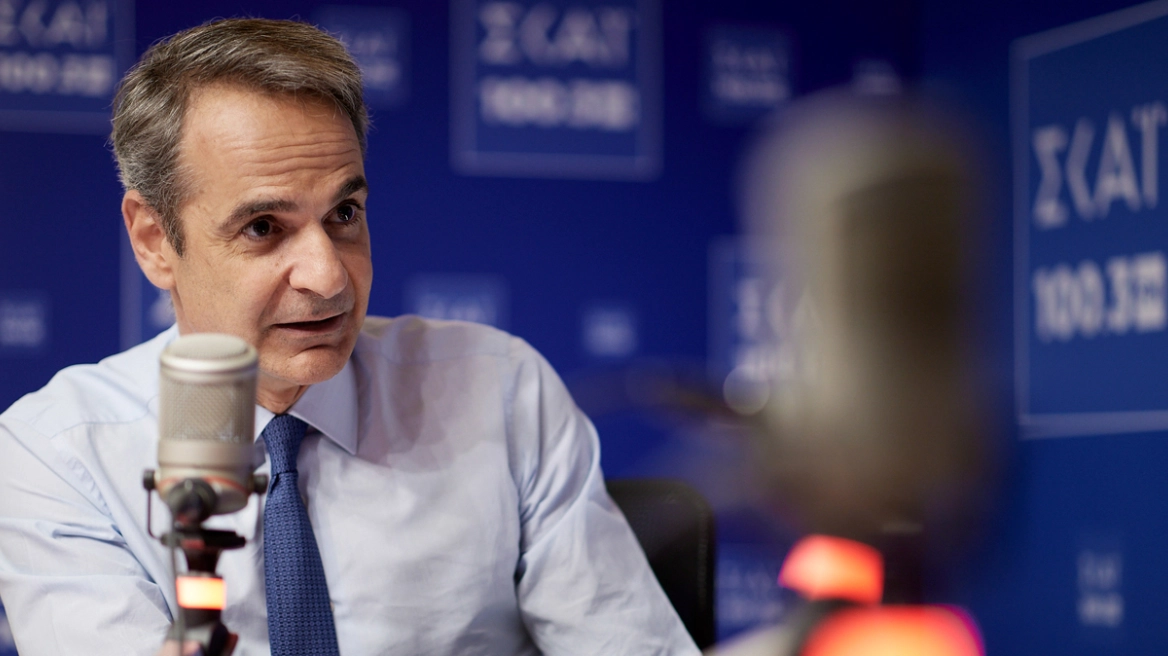
Kyriakos Mitsotakis sent a clear message that the Greece-Cyprus electricity interconnection can move forward without any concessions on Greek sovereign rights, while also highlighting the importance Athens attaches to U.S. support for the project following Marco Rubio’s visit.
Speaking to SKAI 100.3, the prime minister declined to reveal details about the operational aspects of the cable project, while insisting that a way forward for its implementation exists.
“I don’t want to revisit any operational details on this issue because it is very sensitive. I do believe, however, that there is a framework within which the cable can and must move forward without making absolutely any concessions on our sovereign rights,” he stressed.
Kyriakos Mitsotakis placed particular emphasis on Washington’s position, noting that the United States supports interconnection projects, with this particular cable potentially being extended as far as Israel.
“This project is no longer a Greek-Cypriot project; it is a European project,” he stressed, clarifying at the same time that the survey carried out off Kasos concerned activity exclusively within territorial waters.
“Rubio’s visit to Athens left a positive impression”
Assessing the visit by U.S. Secretary of State Marco Rubio, Mr. Mitsotakis emphasized not only what had been agreed but also the symbolism of Rubio’s presence in Athens.
“Mr. Rubio does not often travel abroad to participate in this kind of dialogue,” he observed, recalling that the visit took place within the framework of the institutionalized Greece-United States Strategic Dialogue.
According to Kyriakos Mitsotakis, the visit confirmed the excellent state of bilateral relations, which now extend beyond the traditional sphere of defense into energy, interconnections and investment.
“Undoubtedly, the visit left a positive impression,” he said, noting that Marco Rubio had highlighted Greece’s role as an indispensable strategic partner of the United States in a region experiencing intense geopolitical turmoil.
He also made particular reference to the imagery surrounding the visit, with the U.S. Secretary of State speaking on the Pnyx, with the Acropolis in the background.
“Images often speak for themselves,” he remarked, linking the powerful symbolism to the international exposure generated by the visit and the reaffirmation of close defense cooperation.
Asked whether Marco Rubio might run for the U.S. presidency in the future, he avoided making any predictions, describing it as a personal decision for the American politician. He nevertheless praised the personal relationship between the two foreign ministers and the preparations for the visit carried out by Giorgos Gerapetritis and his team.
“The strategic relationship is with the State of Israel, not its current government”
Responding to criticism of Athens’ relations with Israel, Kyriakos Mitsotakis made clear that Greece’s strategic choice is not tied to whichever Israeli government happens to be in office.
“Greece’s strategic relationship is with the State of Israel,” he stressed, highlighting the multiple benefits the cooperation brings to the country.
As a characteristic example, he cited the “Achilles’ Shield” project and cooperation on the development of advanced defense capabilities.
“Do you think the Israelis sell it to many countries?” he asked, referring to the defense system and the provision of its source code for further development.
The prime minister was quick to stress, however, that strategic cooperation with Israel has not come at the expense of Greece’s strong relations with the Arab world and the Palestinians.
He also made clear that Athens does not hesitate to criticize Israel when it considers that its actions are inconsistent with Greek principles and values.
His message was that Greece seeks to maintain strong strategic alliances without allowing them to limit its ability to express independent positions on the region’s major issues.
On Tsipras and the F-35s: “He doesn’t know the basics”
“I was very surprised that someone who served as prime minister of the country and wants to return to office does not know the basics,” he said, responding to Alexis Tsipras’s remarks on defense procurement and the possibility of Turkey acquiring American fighter jets.
The prime minister recalled that Greece has already joined the F-35 program, with the first aircraft expected in 2029–2030. Training for Greek pilots will begin soon, while major investments at the Andravida air base are also being planned.
He contrasted Greece’s progress with Turkey’s position, noting that Ankara remains outside the program.
“For Mr. Tsipras to take it for granted that Turkey will get the F-35s, when even the Turks themselves are not saying that, surprises me greatly,” he commented.
“Would they grab Trump by the lapels?”
Kyriakos Mitsotakis raised the rhetoric another notch, challenging the former prime minister to clarify his own position on the possibility of the fighter jets being sold to Ankara.
“Do you remember any statement by Mr. Tsipras opposing the United States’ decision to sell F-35s to Turkey? I don’t,” he said.
At the same time, he made clear that Greece cannot dictate to Washington which countries it should supply with its advanced weapons systems.
He then resorted to humor to pre-empt accusations that he might be showing weakness or making concessions.
“I imagine they would be the very same people who would storm the White House and grab Mr. Trump by the lapels to tell him, ‘Don’t give them the F-35s,’” he remarked sarcastically.
Behind the political confrontation, however, the prime minister wanted to emphasize that the country’s own strength is the real guarantee of its security.
“No one can guarantee us anything if we ourselves do not first feel strong and actually are strong,” he stressed.
The “breeze” in the Aegean and the pointed remark aimed at Samaras
Turning to Greek-Turkish relations, Kyriakos Mitsotakis used a nautical metaphor to describe the current situation.
“There’s a breeze on the waters of the Aegean, a light swell,” he said, observing that relations between Greece and Turkey go through periods of calm as well as spells of greater tension.
Asked about the possibility of another meeting with Recep Tayyip Erdoğan, he said that nothing was currently scheduled, while making clear that he would continue to seek open channels of communication.
His reference to the Athens Declaration was also of particular political significance and could be read as an indirect response to criticism from Antonis Samaras.
“Many people have rushed to denounce the Athens Declaration,” he observed, defending one of its key achievements: the establishment of stable channels of dialogue and political contact between the two countries.
He explained that the value of such communication becomes apparent precisely when difficulties arise, since it allows the two sides to pick up the phone before tensions spiral out of control.
“I don’t think either side is seeking tension at this moment,” he added.
“They are waiting for us to stumble”
The prime minister also took a swipe at the attitude of his political opponents, accusing them of banking on potential government failures.
“Sometimes those who want to criticize us are waiting for us to stumble,” he said, advising his critics to be patient.
“Why should I call an election?”
“The only reason to go to the polls would be if it were politically convenient for me. Let’s have this discussion again when the government’s term expires.
“Because winter will be difficult, we need a stable government. It would be completely wrong for the country to send a message of weakness by having a government with a strong parliamentary majority call an election simply because it suited its political interests.
“That is not my way of doing things. I could have done it in 2023 as well. I do not understand politics that way. We cannot talk about stability and then call an election ourselves.
“I see no major national reason for going to the polls. And suppose we hold an election and win it — would I be able to deliver more? What are elections, a mechanism for filling up the piggy bank?”
“No arrogant behavior is acceptable”
“Can you name a government that has never been accused of arrogance at some point? I don’t see it to the extent that some people claim, and I am the first to send the message that no arrogant behavior is acceptable,” Mr. Mitsotakis also said.
“I think there may be exceptions here and there, but I don’t see such signs among ministers or the parliamentary group, because society itself does not tolerate them.
“The first person to be punished for such behavior will be the person who engages in it, because citizens today expect an ethos and a manner that are incompatible with the attitude that we are irreplaceable.”
Asked whether he was considering a cabinet reshuffle, the prime minister gave a categorical, one-word answer: “No.”
His response to those who say New Democracy has lost its soul
“Ten years and a little more ago, I took over a New Democracy that was badly wounded. It had suffered electoral defeats, was barely reaching 30%, and gave the impression that it could not return as a party capable of governing.
“To those who wonder whether we are losing our soul or our DNA, I would say: look back at what Konstantinos Karamanlis did. Wasn’t that what brought Konstantinos Mitsotakis into the picture? Wasn’t the Center Union the Right’s great enemy?
“If we want to be a major political force, we have to broaden our appeal and agree on most things.”
Asked about the former party leaders who were absent from New Democracy’s 52nd anniversary celebrations, he said:
“Mr. Meimarakis called me and told me he had an important commitment in Brussels.
“The battle is always fought by those who show up. We face a difficult electoral contest, but our strategy is for a New Democracy that is economically liberal while also treating national issues seriously, that is socially sensitive, that represents pensioners and small-business owners, and that reaches out to every Greek citizen as part of the plan we have outlined.”
Ask me anything
Explore related questions




