





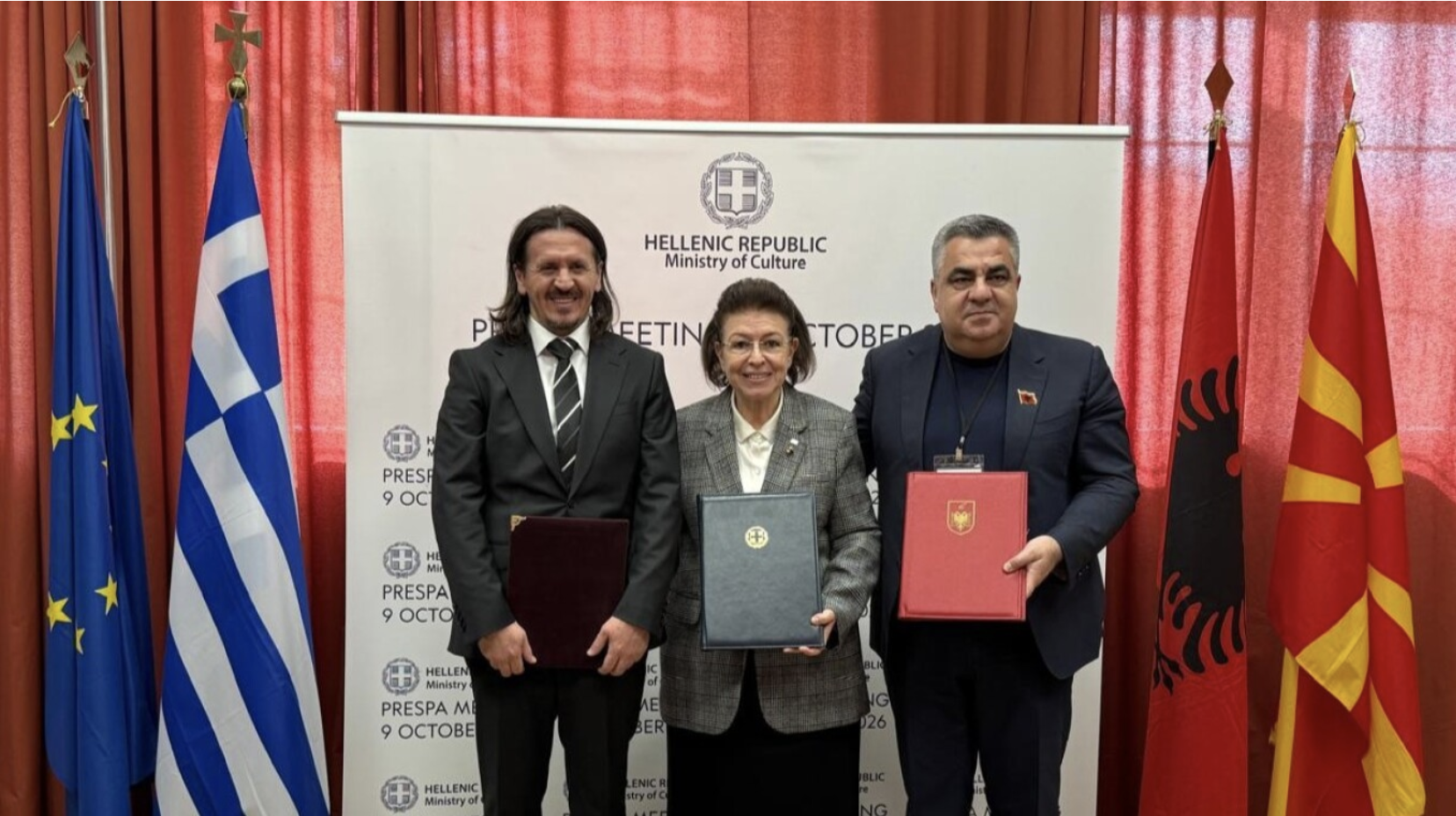
The Prespa Lakes are building a bridge of cooperation between Greece, Albania and North Macedonia, which will work together to protect the region and secure its inscription on the UNESCO World Heritage List as a Mixed World Heritage Property.
Greek Minister of Culture Lina Mendoni, Albania’s Minister of Tourism, Culture and Sports Blendi Gonxhja, and North Macedonia’s Minister of Culture and Tourism Sedat Sulejmani held a trilateral meeting at the Prespa Municipality Hall in Laimos, at the initiative of Greece’s Ministry of Culture. Representatives of UNESCO, the United Nations Development Programme (UNDP), the European External Action Service (EEAS) and the European Commission were also present. The three ministers signed an agreement to explore cross-border cooperation to protect the region’s unique and exceptionally valuable cultural and natural environment.
The trilateral meeting marks the first political expression of the three countries’ shared determination to work together on a joint effort to secure the transnational inscription of the Prespa region on the UNESCO World Heritage List as a Mixed Property. The ministers agreed to proceed with the necessary preparations for a joint nomination, working together on the required scientific, technical and institutional tasks in accordance with the procedures and requirements of the UNESCO World Heritage Convention.
In their joint statement, the ministers acknowledged that the Prespa region is a unique natural and cultural landscape of exceptional value, forming an interconnected whole whose significance extends beyond the regional level. They expressed their conviction that the joint effort to protect and secure recognition for Prespa could provide a meaningful example of constructive regional cooperation, demonstrating the role that shared cultural and natural heritage can play as a bridge between neighbouring countries and peoples.
The initiative marks the beginning of a long-term joint effort to secure international recognition of Prespa’s natural and cultural value and establish the region as a model of cross-border cooperation in conservation, sustainable management and the promotion of the area, for the benefit of local communities and future generations.
Greek Minister of Culture Lina Mendoni said:
“Prespa is a place of unique cultural and natural value, a place that is not divided by borders but unites three countries and three peoples. That is why the joint nomination by Greece, North Macedonia and Albania to inscribe Prespa on the UNESCO World Heritage List as a Mixed Property is an initiative of Greece with particular symbolic significance and substantive importance.
“The joint inscription of Prespa on the UNESCO list demonstrates in practice that borders can become meeting points and spaces for cooperation, and that natural and cultural heritage can serve as a bridge between peoples. Greece is ready to work consistently, continuously and decisively with its two neighbouring countries so that Prespa can become an international example of shared protection, sustainable development and peaceful cooperation.”
North Macedonia’s Minister of Culture and Tourism, Sedat Sulejmani, noted:
“Geographically and historically, Prespa has always been a single entity, even though its shores are divided among three neighbouring countries. Lake Prespa, with its unique natural environment, biodiversity and rich cultural heritage, makes the region exceptionally valuable and calls for coordinated cooperation.
“The nomination of the Prespa region for inscription on the UNESCO World Heritage List as a mixed natural and cultural site is aimed not only at securing international recognition, but also at ensuring long-term and sustainable management that will benefit local communities, turning Prespa into an enduring bridge of friendship and cooperation between the three countries.”
For his part, Albania’s Minister of Tourism, Culture and Sports, Blendi Gonxhja, said:
“Prespa unites us through its nature, history and culture. Our shared ambition is to safeguard this heritage, create more opportunities for local communities and promote sustainable tourism.
“The European Union will provide €2 million to fund the preparation of the study for this nomination. On the Albanian side, the restoration of the frescoes and the installation of lighting at the Church of the Virgin Mary on Maligrad Island, as well as the Sterjo Spasse House Museum in Gollomboç, have enriched the area’s cultural and tourism offerings.
“We also aim to develop joint tourist routes, research missions and exploration initiatives to showcase Prespa and Ohrid, alongside artistic, sporting and youth exchanges with our neighbours.”
The Prespa region has been on Greece’s Tentative List since 2003. When the list was revised in 2014, the region was included again as a mixed nomination under the title “The Area of the Prespa Lakes: Megali and Mikri Prespa which includes Byzantine and post-Byzantine monuments.”
The proposal concerns the Prespa National Park in Florina, covering approximately 327 square kilometres. The park forms part of the transboundary Prespa Park and includes the Mikri and Megali Prespa lakes, their basin and the surrounding mountain ecosystems.
To advance the joint transnational nomination, the three countries plan to establish a trilateral working group, include the joint nomination on their respective national Tentative Lists and submit a request for a Preliminary Assessment in 2027. This assessment will be carried out by ICOMOS (the International Council on Monuments and Sites) and the IUCN (the International Union for Conservation of Nature).
During 2028–2029, the full nomination dossier will be prepared, including supporting documentation, maps, a management plan and details of consultations with stakeholders. Final submission is scheduled for 2030.
The final dossier will then be assessed, followed by an on-site visit by the ICOMOS/IUCN advisory bodies during 2030–2031. The nomination is expected to be examined by the World Heritage Committee in 2031.
The Prespa region has a long history of human settlement, dating back to the Late Neolithic and the Bronze Age. Significant remains from the Hellenistic and Roman periods, including the ancient city of Lyke on the islet of Agios Achilleios, testify to its long historical continuity.
During the Byzantine and post-Byzantine periods, the region developed into an important religious and administrative centre, with the establishment of the Archbishopric of Ohrid. Today, more than 40 churches and monuments remain, distinguished by their architectural, artistic and historical significance, alongside important hermitages and rock paintings along the lakeshores.
Ask me anything
Explore related questions




