





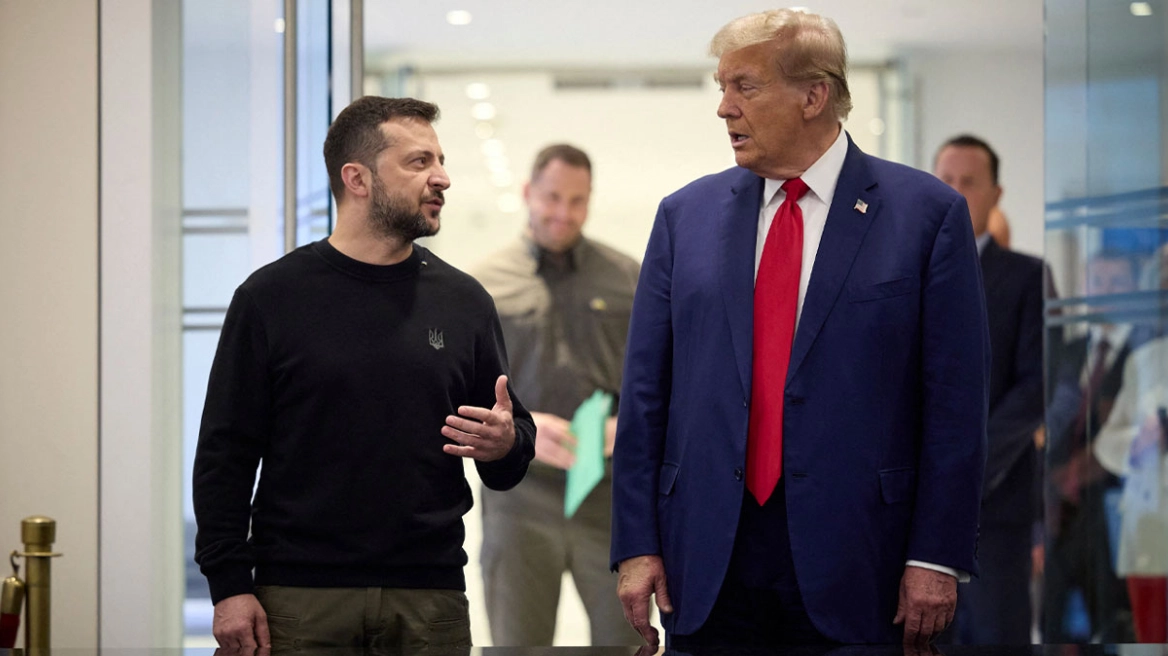
The energy truce announced by Donald Trump yesterday, Sunday, was tested and disproved on the ground before even 24 hours had passed. New Russian attacks on Ukrainian energy facilities gave Volodymyr Zelensky an opportunity to raise a question publicly that now directly concerns Washington: What exactly has the American president agreed with Moscow, and who will ensure that Russia honours the commitments attributed to it?
There is, however, an important qualification. There is no evidence that a mutual agreement was implemented for 24 hours and then terminated. The announcement of the truce came before the terms had been publicly confirmed as mutually agreed. The Kremlin is insisting today that contacts are continuing, but this has become standard practice on Moscow’s part, and no one is surprised that Washington’s latest initiative has once again run into a brick wall…
This gap between the American announcement and Russia’s stance lies at the heart of Ukraine’s response. According to Zelensky, Kyiv did not attack energy facilities inside Russia overnight precisely because Trump had announced a halt to such strikes. Moscow, by contrast, continued its attacks.
The Ukrainian president presented this development as Vladimir Putin’s tangible response to his American counterpart. By framing it this way, he is attempting to shift the political responsibility for the failure away from Ukraine and onto the relationship between Washington and Moscow. Since Kyiv responded to the American initiative, the continuation of Russian bombardments now demands a response from the United States.
The Challenge to Washington Is Becoming Explicit
Zelensky’s increasingly forceful language is unmistakable. His remark that Putin apparently does not read Truth Social, the platform on which Donald Trump announced the truce, contains clear irony about the way the agreement was presented.
At the same time, the Ukrainian president continues to say that he is ready to accept a halt to strikes on energy infrastructure, provided Russia complies in kind. The door to negotiations remains open, but American assurances are no longer being treated as a sufficient guarantee.
The shift primarily concerns the way Zelensky has chosen to defend his position. In these particular statements, he is doing more than explaining why Ukraine needs support. He is questioning the logic behind American priorities, demanding proof that contacts with Putin are producing results, and rejecting the idea that Kyiv’s willingness to negotiate means accepting any terms whatsoever.
His statement that Ukraine is an independent country, ready for talks but unwilling to be humiliated, defines the political boundary he is seeking to establish. To be fair, this is hardly surprising either: during the first six months of Trump’s presidency, this was already the principal counterargument advanced by Ukraine and Europe against the American president’s extreme moves in Moscow’s favour.
This is not enough to justify speaking of a strategic break with the United States. It does, however, mark a public challenge to the way the American administration is conducting its mediation efforts.
Zelensky continues to call for greater pressure on Russia, meaning he still recognises that Washington has tools capable of influencing decisions in the Kremlin. What is changing is his demand that those tools also be used against Moscow, rather than leaving the implementation of an announced agreement dependent primarily on Ukrainian restraint.
The Cost of a Unilateral Halt
The issue has immediate military significance. A halt to Ukrainian attacks on Russian energy facilities, without corresponding protection for Ukraine’s own energy network, would impose unequal restrictions on the two sides.
Russia would retain the ability to strike Ukraine’s electricity supply and energy security, while Kyiv would lose the ability to retaliate in the same sector. For Ukraine’s leadership, therefore, reciprocity is a concrete operational requirement. It cannot make such a concession without establishing exactly what the other side will stop doing.
In this context, reports of American pressure take on particular significance. The Kyiv Independent, citing Ukrainian officials, reported that Washington threatened to suspend intelligence sharing and the mechanism for supplying American weapons known as PURL if Ukrainian strikes on Russian energy infrastructure continued.
These are media reports based on sources, not a publicly announced American decision to suspend assistance. Nevertheless, they reflect the circumstances in which Kyiv must decide how far it can afford to confront its most important military partner.
Zelensky’s statement that Ukraine does not announce its upcoming operations in advance therefore carries additional weight. It preserves uncertainty about what comes next and avoids turning a temporary abstention from attacks into an open-ended public commitment.
At the same time, his reference to Ukraine’s compliance the previous night allows him to argue that he gave the American initiative a genuine chance. His argument is that its failure cannot be blamed in advance on Kyiv’s unwillingness to cooperate.
The Dispute Over Diesel
The confrontation also extends to the economic rationale behind the American approach. Zelensky attributes the roots of the energy crisis to the Middle East and questions whether Russian diesel supplies can decisively influence international prices.
He cites a figure of 2.2% for Russia’s share of the global market, without providing a clear methodology for the calculation. The figure should therefore be treated as his own claim, rather than as independent proof that Russian supplies have no effect on prices. After all, the size of a market share alone is insufficient to determine how additional volumes would affect a market under pressure.
The political message of his intervention is clearer than the numerical calculation. The Ukrainian president is seeking to weaken the argument that cooperation with Russia is a necessary response to high energy prices.
If Putin is presented as an indispensable supplier for addressing the crisis, he gains additional bargaining power. Zelensky’s statement that Russian influence will remain limited as long as Russia is not given opportunities is directed precisely against this political elevation of Moscow through energy.
His warning about grain supplies forms part of the same argument. When he says that everyone is discussing diesel and forgetting food, he is implicitly accusing Washington of assessing the consequences of the war according to what most affects its own economy.
His warning about food pressures in countries across Africa, Asia and the Middle East seeks to broaden the discussion. It remains a prediction by the Ukrainian president, but it serves a specific diplomatic purpose: to highlight that the security of Ukrainian exports matters to countries far beyond Kyiv’s European allies.
Trump’s Next Test
The first 24 hours following the announcement ultimately exposed what the energy truce lacked: publicly accepted terms, a clearly defined starting point, identification of the facilities covered by the arrangement, and a mechanism for dealing with violations.
Without these elements, each side can invoke a different interpretation of the agreement while the attacks continue. The political value of a presidential announcement quickly runs out when it is not accompanied by a change in the behaviour of the warring parties.
Zelensky is now seeking to turn this failure into pressure on the White House. He is not withdrawing his consent to a mutual energy truce. Instead, he is demanding proof that the United States can secure Russia’s participation and that Ukraine’s restraint will produce a tangible reciprocal benefit.
The next significant development will depend on the decisions that follow: whether Moscow curbs its attacks, whether Washington demands compliance, and whether Kyiv believes there are sufficient grounds to extend its restraint.
Until then, the energy truce remains an American announcement whose implementation has not been secured.
Ask me anything
Explore related questions




