





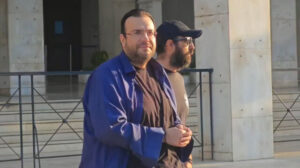
One company changed its director, another appeared at the same address, while a third took over employees and social security obligations. Business activities continued, debts to the Greek state mounted and, according to investigators, the individuals actually running the businesses remained behind the scenes.
Behind this alleged mechanism, operating through dozens of companies, investigators uncovered an extensive network of financial fraud, with estimated proceeds from criminal activity amounting to at least €5,618,873.90.
At the centre of the case is Filippos Kampouris, among others, whose name features prominently in a 17-page asset-freezing order issued on 16 October 2026 by Greece’s Anti-Money Laundering Authority.
The investigation was launched by the Directorate for Combating Organised Crime, specifically the Social Security Department of its Financial Crimes Sub-Directorate. A report was submitted to the Anti-Money Laundering Authority on 7 October, prompting it to issue Order 65/2026 nine days later.
The case file names 12 individuals, including Filippos Kampouris and Anna Synouli, as well as a network of 30 companies and organisations.
The alleged offences include forming, joining and directing a criminal organisation, fraud against the state, tax evasion, breaches of social security legislation and money laundering.
How the alleged shell-company scheme operated
According to the order, the mechanism was organised around two groups of companies with distinct roles.
The first consisted of businesses established by the individuals actually running the operations, who were officially registered as their directors.
The second group comprised companies established in the names of third parties, allowing those exercising actual control to distance themselves from financial and legal responsibilities.
The businesses operated mainly in the catering, nightlife, advertising and clothing sectors. Some were registered at the same addresses as previous companies, while others had only a virtual office or rented mailbox as their registered address.
The authority describes shell companies with no genuine economic activity, physical premises or, in many cases, bank accounts.
According to investigators, these entities were used to register employees for social security purposes without paying the corresponding contributions to EFKA, Greece’s social security agency.
At the same time, the businesses allegedly avoided paying income tax and value added tax (VAT).
Particular attention is drawn to the use of frontmen, or individuals who acted as nominal company directors.
According to the document, these were frequently people facing financial hardship or social exclusion who agreed to take on the formal management of companies in exchange for payment or social insurance cover.
As a result, when regulatory authorities attempted to identify those responsible for outstanding debts, they encountered individuals listed in company registers who did not necessarily exercise any genuine control over the businesses.
Kampouris’s companies and the links to LAOS
In the case of Filippos Kampouris, the order records his involvement in or representation of several legal entities.
These include the non-profit civil organisation Apollon, the Environmental Crime Observatory, the Consumer, Youth and Unemployed Information Network, and the non-profit organisation I Love Life, which ceased operating in 2012.
The order also records his previous role as a director of Facegroup Hellas, a company involved in advertising, publishing and radio and television production.
Of particular interest is the reference to the Popular Orthodox Rally (LAOS) political party.
According to the document, Kampouris has been registered as the party’s legal representative since 20 December 2023.
He is also listed as the director of Viral Media Group, established in May 2026, with LAOS as one of its partners.
The list of entities also includes the municipal political group Together We Can – Filippos Kampouris and the regional political group Battle for Attica – Filippos Kampouris.
His wife, Anna Synouli, is also named in the case file. She is recorded as a partner and director of Famous Group Hermis, a company operating in advertising, commerce, publishing and radio and television production.
Properties, vehicles and bank accounts frozen
The Anti-Money Laundering Authority ordered the freezing of bank accounts, investment products and other financial assets belonging to those implicated in the case, up to a total of €5,618,873.90.
The measure also covers joint bank accounts and safe deposit boxes, with exemptions for funds corresponding to salaries and pensions.
In addition, eight vehicles have been frozen, including a BMW 318i, a Skoda Octavia, a Renault Scenic, a Smart Fortwo, a motorcycle and another Skoda passenger car.
Significantly, the list includes two vehicles owned by LAOS: a Daimler Chrysler and a Citroën Jumper van.
The freezing order also covers five properties or property rights: a 501.62-square-metre plot of land in Vrachati, Corinthia; three small flats in Piraeus; and commercial premises in Argyroupoli, comprising a 108.52-square-metre ground floor and a 56.16-square-metre mezzanine.
The order does not identify these properties as being personally owned by Filippos Kampouris or his wife, but rather by other individuals implicated in the investigation.
According to the authority, there are serious indications that funds derived from the activities under investigation were mixed with legitimate assets, thereby concealing their true origin.
The freezing order forms part of the investigation into the alleged financial crimes and does not, in itself, constitute a finding of criminal guilt.
Ask me anything
Explore related questions




