





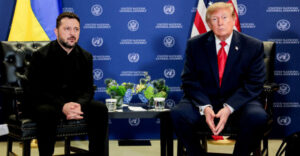
Relations between Donald Trump and Volodymyr Zelensky appear to have reached a critical juncture, with the latest confrontation between the two presidents raising serious concerns about the future of American support for Ukraine. As The New York Times points out in its analysis, the latest crisis appears deeper than previous disputes and threatens to deprive Kyiv of military capabilities that remain vital to its defence against Russia’s invasion.
The US president has never concealed his distrust of Zelensky or his willingness to engage with Vladimir Putin. Yet, despite periodic clashes with the White House, the Ukrainian president had until now managed to maintain a degree of American support by participating in Washington’s peace initiatives and repeatedly expressing gratitude to Trump for his “strong leadership”.
This time, however, the situation appears different. With the US midterm elections approaching, the two leaders are facing a crisis that analysts say could have serious consequences for both Ukraine and American foreign policy.
The week that pushed relations to the brink
For Kyiv, the past week has brought a succession of setbacks. Trump blamed Russia’s war against Ukraine for rising diesel prices, even though energy experts believe the main cause lies in the war launched by the United States against Iran.
The US president then temporarily lifted sanctions on Russian diesel sales in an attempt to contain fuel prices. According to The New York Times, it is unclear whether the move will achieve its economic objective, while it also provides Moscow with an opportunity to benefit.
Trump subsequently unilaterally announced an “energy ceasefire”, presenting it as an agreement to limit attacks on energy infrastructure.
According to the American newspaper, the initiative served Russia’s interests more than Ukraine’s. Trump even went so far as to call for a new president to be elected in Ukraine, openly challenging Zelensky’s position.
This time, the Ukrainian president responded far more forcefully. Visibly furious, he effectively accused his American counterpart of aligning himself with Russia while Russian attacks continue to kill Ukrainian civilians.
Defying Trump’s announcement of an energy ceasefire, Zelensky said Ukraine would resume attacks on Russian oil refineries. When journalist Piers Morgan asked whether he believed his country was “losing” the United States, Zelensky replied with a single word: “Yes”.
Trump, for his part, told Newsmax that “Zelensky is not a good person for us to work with”.
Starshield restrictions raise alarm in the Ukrainian military
The confrontation took on an even more serious dimension when the Ukrainian military reported sudden and unexplained restrictions on its use of Starshield, the military version of the Starlink satellite system.
The network, operated by Elon Musk’s SpaceX, is crucial for communications on the front line and for coordinating many military operations.
According to The New York Times, the restrictions affected drone launches as well as a range of other operational activities carried out by Ukrainian forces.
Musk, whose relationship with Trump has at times been close and at other times confrontational, suggested that only the US military and, ultimately, the American president himself could restrict access to Starshield.
He also voiced support for replacing Zelensky as Ukraine’s president.
The developments prompted a reaction in Washington, with a bipartisan group of US senators calling for an investigation into the restrictions.
The prospect of losing access to critical satellite services is considered particularly dangerous for Kyiv, as it could significantly hamper the conduct of military operations.
Fears that US military aid could be cut off
According to The New York Times analysis, the worst-case scenario for Ukraine would be a decision by Trump and the US Department of Defence to suspend assistance to the Ukrainian armed forces. Although Ukraine has significantly expanded its domestic defence production, it remains dependent on the United States in several critical areas.
One is the provision of military intelligence, which enables the early detection of Russian missile attacks and supports Ukrainian operations against targets at medium range. American assistance with weapons supplies is equally important, even when the weapons themselves are purchased with money provided by European allies.
Ukraine needs American spare parts for its F-16 fighter jets, missiles designed to home in on enemy radar systems and, above all, Patriot interceptor missiles. These systems are a key means of protecting Ukrainian cities against Russian ballistic missiles.
A suspension of this assistance could weaken Ukrainian forces at a time when, according to the newspaper, they are performing well on the battlefield. It would also leave cities that face daily missile and drone attacks more exposed, increasing the risk of civilian casualties.
“We will die because we won’t have time to reach shelters”
Oleh Katkov, a military analyst and editor-in-chief of a Ukrainian media outlet specialising in defence and technology, explains the importance of American intelligence.
“We will die because we will not receive warnings of ballistic missile attacks,” he warns.
As he explains, without timely alerts, civilians would not have enough time to reach shelters, while a potential shortage of Patriot missiles would deprive Ukraine of its ability to intercept incoming attacks.
Nico Lange, a former official at Germany’s Ministry of Defence and an associate of the Munich Security Conference, has expressed similar concerns. He points out that although European countries provide Ukraine with some intelligence, they cannot fully replace American early-warning capabilities.
This is particularly true when it comes to missile launches from ships in the Black Sea and attacks involving ballistic weapons.
If Ukraine loses both early-warning information and Patriot missiles, Russia will have a much greater ability to strike targets without effective resistance.
Two attacks on Kyiv without advance warning
An initial indication of the potential consequences emerged during the same week, according to The New York Times.
Ukrainian officials reported that they had received no advance intelligence from their allies about two waves of missile attacks on Kyiv, on Tuesday and Wednesday.
The missiles reached their targets almost simultaneously with the activation of the air-raid sirens.
Ukrainian authorities said they had not been informed by their “partners”, an indirect reference to the United States. However, it remains unclear why no advance warning was provided.
One possible explanation is that the attacks were carried out using S-400 missiles, which can travel relatively short distances at extremely high speeds, leaving very little time for a warning.
Ukrainian officials also reported that they had received information as usual about other ballistic attacks.
Despite the uncertainty surrounding these incidents, their timing, coinciding with the Starshield restrictions, intensified concerns that military cooperation with the US may be entering a new and more uncertain phase.
Ukraine has reduced its dependence on the US, but cannot replace it
The New York Times notes that Ukraine’s position today differs from that of the early years of the war.
When Trump returned to power, he announced that the policy of isolating Russia should come to an end and reversed key elements of American foreign policy.
This was followed by his highly contentious meeting with Zelensky at the White House, during which the Ukrainian president was publicly reprimanded for not wearing a suit and for allegedly failing to show sufficient gratitude for US assistance.
Zelensky subsequently managed to repair relations with Washington, but American policy had already changed. The United States stopped providing weapons to Ukraine free of charge, requiring Kyiv and its Western allies to pay for supplies.
In the period that followed, Ukraine significantly developed its own defence industry, reducing its dependence on certain American weapons systems. This progress gives Zelensky greater room to respond to pressure from Trump.
“Trump’s leverage through cutting off the supply of equipment to Ukraine is now very limited,” Nico Lange argues.
As he explains, there is still a widespread perception that Ukraine would automatically lose the war without American assistance, but that assessment no longer fully reflects the current situation.
Nevertheless, there are critical areas in which American support remains irreplaceable.
Anxiety over Patriot missiles and dwindling stockpiles
Kyiv is particularly concerned about the possibility that supplies of Patriot interceptor missiles could be halted.
Solomiia Bobrovska, a member of the Ukrainian parliament’s Defence Committee and deputy head of Ukraine’s delegation to NATO, fears that such a decision would have serious consequences for the country’s air defences.
Global stocks of these missiles have fallen significantly, largely because of the war in Iran, while Ukraine continues to receive only a small number each month.
Bobrovska stresses that Kyiv and its allies must seek alternatives to reduce Ukraine’s future dependence on the United States. She makes clear, however, that Ukraine has no intention of abandoning its fight.
“If you want to hear me say the words ‘peace’ and ‘capitulation’, that is not even an option,” she says.
Zelensky’s smile in Brussels said it all
The extent of the distrust between the two leaders was also captured in a telling moment during Zelensky’s press conference in Belgium on Friday.
When a journalist asked whether he believed Trump was using him as a scapegoat for his own political problems, the Ukrainian president chose not to respond immediately. He smiled slightly, paused for an extended moment and waited, prompting laughter in the room.
He then leaned towards the microphone and said: “That is my answer.”
As The New York Times notes, the moment vividly illustrated the Ukrainian president’s frustration. This time, he made little effort to conceal his displeasure with the American position.
“A lose-lose situation”
It remains uncertain where the confrontation will lead.
Balázs Jarábik, a former European Union diplomat in Kyiv who now works as an analyst at R. Politik, believes the dispute serves none of the parties involved.
“It is a lose-lose situation,” he says, explaining that the outcome is negative for Trump, Zelensky and the Europeans alike.
Analysts warn that a continuation of the confrontation could benefit Russia by weakening cooperation between Ukraine and its Western allies. At the same time, a complete halt to American military assistance could prove politically damaging for Trump himself, who is already facing criticism from members of the Republican Party over his approach to Kyiv.
Harry Nedelcu, a senior figure at the European consultancy Rasmussen Global, believes the period leading up to the US midterm elections will be decisive.
As he notes, Trump wants to show American voters that he is trying to bring fuel prices down, while also responding to criticism from within his own party.
From a geopolitical perspective, however, Nedelcu describes the American position as a “stab in the back” and “geopolitical betrayal”.
The conclusion of The New York Times analysis is that the crisis between Trump and Zelensky has moved beyond the level of a personal dispute. The real question is whether Ukraine will continue to receive the American operational support it needs to defend itself against Russian attacks.
Although Kyiv has achieved greater military autonomy than in the past, the potential loss of critical intelligence, satellite services and air-defence missiles could have immediate consequences both on the battlefield and for the safety of millions of Ukrainian civilians.
Ask me anything
Explore related questions




