





The rising cost of living, the housing crisis, the state of public education and corruption have driven hundreds of thousands of Europeans on to the streets. From violent clashes in France and Albania to demonstrations across the Iberian Peninsula and Serbia, national crises are increasingly displaying common social characteristics. Economic pressures on younger generations and growing distrust of governments lie at the heart of unrest that is no longer confined to a single country.
The picture emerging across Europe in recent days points to a period of intense social discontent, with different national triggers but an increasing number of shared characteristics. From Paris, where demonstrations on 17 October escalated into one of the most serious outbreaks of violence in recent years, to Tirana, where students clashed with police while demanding the government’s resignation, significant sections of European society are taking their grievances to the streets.
Violent incidents were also reported in Milan and Brussels, while the housing crisis is mobilising thousands of people in Spain and Portugal. In Serbia, protests against state corruption have taken on an unmistakably political dimension, while demonstrations in Greece over education and student accommodation reflect similar, albeit less intense, social pressures.
The simultaneous emergence of these protests does not mean Europe is facing a single, unified uprising. The causes differ, as do the political circumstances and the scale of the unrest. One characteristic, however, recurs from country to country: everyday life is becoming more difficult for large sections of society as living costs rise and access to housing, quality education and public services becomes increasingly challenging.
At the same time, governments’ ability to respond to public demands is constrained by fiscal obligations and competing policy priorities. For European governments, the problem is particularly significant because social discontent is emerging amid increased defence spending, energy uncertainty and continuing international crises.
Support for Ukraine, the consequences of wars for international markets and demands for fiscal stability are limiting the scope for new social spending measures. While these factors do not, in themselves, explain the demonstrations, they provide the economic and political context in which they are unfolding.
France: From student protests to the deepest crisis of Macron’s recent years
France is the clearest example of how a mobilisation centred on specific educational demands can develop into widespread social unrest. The first protests were organised by school students who complained of teacher shortages, problems with school facilities and the continuing deterioration of public education. The movement gradually gained wider support as university students, trade unions and organisations that had played leading roles in previous waves of demonstrations joined the students’ calls.
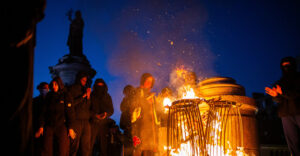
17 October marked a turning point. According to the French Interior Ministry, approximately 550,000 people took part in demonstrations, while the General Confederation of Labour (CGT) put the figure at 800,000. In Paris, Lyon, Marseille, Limoges and other major cities, sections of the demonstrations escalated into widespread clashes with police. Shops were looted, cars set on fire and public buildings attacked. Limoges town hall was set ablaze, while in the capital police struggled to regain control in several areas.
❗️🇫🇷 #France. Violent clashes erupted in central Paris around Place de la République. Rioters attacked police with projectiles and fireworks, looted shops along Boulevard Magenta, torched vehicles and set fires in several buildings as emergency crews battled the blazes nearby. https://t.co/sRfTQ8lhrw
— World Wide Leak (@leaklive1) October 17, 2026
According to figures reported by Reuters on 18 October, one demonstrator was killed, hundreds of police officers were injured and arrests approached 1,800. These figures illustrate the scale of the crisis, but they should not lead to peaceful demonstrators numbering in the hundreds of thousands being equated with the groups responsible for destruction. The government attributed a significant proportion of the violence to far-left groups, while allegations of excessive police force added to the political dispute.
The underlying causes of France’s crisis extend beyond the education system. The rising cost of living, fuel prices and the state of public services have intensified discontent with Emmanuel Macron. France is also facing serious fiscal difficulties, with high public debt and the need to rein in deficits limiting the scope for increased social spending.
The government of Sébastien Lecornu therefore faces two conflicting demands. On the one hand, it is expected to curb public expenditure; on the other, it must fund a welfare state whose performance is coming under increasingly intense scrutiny. Even the promise to provide schools with an additional 3,000 teachers is unlikely to address the full range of demands now being raised.
The political dimension is equally important. Macron is entering the final period of his presidency, with the next presidential election scheduled for spring 2027. The government’s declining popularity and the lack of effective parliamentary consensus are adding to the political strain. The current unrest comes on top of a long period of social conflict, including the Yellow Vests movement, protests against pension reform and repeated public-sector strikes.
The recurrence of protests over almost a decade reveals the French political system’s difficulty in securing broad social consensus for economic reforms.
Albania: Young people take to the streets in direct challenge to Edi Rama
In Albania, the protests have different characteristics. While the state of public services and the cost of living dominate in France, social demands in Tirana are directly linked to challenges to political authority.
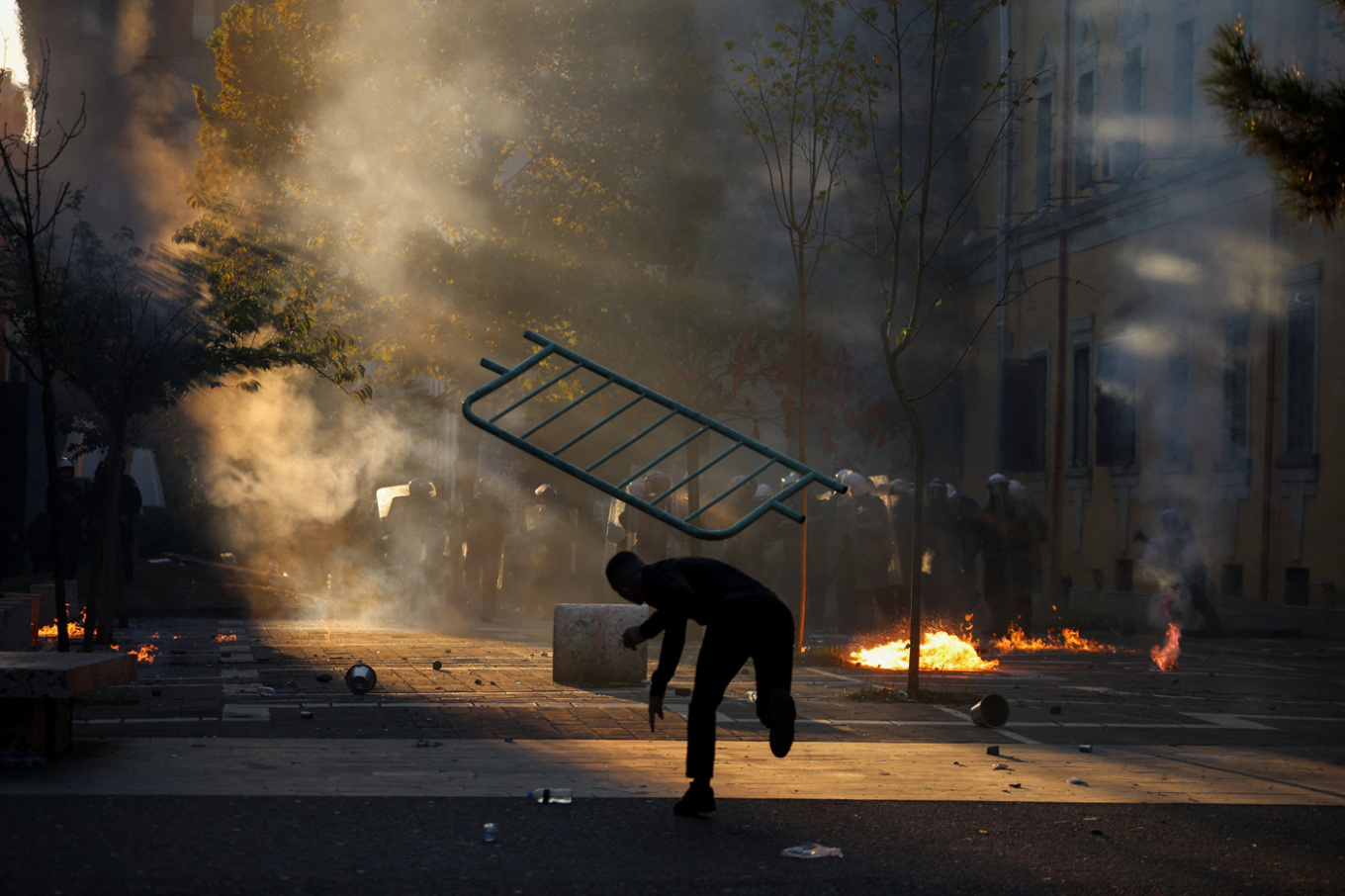
Thousands of young people gathered outside the Ministry of Education on 17 October, on the fifth day of an expanding student movement, demanding the resignation of Prime Minister Edi Rama. Groups of demonstrators attacked police officers with stones and other objects, while security forces deployed tear gas, stun grenades and water cannon.
A day earlier, attacks on public buildings had been reported, including an arson attack on the entrance to the Ministry of Finance. Youth unemployment, limited career prospects, the state of universities and allegations of corruption lie at the heart of the protesters’ demands.
At the centre of the unrest is a widespread perception that economic growth is not translating into a corresponding improvement in living standards for a significant proportion of the younger generation. What distinguishes Albania is that the student protests have acquired an explicit anti-government objective. Demonstrators are not merely calling for changes to education or financial support; they are questioning whether the prime minister should remain in office. The government has attributed some of the incidents to extremist elements, although this assessment alone does not explain the extent of public discontent.
For a country still grappling with the emigration of young people and significant income disparities with western Europe, student participation carries particular political weight. Demands for better career prospects are now linked to calls for greater transparency and more effective institutions.
Serbia: A railway tragedy that became a political movement
In Serbia, the current protests can be traced back to 1 November 2024, when the canopy of the railway station in Novi Sad collapsed, killing 16 people. The tragedy prompted allegations of inadequate oversight of public works, state corruption and a lack of accountability.
The first demonstrations were organised in Novi Sad but soon spread to Belgrade and other cities. Students and university academics formed a movement demanding the publication of information about the disaster, accountability for those responsible and protection for people taking part in protests. Attacks on demonstrators by government supporters further heightened tensions, while the political crisis led to resignations, including that of Prime Minister Miloš Vučević.
The movement has since broadened its scope, with demonstrators challenging the way power is exercised and demanding greater institutional transparency. Political tensions have been intensified by the election period, as students seek to carry the momentum of the protests into the electoral arena.
Serbia’s experience differs from that of most western European countries. The immediate trigger was neither a tax increase nor an education reform, but a tragedy that demonstrators regard as the consequence of systemic failings. The central demand is not primarily economic relief, but accountability from those in power.
Italy: Rising prices, public services and renewed social tensions
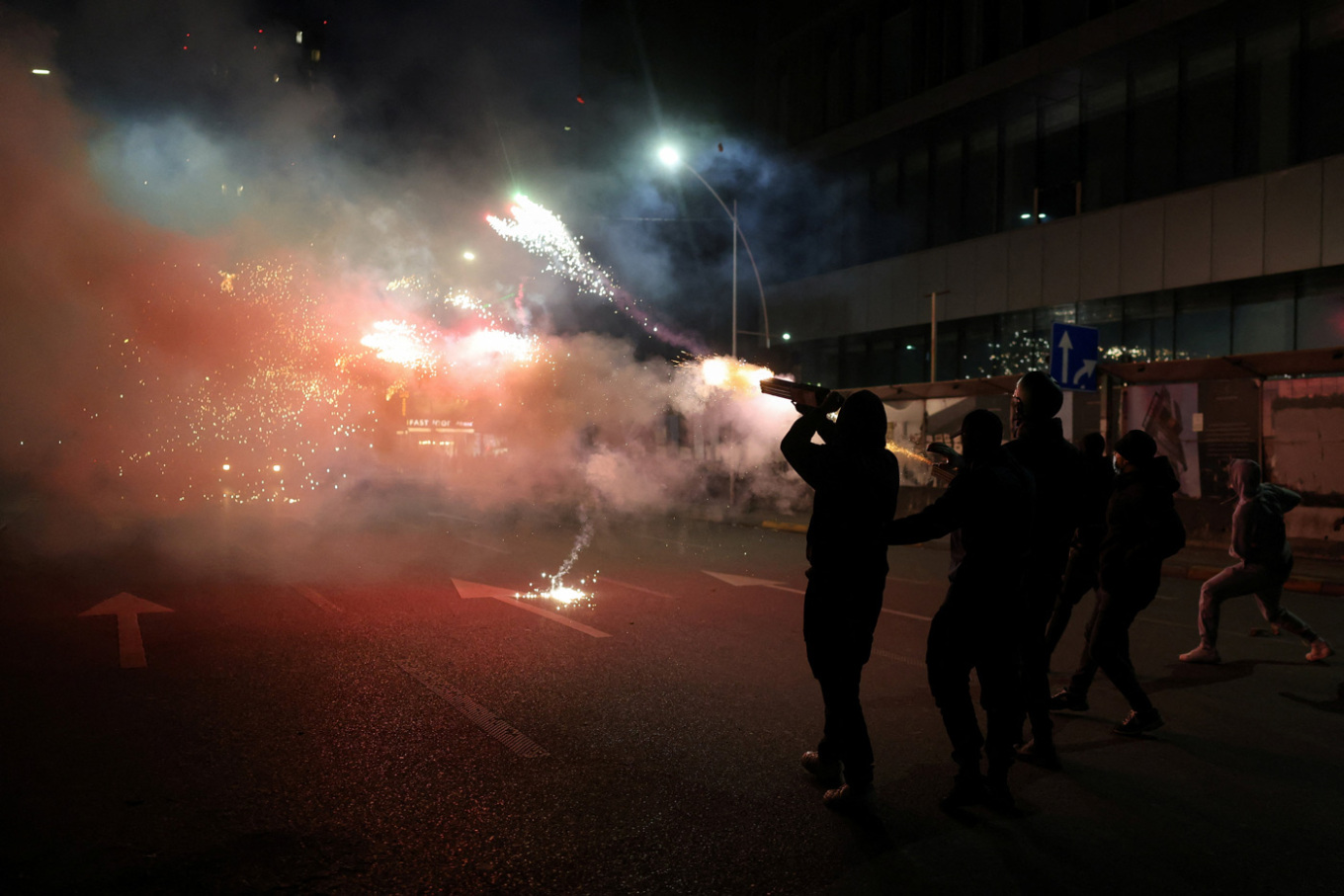
Italy also experienced violent incidents over the weekend of 17–18 October. In Milan, demonstrations over the rising cost of living, public services and wars escalated into clashes in Piazza del Duomo. Groups of masked protesters attacked police, looted shops and started fires, while similar scenes were reported in Bologna and other cities in northern Italy. Police used tear gas and water cannon to disperse crowds, and authorities made dozens of arrests.
Tensions remained high in Milan on 19 October, with shops in the luxury shopping district of Via Montenapoleone closing early amid fears of further unrest. According to Reuters, Italian authorities had made 271 detentions and 32 arrests, with a significant number of minors among those arrested. Prime Minister Giorgia Meloni condemned the violence and convened a government meeting to discuss how to tackle it, while tougher security measures are being considered.
The Italian protests cannot be attributed to a single economic factor. Rising everyday expenses, pressure on incomes and dissatisfaction with public services are combining with anti-war demands and opposition to government priorities. The participation of younger people and the presence of groups that do not appear to be directly connected to the original organisers are creating additional challenges for the authorities.
For Meloni’s government, the renewed tensions pose a political dilemma. Addressing the destruction and protecting public safety are immediate priorities. However, tougher policing does not address the economic causes motivating peaceful demonstrators. These are two distinct problems that the Italian government must manage simultaneously.
Belgium: Education reforms bring students into clashes with police
In Belgium, social tensions are primarily rooted in changes to the education system and rising study costs. On 7 October, students in Liège took part in demonstrations against reforms proposed by the government of the French Community of Belgium, also known as the Wallonia-Brussels Federation, and increases in university fees. Police used tear gas. The protests subsequently spread, with clashes also reported in Brussels on 17 October.
In the Belgian capital, hundreds of demonstrators, mainly young people, gathered in the city centre. The situation deteriorated when groups of protesters clashed with police and overturned a car, prompting security forces to intervene with water cannon and tear gas. Interior Minister Bernard Quintin condemned the violence and stressed the need to protect public order.
Belgium’s particular challenge is that the dispute is unfolding within a complex institutional system in which responsibility for education is divided among the country’s language communities. Demonstrators oppose reforms that, in their view, could restrict access to higher education and increase the financial burden on families.
The Belgian example shows how a specific education issue can acquire broader social significance when it becomes linked to rising prices and uncertainty over young people’s prospects. Belgium’s proximity to France and the coincidence of the demonstrations have brought greater attention to the protests, although this does not mean the two movements share identical demands or a unified organisation.
Spain and Portugal: Housing crisis becomes a political problem
On the Iberian Peninsula, the protests have different origins. The inability to find affordable housing is emerging as one of the most pressing issues for younger generations, placing growing pressure on the governments of Spain and Portugal.
In Spain, demonstrations intensified following the eviction of an 87-year-old woman from her home in Madrid and her subsequent death. The case attracted considerable public attention and became a catalyst for protests against evictions, rising rents and the limited supply of housing. Violent incidents were also reported in Barcelona, although most of the demonstrations have focused on specific social and legislative demands.
The government of Prime Minister Pedro Sánchez approved 21 emergency measures to address the housing crisis. These include provisions to protect vulnerable tenants, interventions in short-term and seasonal rentals, and financial instruments to support housing. Of particular significance is a proposed €10 billion financing mechanism for mortgages and construction subsidies. The measures were announced against an already strained political backdrop, ahead of the snap general election scheduled for 29 November.
Spain’s housing problem has deeper economic roots. Rising property prices and rents, a limited supply of new homes in major cities and the gap between economic growth and the purchasing power of many workers have made housing increasingly inaccessible. Young workers face significant barriers to achieving financial independence, even when they have stable employment.
Portugal presents a similar picture. On 17 October, tens of thousands of demonstrators gathered in Lisbon in response to a call by the country’s largest trade union confederation, the General Confederation of Portuguese Workers (CGTP). The protests focused on low wages, the high cost of living and difficulties finding housing, particularly in Lisbon and Porto.
The figures highlight the scale of the problem. According to Reuters, house prices in Portugal have more than doubled since 2017, while rents for new tenancies have almost doubled. Inflation stood at 3.6% in September 2026, with food and fuel prices placing further pressure on household budgets. During the same period, fuel prices had risen by 15% year on year.
The economic strain is particularly acute for households relying on one or two low wages. Rising rents are absorbing an increasing share of disposable income, reducing people’s ability to save and start families. The demonstrations in Lisbon, along with symbolic protest camps organised by activists in Porto, reflect a social demand that now extends beyond students and low-paid workers.
Unlike France or Albania, Portugal is not currently experiencing a comparable level of violent clashes. The key difference is that organised labour and social movements are putting pressure on the government through mass demonstrations that remain largely peaceful.
The younger generation at the centre of unrest and the limits of Europe’s economy
A comparison of the eight countries reveals a particularly significant pattern. Younger people are no longer taking part in protests solely over education. In France, they are demanding better schools and public services; in Albania, they are calling for career opportunities and political change; in Serbia, they are demanding accountability; while in Spain, Portugal and Greece, the right to housing has become a central issue.
Economic growth alone is insufficient to guarantee social stability, particularly when its benefits are not reflected in disposable incomes and everyday living standards. The question is not simply how much national income grows, but how much remains available to workers after essential expenses have been paid. Housing, transport, energy and education have become critical determinants of households’ real purchasing power.
At the same time, European governments are facing increasingly difficult decisions over how to allocate public resources. The need to strengthen defence, energy security concerns, demographic pressures and the cost of servicing public debt are all limiting the scope for additional interventions. Social spending is therefore at the centre of a broader debate over policy priorities in the years ahead.
Rising defence budgets are not an established direct cause of today’s demonstrations in every country. They do, however, create additional fiscal pressure that can limit governments’ ability to respond to demands concerning education, healthcare and social protection. This distinction matters because it helps explain why public discontent can intensify even in countries where key macroeconomic indicators are positive.
A second common feature is distrust of political representation. In Albania and Serbia, corruption and the functioning of institutions are direct triggers for mobilisation. In France, repeated cycles of social conflict are linked to the difficulty of reaching political consensus. In Spain, pressure over housing is mounting amid a period of intense parliamentary confrontation.
Governments are facing different forms of discontent, but a common thread is the growing questioning of whether existing policies are effective.
What comes next for Europe?
The social unrest unfolding across Europe does not yet amount to a single crisis with a shared political direction. France is facing widespread conflict over the cost of living and the functioning of the welfare state. Albania and Serbia are confronting movements that directly challenge corruption and demand political accountability. Italy and Belgium are dealing with protests combining economic and educational demands, while access to affordable housing dominates in Spain, Portugal and Greece.
The duration and evolution of these protests will depend largely on how governments respond. Police action against violence can restore public order, but it is not, by itself, enough to address the discontent caused by economic and institutional problems. Similarly, individual social measures may provide short-term relief without necessarily tackling the causes that have accumulated over many years.
Europe faces a contradiction that is becoming increasingly difficult to ignore. On the one hand, governments are seeking to adapt to an international environment characterised by growing strategic and economic demands. On the other, significant sections of their populations are calling for better living conditions, greater financial security and more effective public institutions.
The simultaneous presence of thousands of demonstrators on the streets of different European countries reflects this contradiction. It does not herald a continent-wide uprising, but it highlights the difficulties governments face when economic pressures persist, public services come under scrutiny and trust in institutions declines.
The most important political question in the period ahead is whether these social demands will remain distinct and nationally defined, or whether prolonged economic pressure will fuel new waves of protest in other European countries.
Photographs: Reuters
Ask me anything
Explore related questions




