





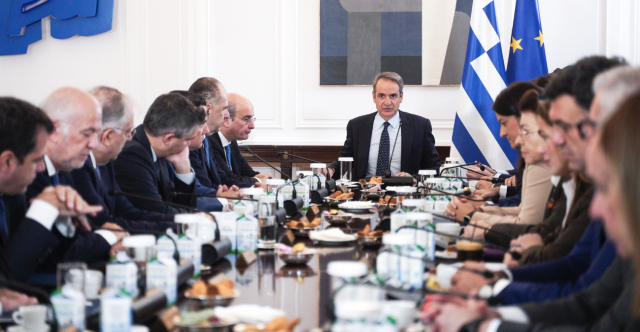
At the emergency European Council summit in Brussels, which focused on the European budget, Kyriakos Mitsotakis came face to face with the cold, both inside and outside the meeting room in the European Council building. On his return to Athens, however, the deep freeze lies ahead for the government, as it navigates through a foggy landscape. It is not just the adverse weather forecasts for the coming days; it is also the mounting problems that are testing the government’s resilience for yet another winter as it heads towards the final stretch before the elections. Perhaps this is why Mr Mitsotakis is betting on elections in the summer, in mid-June: by then, the weather may have changed, the political climate may have improved, and the bleak days of winter may be behind us.
Until then, however, the government faces considerable headwinds. The Liakos affair, following the Tsavdaridis affair, which was of course resolved very quickly, put the Maximos Mansion on the defensive and in an awkward position. The Gordian knot was finally untied yesterday morning, when Mr Liakos met with Mr Mitsotakis for approximately 10 minutes and announced his resignation a few hours later.
Government leaks stating that the decision “does credit both to him and to the party” and that, objectively speaking, there is no family responsibility do not diminish the political problem. The government tried to buy time, as did Mr Liakos, but he was ultimately brought down by the reactions of other MPs, their reluctance to support him, and their urging that he take responsibility for the situation—which is precisely what happened. Mr Liakos is now a thing of the past, but the problem facing the Maximos Mansion remains.
Against this backdrop, former minister and MP Stelios Petsas called on Mr Mitsotakis on Saturday morning, speaking on SKAI television, to “press the button” and take the country to elections, so that New Democracy would not become trapped in a cycle of scandal allegations.
At the Maximos Mansion, Mr Petsas’s suggestion was not received with enthusiasm, primarily because Mr Mitsotakis’s position is clear. However, quite a few government officials and MPs believe that elections should have been held immediately after the Thessaloniki International Fair (TIF). They see the developments surrounding the Recycling Huts and the increasingly gloomy political climate as confirmation of their view.
The “Recycling Huts” and the growing concerns
Just as the Maximos Mansion had attempted to “even the score” over the Liakos affair by raising a series of pressing questions about the dealings of ELAS secretary Miltos Chatzigiannakis with the Municipality of Stylida and other public-sector bodies, the Recycling Huts affair emerged on Thursday, creating fresh embarrassment for the government camp.
One obvious line of defence for the government is that, so far, there appears to be no involvement of a former government official in the case, despite references in the case file to political figures and their handling of the matter. Early on Saturday morning, however, government officials gathered at the Maximos Mansion to assess the aspects of the case that were known to them.
The approach of “let this cup pass from me” is unlikely to prove politically sufficient, since the problem for the government is not each individual case in isolation. Rather, it is the perception of accumulated corruption across different cases that is troubling citizens and making it more difficult for New Democracy to achieve its goal of further consolidating its support.
As shown by the rolling polling data available to the Maximos Mansion, public concern over corruption cases is being added to the persistent problem of high prices. Both factors are having an erosive effect.
A long road ahead
An additional cause for concern is the sense of inertia spreading throughout the government, despite the fact that the elections are still several months away.
A senior figure at the Maximos Mansion disagrees, pointing out to Proto Thema that this is precisely why ministers have been called upon to deliver 90 milestones before the end of the government’s term.
At the recent Cabinet meeting, the Prime Minister also urged his ministers to make productive use of the remaining time to complete the government’s work. After all, the delivery of tangible results is a central political priority for Mr Mitsotakis on the road to the ballot boxes, serving as a key argument in his confrontation with the opposition, which is on the verge of resolving its own differences in court (ELAS–PASOK).
Nevertheless, as an experienced minister told Proto Thema, with the dawn of 2027, ministers will throw themselves wholeheartedly into the battle for preference votes.
This is politically unavoidable, while senior government figures are already devoting more attention to electoral balances than to their ministerial portfolios.
There are also those who believe that the government should already have gone to the polls in the autumn to avoid everything it is now facing. Mr Mitsotakis, however, has consistently favoured extending the political timetable, believing that, at the end of the government’s second four-year term, voters will make a more comprehensive political assessment, particularly given the difficult political dilemmas that will be put before them.
Indeed, some figures, such as Development Minister Takis Theodorikakos, are already promoting the narrative of a “single ballot”, stressing that Mr Mitsotakis must persuade voters that the elections will not require a second round, in order to achieve the greatest possible consolidation of the party’s support.
The difficult winter and financial support measures
The winter months are putting the government under pressure, particularly when it comes to citizens’ disposable income. Bills are rising, especially energy costs.
The government has taken up the challenge posed by the president of the Hellenic Federation of Enterprises (SEV), Spyros Theodoropoulos, and Giannis Masoutis over high prices, while also rejecting proposals that any fines imposed should not be made public.
At the same time, a successor arrangement to the so-called “gentlemen’s agreement” is being sought for the period beginning in January. Meanwhile, support for energy-intensive businesses, such as bakeries and pastry shops, has now been outlined to help them cope with the increased and inflexible energy costs they face.
If no solution is found and we enter another spiral of price increases due to international pressures, the situation will deteriorate both for households and for the government.
At the same time, Mr Mitsotakis is banking on a series of positive announcements concerning incomes.
A few days ago, the €400 payments to pensioners were snapped up at ATMs, while in recent days it was the turn of tenants and beneficiaries of social welfare benefits to see money credited to their bank accounts.
Next, in mid-December, Parliament will vote on the budget, which includes a series of positive measures, several of which will become visible in January. Meanwhile, earlier this week, Mr Mitsotakis announced that the minimum wage would be increased twice in 2027, reaching €1,000 gross as of 1 January 2028.
At the same time, he set a target of an average salary of €1,800 by 2030, seeking to give greater substance to the argument about rising incomes.
In addition, the surprise measure in the budget is expected to be finalised in the coming days, maintaining an annual tradition that has by now become established. It remains to be seen whether this will be a measure benefiting a large number of people or a more targeted one.
The former Prime Ministers
At the same time, Mr Mitsotakis must also deal with the political pressure coming from the flanking attacks by Antonis Samaras, who has begun touring the country in connection with his political party, which is currently being formed and whose name will be revealed in the coming months.
There is, however, no doubt about the nature of the undertaking, while Mr Samaras is using these visits to “test his strength”.
His associates believe there is considerable interest in the party’s candidate lists, although the Maximos Mansion has serious doubts about whether he interrupted his tour last weekend to meet a friend from the United States who had come to Athens for just a few hours.
Nevertheless, in order to leave no unfinished business, Mr Samaras repeated his visit to Thessaloniki on Saturday, adding appointments at the Sindos Industrial Area (VIPA) and with the city’s mayor, Stelios Angeloudis.
He also launched an attack on the government, saying that it had become synonymous with corruption.
Meanwhile, the other former Prime Minister, Kostas Karamanlis, who maintains a relationship of unyielding coolness with the Maximos Mansion, returned with fresh barbs from Thessaloniki, speaking about “benefit-based policies”, the “abandonment of the regions”, “the lowest purchasing power”, and so on.
This has led many to believe that, although he may not be expressing his position publicly, he is discreetly lending support to Mr Samaras’s political undertaking. People close to the former Prime Minister share this assessment.
The Maximos Mansion, for its part, is hoping that the former Prime Minister will maintain a position of strict neutrality.
The fact that Mr Mitsotakis will meet Mr Karamanlis in the coming days at the presentation of Dora Bakoyannis’s book, A Woman, is unlikely to change the course of events.
Ask me anything
Explore related questions




