





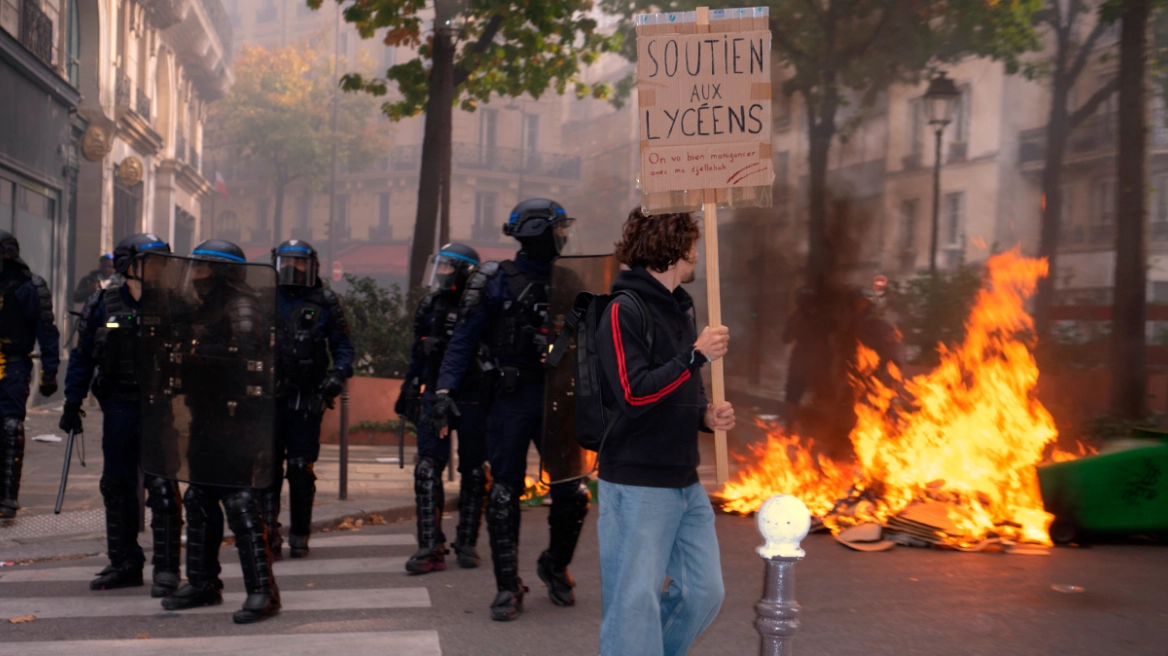
Mass protests and violent unrest that rocked France over the weekend eased significantly on Monday following the introduction of tougher security measures, including targeted curfews. French authorities are seeking to prevent another outbreak of violence after demonstrations over the rising cost of living escalated into widespread vandalism and the looting of shops.
Curfews came into force in parts of Paris from 11pm on Monday, while similar restrictions were imposed in other cities. Prime Minister Sébastien Lecornu had previously instructed regional authorities to introduce curfews wherever necessary to maintain public order.
Although France has experienced similar disturbances in the past, including the riots of 2023 and the Yellow Vest protests of 2018, the scale and intensity of the latest clashes caught the authorities by surprise.
The crisis has also erupted at a particularly sensitive moment, with the country facing growing political and economic pressure just six months before the presidential election to choose Emmanuel Macron’s successor.
Not protests. These are riots. Paris, France October 17-18 burnt cars, looting, arson, you name it. https://t.co/QaeKbQyflH
— 🤍Silva Tetro🖤 (@tetro_silva) October 19, 2026
More than 2,500 arrests as damage approaches €1bn
More than 500,000 people took part in demonstrations against the rising cost of living across France on Saturday. However, the protests turned violent when groups of demonstrators began attacking hundreds of shops, causing extensive damage.
According to figures released by the French Interior Ministry, 2,397 people were arrested on Saturday alone. The violence continued into Sunday night, with further looting and another 108 arrests in Paris.
The economic cost of the unrest continues to rise, although initial estimates suggest losses remain below the €1bn to €1.2bn range.
Marcos Alvarez, head of insurance at Morningstar DBRS, said that provided there were no further outbreaks of violence, the financial consequences for France’s largest insurance companies should remain manageable.
He estimated that the losses would primarily affect insurers’ profitability without threatening their capital adequacy.
Financial markets under pressure as retailers fear further damage
The political and social turmoil was also reflected in financial markets, with French shares and government bonds falling on Monday and dragging wider European stock markets lower.
Meanwhile, Paris retailers have appealed to the authorities to prevent a repeat of the destruction, warning that the unrest is damaging both economic activity and the French capital’s international reputation.
Representatives of businesses in some of Paris’s most exclusive shopping districts complained that they had been forced to hire private security personnel to protect their premises.
Trade associations representing businesses on the Champs-Élysées and Rue du Faubourg Saint-Honoré, among other locations, stressed that the violence was seriously damaging France’s reputation, given that these districts are internationally recognised symbols of the country.
Despite the easing of tensions, the threat of further unrest remains. Social media accounts associated with the Yellow Vest movement have called for demonstrations to continue throughout the week, with further action planned for Saturday, 24 October.
Several trade unions have also announced a strike for 5 November, suggesting that social tensions could persist for some time.
Political tensions intensify ahead of presidential election
The weekend riots have further inflamed an already tense political atmosphere in France, deepening divisions between rival parties.
Jordan Bardella, leader of the far-right National Rally party, blamed the clashes on the left-wing France Unbowed movement, accusing its leader, Jean-Luc Mélenchon, of portraying police officers as enemies and law enforcement as an injustice that must be challenged.
Meanwhile, a Cluster 17 opinion poll published on Monday, but conducted before the violence, put National Rally figure Marine Le Pen on at least 31% in first-round presidential voting preferences.
Mélenchon and centre-right presidential contender Édouard Philippe were both polling at 20%.
The political confrontation comes as the government struggles to address public anger over the cost of living while attempting to prevent further economic instability.
Macron visits Gulf as unrest spreads to other European countries
Following his televised address on Sunday evening, President Macron declined to speak to journalists when he arrived in the United Arab Emirates on Monday.
The UAE was the first stop on a three-day tour of Gulf countries aimed at strengthening business ties and securing energy supplies, according to the Élysée Palace.
France, however, was not the only European country to experience serious disturbances.
In Italy, Prime Minister Giorgia Meloni convened an emergency meeting with her advisers on Monday following demonstrations in Milan that also descended into violent clashes and looting.
Protests also took place in Belgium, Portugal and Albania, highlighting the broader extent of public dissatisfaction across several European countries.
Despite the relative calm that followed the tightening of security measures in France, planned demonstrations and continuing political confrontation have left considerable uncertainty.
The central question for the French authorities is whether the easing of tensions will prove lasting or merely represent a temporary lull before another wave of protests.
Scale of destruction of Limoges historic town hall in the light of day
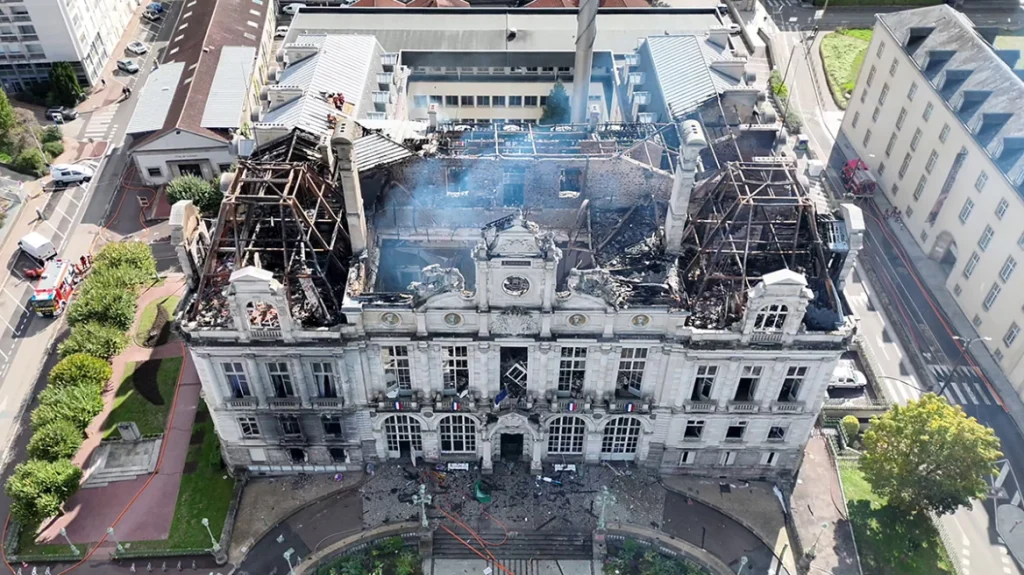
New images released on Monday reveal the scale of the destruction at the historic town hall in Limoges, which was set ablaze on Saturday, 17 October, following an attack by masked rioters after a demonstration.
The fire caused extensive damage to the landmark 19th-century building, inaugurated in 1883. Much of its roof collapsed, its distinctive clock tower was destroyed and the interior suffered severe damage.
Local prefect Maurice Barate said the roof had collapsed onto the lower floors, apart from the west wing, while two-thirds of the façade had been destroyed. He described the blaze as an act of deliberate destruction by rioters and a devastating loss of cultural heritage.
Hundreds of shocked residents gathered at a safe distance to watch the building burn, including a municipal employee who broke down in tears.
The town hall was built thanks to a bequest from wealthy benefactor Alfred Fournier, who died without heirs. Designed by architect Charles-Alfred Leclerc and inspired by Paris City Hall, it stands on the site of the city’s ancient Roman forum.
Incendie de la mairie de Limoges. Le feu continue à gagner. La salle des mariages et le service de l’état civil sont partis en fumée. https://t.co/nQfICNOtZR
— Denis Carreaux (@DenisCarreaux) October 17, 2026
Its architecture combines late Renaissance and Louis XIII styles, with a limestone façade resting on a granite base. Four mosaics honour prominent figures associated with Limoges: enamel artist Léonard Limosin, Chancellor d’Aguesseau, revolutionary Pierre Vergniaud and Napoleonic Marshal Jean-Baptiste Jourdan.
The destruction is particularly poignant as the building had been undergoing a long-term conservation and restoration programme, supported by the French Heritage Foundation, with the municipality appealing for public donations to help finance the work.
Ask me anything
Explore related questions




