





Greece is set to unveil key elements of its new multi-layered defence architecture, known as the “Achilles’ Shield”, during Wednesday’s military parade in Thessaloniki, marking one of the most significant public demonstrations of the country’s ongoing military modernisation.
The annual parade commemorating Oxi Day, 28 October, will take place along Megalou Alexandrou Avenue in the presence of President of the Hellenic Republic Konstantinos Tasoulas and Prime Minister Kyriakos Mitsotakis.
This year’s event will depart from tradition, opening at 11am with a presentation of equipment associated with Achilles’ Shield, Greece’s ambitious five-layer defence system designed to counter a range of modern threats.
The parade will feature advanced anti-drone technology, unmanned aerial vehicles, autonomous maritime systems, electronic warfare equipment and modern armoured vehicles, highlighting a shift towards increasingly networked, technology-driven military operations.
Defence Minister Nikos Dendias said the event would demonstrate the progress achieved in transforming the Greek Armed Forces.
“The parade will highlight the progress made in the transformation of the Armed Forces today. The Greek public will see the transition to a new era, the first examples of which we presented last year in Thessaloniki. And that progress continues this year,” he said.
Achilles’ Shield takes centre stage
The centrepiece of the parade will be the first public presentation of selected components of Achilles’ Shield, a comprehensive defensive architecture intended to integrate multiple layers of protection against aerial and other emerging threats.
The system is designed to combine surveillance, detection, communications and interception capabilities through a networked command-and-control structure, allowing different defensive platforms to operate together.
Among the equipment scheduled to appear are the Drone Dome counter-unmanned aircraft system, a SPYDER missile launcher and an accompanying missile resupply vehicle.
Together, these systems illustrate the emphasis being placed on improving Greece’s ability to detect and counter hostile drones, missiles and other airborne threats.
The wider Achilles’ Shield concept also incorporates unmanned aerial platforms, autonomous maritime assets and advanced communications systems, reflecting the lessons drawn from recent conflicts in which drones, electronic warfare and integrated air defence have become central to military operations.
Although the parade will display only selected components rather than the entire planned defensive network, their appearance represents an important milestone in the programme’s public presentation.
Drones, autonomous vessels and Greek-developed defence technology
Unmanned systems will feature prominently in this year’s parade, reflecting their growing importance across the Army, Navy and Air Force.
According to information about the programme, the Hellenic Navy will present a range of unmanned and autonomous platforms, including PLUTINO, PLUTO GIGAS and CORSAIR, alongside the Greek-produced Pyrpolitis system.
The display will also include three notable Greek defence technology projects: Archytas, Kentauros and Hyperion.
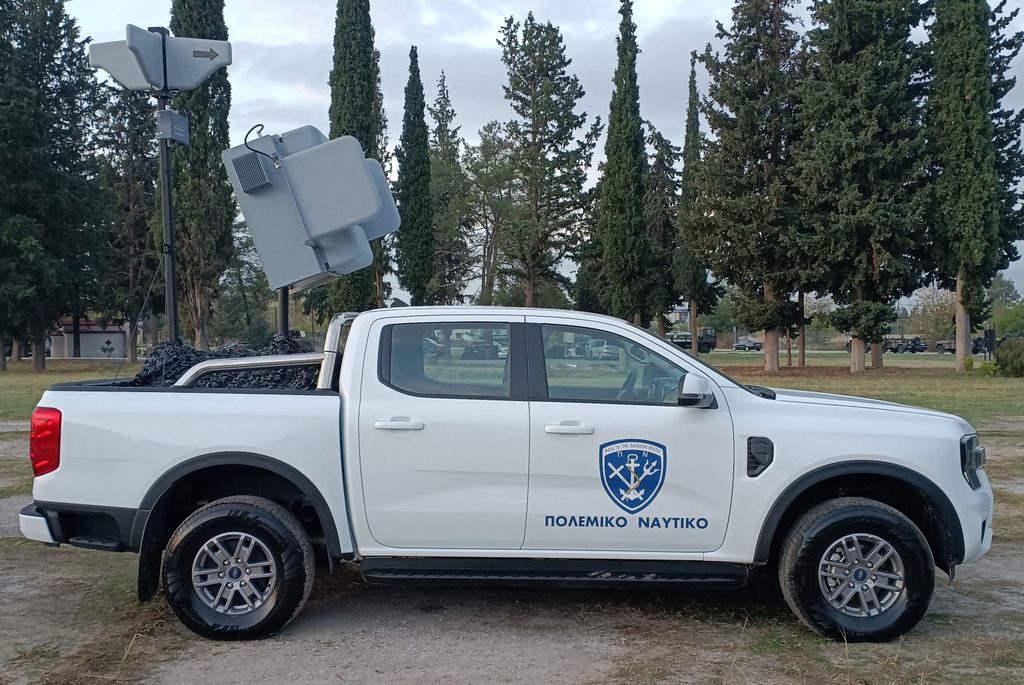
Kentauros is a counter-drone system developed to detect and disrupt hostile unmanned aircraft, while Hyperion is designed for drone detection and neutralisation. Archytas is a Greek-developed unmanned aerial vehicle, representing efforts to expand domestic capabilities in the design and production of military drones.
Other platforms expected to feature include the Patroller and V-BAT unmanned aircraft systems, together with a mobile drone production unit operated by the Hellenic Army.
The inclusion of a mobile production capability is particularly significant, demonstrating the growing emphasis on producing, adapting and deploying unmanned systems closer to operational requirements.
The parade will also feature a Stryker M1126 armoured vehicle, linked to plans for the transfer of American military equipment to Greece discussed during the recent sixth round of the US–Greece Strategic Dialogue.
These technologies form part of a broader transition towards military operations in which sensors, drones, automated platforms and real-time communications increasingly complement conventional weapons.
Leopard tanks, Marder vehicles and long-range missile systems
Despite the focus on emerging technologies, conventional military hardware will remain a major feature of the parade, which is expected to last approximately four hours.
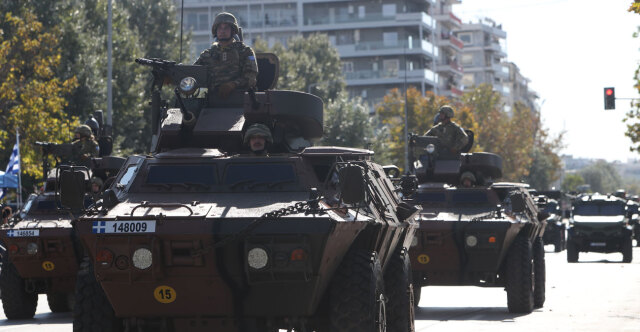
Among the vehicles and weapons on display will be Leopard main battle tanks, M109 self-propelled howitzers, Marder infantry fighting vehicles and M1117 Guardian armoured vehicles, alongside electronic warfare platforms and Spike NLOS precision-guided missile systems.
Residents of Thessaloniki have already witnessed extensive preparations, with tanks and military vehicles arriving from different parts of northern Greece over recent days.
The movement of heavy equipment through the city, supported by police escorts, has attracted considerable public attention ahead of the national celebrations.
The Hellenic Air Force will also contribute to the spectacle, with military aircraft flying in formation over the city as part of the traditional aerial display.
Frigate Kimon brings Greece’s naval modernisation into focus
Another major attraction is the presence of the FDI frigate Kimon, which arrived in Thessaloniki on Sunday, 25 October, for the national anniversary celebrations.
Moored just a short distance from the parade route, the modern warship has already attracted thousands of visitors and considerable interest from residents of northern Greece.
The frigate represents a major element of Greece’s naval modernisation programme, bringing advanced sensors, air-defence capabilities and modern combat systems to the Hellenic Navy.
Its presence alongside the new equipment displayed on land provides a broader picture of the country’s defence investments across its naval, ground and air forces.
Agenda 2030 and the transformation of the Greek Armed Forces
The new equipment forms part of the wider Agenda 2030 defence reform programme, which aims to modernise Greece’s military capabilities, organisational structures and technological infrastructure.
Beyond acquiring new weapons platforms, the strategy places considerable emphasis on developing domestic defence technology, integrating unmanned systems, strengthening electronic warfare capabilities and improving coordination between different branches of the military.
Another priority for the Ministry of National Defence is attracting a new generation of personnel with the technical expertise needed to operate increasingly sophisticated equipment.
At the strategic level, Athens also hopes that these investments will reinforce Greece’s position as a provider of security and stability in the wider Eastern Mediterranean.
The Thessaloniki parade therefore carries significance beyond its traditional commemorative role. While the celebrations honour Greece’s rejection of the Italian ultimatum on 28 October 1940, this year’s display will also offer a glimpse of the military capabilities the country intends to develop over the coming decade.
From Leopard tanks and the new Kimon frigate to autonomous drones and the Achilles’ Shield air-defence network, the parade will bring together established military power and emerging technologies in a demonstration of Greece’s ambitions for its Armed Forces in the 21st century.
Ask me anything
Explore related questions




