





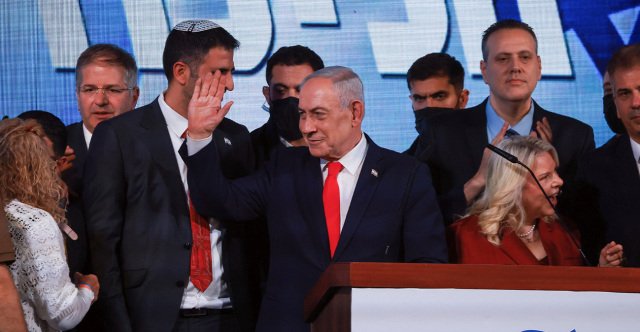
A political paradox has emerged from Israel’s general election, potentially allowing Israeli PM Benjamin Netanyahu to remain in power despite losing his parliamentary majority. The prime minister’s unexpectedly strong support among Jewish voters, combined with historic gains for Arab parties, has created an exceptionally difficult equation for the opposition, which has enough seats to remove him but no agreed governing majority.
With nearly 86% of votes counted, projections from Israel’s three largest television networks give Netanyahu’s coalition of right-wing, far-right and ultra-Orthodox parties 53 seats, compared with 48 for the opposition bloc led by Gadi Eisenkot.
Meanwhile, parties representing Israel’s Arab citizens are expected to secure a record 19 seats in the 120-member Knesset.
The parliamentary arithmetic is striking. Netanyahu’s opponents could potentially command 67 seats, comfortably exceeding the 61 required to form a government. However, Eisenkot would need substantial support from Arab parties to take office, a prospect strongly opposed by influential figures within his own political camp.
As Reuters and Axios report, losing his majority does not automatically mean the end of Netanyahu’s premiership. Instead, the political deadlock could prolong his time in office, potentially until fresh elections in 2027.
Netanyahu’s unexpected resilience and the rightward shift among Jewish voters
The vote count has overturned the initial picture of an election that pre-election polls suggested would be extremely close.
Netanyahu’s coalition has lost its parliamentary majority, falling from 64 to 53 seats, but its performance has proved considerably stronger than early post-election projections indicated.
By contrast, Eisenkot’s opposition alliance, which spans parties from the centre-left to the hard right and is united primarily by its determination to remove Netanyahu, has failed to secure the result it had hoped for.
Beyond the immediate battle for the premiership, the election reflects a deeper transformation in Israeli politics: the strengthening of the right among Jewish voters after years of Netanyahu’s political dominance.
The centre-left, which played a leading role during the first decades of Israel’s existence, has declined substantially as an independent political force. Even parties opposed to Netanyahu now share many of his fundamental positions on national security.
Notably, almost all major Jewish political parties currently reject the prospect of an independent Palestinian state, a proposal that formed the basis of international peace initiatives for decades.
The confrontation between Netanyahu and Eisenkot therefore does not necessarily represent a clash between two fundamentally different approaches to the Israeli-Palestinian conflict.
Instead, much of the electoral battle concerns political leadership, governance and responsibility for the security failures preceding Hamas’s attack on 7 October 2023.
Arab parties’ 19 seats change the numbers, but not necessarily the government
The second defining development of the election is the high turnout among Israel’s Arab citizens, who account for more than a fifth of the country’s population.
Overall turnout reached 77.7%, its highest level in more than two decades. The mobilisation of Arab voters contributed to strong performances by the Joint List and Ra’am, which are projected to win a combined 19 seats.
This result is particularly significant because the opposition now has no realistic route to power without the support of at least a substantial proportion of these MPs.
The increased participation partly reflects opposition among Arab citizens to the outgoing government’s policies and the rhetoric used by some of its members towards the Arab minority. Netanyahu’s cabinet includes a political leader who was previously convicted of inciting racial hatred against Arabs.
However, the electoral gains made by Arab parties do not automatically translate into an opportunity to enter government.
Since Israel’s founding, most Jewish political leaders have avoided formal government coalitions with Arab parties, although there was a notable exception in 2021, when Ra’am joined the Bennett-Lapid government.
The situation is now even more complicated. Eisenkot needs not only Ra’am but probably also the support of the Joint List, a prospect that has provoked serious objections among his right-wing allies.
Against this backdrop, comments made to AFP by Youssef Jabareen, the leader of the Joint List, have particular significance.
Jabareen made clear that his party was prepared to contribute to Netanyahu’s removal but did not believe it could immediately participate in a governing coalition.
“We do not see how we could participate in a coalition under the current circumstances,” he said, referring principally to the war in Gaza and conditions in the occupied West Bank, where expanding Israeli settlements and almost daily incidents of settler violence remain major points of contention.
Nevertheless, he left open another possibility.
To bring down the outgoing governing coalition, Jabareen said, his party “could support an alternative government without joining it”.
His position highlights one possible outcome of the election: a minority government led by Eisenkot that would depend on the parliamentary support or tolerance of Arab parties without giving them ministerial positions.
Such an arrangement, however, would require agreements between political forces with profound disagreements, particularly over the Palestinian question and national security.
The opposition’s dilemma: Enough seats to defeat Netanyahu, but no agreement on governing
Eisenkot therefore faces a difficult political choice.
On one hand, the parliamentary arithmetic gives him an opportunity to assemble a governing majority and end Netanyahu’s premiership.
On the other, creating such a majority would require cooperation with, or parliamentary tolerance from, Arab parties, something influential members of the Jewish opposition have already ruled out.
Politicians including former prime minister Naftali Bennett and Avigdor Lieberman have expressed strong objections to any government dependent on Arab parties.
As a result, despite its numerical advantage, the opposition has yet to produce a mutually acceptable plan for governing.
An Axios analysis identifies precisely this problem: removing Netanyahu may be a shared political objective, but that alone is insufficient to hold together a coalition comprising parties with such different ideological positions.
If negotiations fail, the outgoing prime minister will remain in office despite no longer commanding the parliamentary majority he enjoyed before the election.
Netanyahu remains caretaker prime minister with significant powers over national security
The possibility that Netanyahu could remain in power is what makes the political deadlock particularly consequential.
Under Israel’s political system, an outgoing prime minister continues to exercise the duties of office until a new government is formed.
Although caretaker governments face certain restrictions, their powers are not limited to managing routine administrative matters.
According to experts cited by Reuters, Netanyahu retains significant authority over national security, including decisions concerning the war against Iran.
This has taken on particular importance following remarks he made to Likud supporters shortly after 3am on Wednesday.
Netanyahu called for the formation of “a strong, right-wing national government”, highlighted Israel’s military successes and openly raised the possibility of further joint military action with the United States against Iran.
He said Israel and the US had a “unique historic opportunity” to eliminate what he described as the Iranian threat “once and for all”.
His remarks did not constitute an announcement of a new military operation, but they demonstrated how Netanyahu continues to link his political leadership to national security and confrontation with Tehran.
Responding to the situation, Eisenkot acknowledged that Netanyahu remained caretaker prime minister but expressed concern that national security could be used for political purposes.
“I call on the heads of the security services and public services: Netanyahu is a caretaker prime minister, without a mandate or the confidence of the people,” he said.
“Stand firm against any attempt by him to challenge you,” Eisenkot added.
Political uncertainty unsettles Israel’s financial markets
The prospect of a prolonged caretaker administration without a stable parliamentary majority has also affected Israeli financial markets.
The shekel weakened by approximately 1.6%, with the exchange rate reaching 3.10 shekels to the US dollar, while the main Tel Aviv stock market indices fell by more than 3%.
These movements reflect investors’ caution over political uncertainty and the potential implications of a prolonged government deadlock for fiscal policy and the wider economy.
The market reaction adds further pressure on political parties to reach an agreement, particularly as another election could extend the uncertainty for several months.
An opposition-controlled Knesset with Netanyahu still serving as prime minister?
Beyond the negotiations over forming a government, another unusual scenario concerns control of the Knesset itself.
As Axios points out, parties opposed to Netanyahu could use their numerical advantage to secure the position of parliamentary speaker and advance legislative initiatives.
These could include establishing a national commission of inquiry into the security failures preceding Hamas’s 7 October 2023 attack.
Israel could therefore find itself in an unusual constitutional and political situation: Netanyahu remaining prime minister while a parliamentary majority is controlled by parties seeking his removal.
Such an arrangement would significantly complicate the government’s legislative agenda and could intensify political confrontation without necessarily producing a change of government.
Herzog calls for compromise as fresh elections in 2027 remain a possibility
The next steps will depend heavily on consultations between Israeli President Isaac Herzog and the country’s political parties.
Herzog has already called for every possible effort to avoid another election and urged party leaders to approach negotiations with a willingness to compromise.
Several scenarios remain under consideration.
One is a minority government led by Eisenkot with the support of Arab parties. Another is a broader coalition agreement, while a national unity government is also theoretically possible.
The latter option, however, faces a major obstacle in Eisenkot’s public commitment not to govern alongside Netanyahu.
If coalition talks fail and no bloc can assemble the support of at least 61 MPs, Israel could return to the polls in 2027.
Axios has suggested that another election could take place as early as April.
Until then, Netanyahu could continue serving as prime minister.
The real stakes of Israel’s election deadlock
The 27 October election has highlighted two simultaneous transformations in Israeli politics: the resilience of right-wing dominance among Jewish voters and the growing political representation of Arab citizens, whose influence over parliamentary outcomes has increased significantly.
Rather than producing a clear governing solution, these developments have created a political impasse.
Netanyahu has lost his parliamentary majority but retains the premiership and the opportunity to seek new allies or remain in office until another election.
Eisenkot, meanwhile, has the numbers to assemble an anti-Netanyahu majority, but only if he can overcome deep disagreements over cooperation with Arab parties.
The result is an extraordinary political contradiction: Netanyahu may remain in power without a parliamentary majority, while his opponents may hold a majority without being able to form a government.
That is the central paradox likely to shape Israel’s political negotiations in the weeks ahead.
Ask me anything
Explore related questions




