





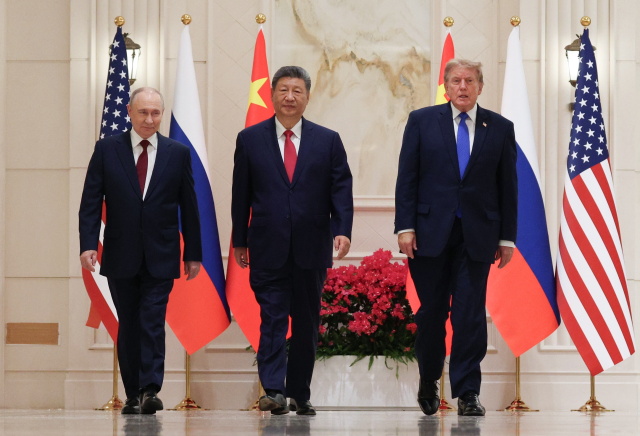
For the first time since the Second World War, the parallel summits held in Shenzhen and Berlin over the past few days brought the two dominant ideological and geopolitical camps fully into view, as the world’s leading powers sought to set out their positions on the unresolved questions of the 21st century and publicly demonstrate their strength at a pivotal moment for the wars in Iran and, especially, Ukraine.
Xi at the centre of it all
With Xi Jinping as host, the People’s Republic of China welcomed US President Donald Trump and his Russian counterpart, Vladimir Putin, to a trilateral summit that evoked memories of Yalta.
Much has happened between 1945 and 2026, including the emergence of signs that American predominance, as it took shape in the post-Cold War era, is waning.
Seen in that light, Xi Jinping’s place at the centre of the table was both a mark of his role as host and, for the first time, a public signal of the decisive role China sees for itself in shaping the geopolitical balance of the 21st century, a process Beijing had until recently pursued behind the scenes through its economic power.
By using Shenzhen to signal a more assertive approach to projecting power globally, Beijing has already marked a shift, even if China appears reluctant to expend its political capital on objectives that could slow its drive for technological and economic dominance.
At the same time, Trump took part in the summit alongside two leaders with well-established ambitions to reshape the world order, a fact that drew attention in the US Congress, even as the president appeared to be seeking common ground among the three countries on issues such as the nuclear threat, artificial intelligence and the war in Ukraine. By the end of the summit, there had been little progress on any of those issues, while positions on Ukraine remained at odds and the Trump administration faced criticism for taking a pro-Russian view.
Meanwhile, some analysts argue that Xi and Putin’s drive to reshape the world order openly undermines the leadership of the United States, until recently the world’s sole superpower, particularly given that the summit yielded no concrete results on the issues Washington raised and came so soon after midterm elections that underscored the sharp criticism of Trump’s strategy at home and abroad.
The West gathers in Berlin
Meanwhile, European leaders gathered in Berlin as the ‘Coalition of the Willing’, with Ukrainian President Volodymyr Zelensky in attendance, followed the trilateral summit in real time and stood firmly behind the liberal post-war international order. European leaders’ chief fear was that Putin and Xi’s ambitions to reshape that order might influence Trump’s agenda and make it easier for Russia to pursue its expansionist aims, but tensions eased somewhat when the US president called them from Air Force One on his way home.
During the call, Trump described spending billions on weapons and financial aid for Ukraine as a waste in a conflict that was killing so many people. European leaders, meanwhile, were discussing a new €45 billion aid package and insisting on a seat at four-way peace talks, with Abu Dhabi proposed as the venue.
Divisions over Article 5
European leaders are well aware of Trump’s mounting pressure to secure peace in Ukraine, with security guarantees remaining the main obstacle to getting negotiations under way. Some support has recently emerged for guarantees modelled on the collective defence provision in Article 5 of NATO’s founding treaty, though their scope and the extent of US involvement remain unresolved.
Speaking to reporters, Ukrainian President Volodymyr Zelensky said he was ‘not sure’ that all sides understood Article 5 in the same way he did. ‘Because what does Article 5 mean? It means there are some forces from partner countries on your soil. So my question is: what about American troops?’ Zelensky asked, while German Chancellor Friedrich Merz made clear that ‘we are not providing this strong support to prolong the war. We want to end this war.’ Polish Prime Minister Donald Tusk, meanwhile, said Trump’s faith in Putin’s goodwill was ‘unshakeable’ and expressed hope that Trump’s optimism about ending the war would prove well founded this time.
Ask me anything
Explore related questions




