





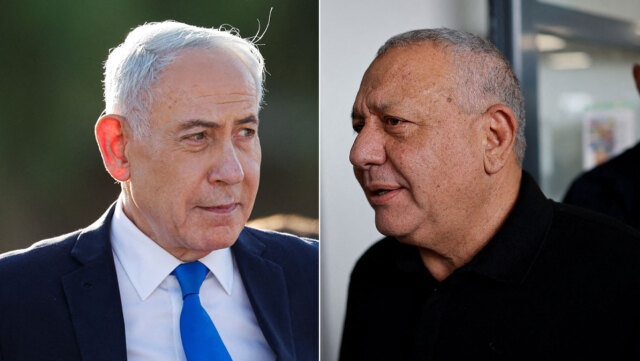
Israeli Prime Minister Benjamin Netanyahu’s political bloc has maintained a narrow lead over the opposition led by Gadi Eisenkot in Israel’s parliamentary election, but neither side has secured the majority needed to form a government, according to the latest partial results.
With 57.3% of polling stations counted as of 7.58am on Wednesday, figures published by Israel’s Central Elections Committee put Netanyahu’s bloc on 55 seats, compared with 49 for the parties opposed to him.
Arab parties are currently projected to secure 16 seats, potentially giving them a decisive role in determining the country’s next government.
Neither of the two main political camps has reached the 61 seats required for a majority in the 120-member Knesset, raising the prospect of difficult coalition negotiations and a prolonged political impasse.
Three parties currently remain below the electoral threshold of 3.25%: the Reservists on 2.6%, the People of Israel on 1.7% and the Ultra-Orthodox Public on 0.2%.
The results remain provisional and could change as counting continues. Votes cast in double envelopes, including those submitted by military personnel, will be counted later.
Netanyahu and Eisenkot both claim a mandate to govern
Despite the lack of a clear parliamentary majority, both Netanyahu and Eisenkot have declared their readiness to form Israel’s next government.
Netanyahu called for the establishment of a “strong right-wing government”, urging the country’s “Jewish and Zionist majority” to unite and make a fresh start.
The prime minister remained silent for several hours after polling stations closed at 10pm on Tuesday. He eventually appeared before supporters at around 3am, smiling confidently as he delivered an unusually brief speech.
He stopped short of claiming victory and made no direct reference to Eisenkot, instead emphasising that his right-wing Likud party remained the largest in parliament.
Likud is projected to secure 27 seats, down from 32 in the outgoing Knesset, but still ahead of Eisenkot’s Yashar party.
Earlier exit polls had suggested that the centrist opposition alliance led by Eisenkot held a narrow advantage over Netanyahu’s bloc. Subsequent projections, however, indicated a dead heat, with both camps winning 51 seats.
Those estimates have since been overtaken by the partial official count, which gives Netanyahu’s bloc a six-seat lead.
Eisenkot interpreted the initial projections as a clear rejection of the incumbent prime minister.
“The people have chosen change,” he told supporters, promising to “do everything” to establish a government while ruling out another election.
Voter turnout reached 77.7%, the highest recorded since 1999, in the first national election held since the Hamas attacks of 7 October 2023.
Arab parties emerge as potential kingmakers
One of the most significant developments has been the sharp increase in support for Israel’s Arab parties.
Initial election-night projections suggested that the two Arab electoral lists, Ra’am, representing moderate Islamists, and the United Arab List, associated with the radical left, could collectively secure between 18 and 19 seats, compared with just 10 in the outgoing parliament.
The latest partial official count puts their combined representation at 16 seats, although that figure could change as more votes are counted.
Their increased parliamentary strength could make them indispensable to efforts to establish a governing coalition.
Mansour Abbas, the leader of Ra’am, described the result as a “major defeat” for Netanyahu’s political camp and indicated that he was prepared to work with Eisenkot.
The opposition leader, however, has repeatedly ruled out such an arrangement.
Netanyahu has also rejected the possibility of a government dependent on Arab parties.
“It is out of the question to form a government supported by the Arab parties,” he declared.
During the election campaign, Netanyahu repeatedly attacked the Arab parties, including through the slogan “Either the right or Palestine”.
The contrasting positions have complicated the coalition arithmetic, particularly as neither major bloc can currently command a majority independently.
Ilana Spizman, a political scientist and conference organiser at Bar-Ilan University, suggested that the emerging result pointed towards a political deadlock.
“Netanyahu has no way of forming a government,” she argued.
According to Spizman, Eisenkot would have to either establish a coalition with the Arab parties or lead a minority government, two options previously rejected by the opposition.
The parties are now expected to begin negotiations over the coming weeks in an attempt to identify a workable governing arrangement.
If those negotiations fail, Israel could face another parliamentary election, a scenario that has occurred repeatedly in the country’s recent political history but which Eisenkot has firmly rejected.
At Yashar’s headquarters in Tel Aviv, early projections favouring the opposition prompted celebrations among supporters, who chanted “Bibi, go home!” in reference to Netanyahu’s widely used nickname.
Yaeli Lifshitz, a student attending the gathering, said the parliamentary situation would require political parties to abandon established conventions.
“To form a government, the rules and everything that was considered established will have to be broken, and unprecedented alliances will have to be formed,” he said.
Netanyahu raises Iran threat in election-night speech
National security remained central to the election campaign, with Netanyahu using his speech to highlight what he described as a historic opportunity to eliminate the threat posed by Iran.
“Israel has a historic, unique opportunity, together with our partner President Trump, to eliminate Iran’s existential threat once and for all,” the prime minister declared.
Netanyahu had repeatedly warned of security dangers during the final days of the campaign.
Eisenkot, a former chief of the Israel Defence Forces General Staff, responded with a warning against using national security for political purposes.
“Do not even think about using Israel’s security for political purposes,” he said.
His remarks followed reports in Israeli media in recent weeks of disagreements between senior military officers and Netanyahu.
Addressing Israel’s security services, Eisenkot insisted that Netanyahu no longer possessed a clear public mandate.
“Benjamin Netanyahu does not have the mandate or the trust of the people. Remember that you serve only the state and the interests of Israeli citizens,” he said.
Election exposes deep divisions in Israeli society
The closely contested election reflects the political divisions that have intensified in Israel since the Hamas attacks of 7 October 2023 and the subsequent war in the Gaza Strip.
The campaign unfolded against a backdrop of mounting international criticism over Israel’s conduct of the war in Gaza, violence by Israeli settlers and the expansion of settlements in the occupied West Bank.
These issues have become increasingly prominent during the tenure of what has been described as the most right-wing government in Israel’s history.
For many voters, the election represented an opportunity to demand political change and address inequalities within Israeli society.
“I want change,” said Asia Eghbaria, a 23-year-old law student, after casting her ballot in Umm al-Fahm, a predominantly Arab city in northern Israel.
“I don’t want to be treated as a second- or third-class citizen. I want to live in peace and tranquillity,” she added.
Coalition negotiations loom as counting continues
Although Netanyahu’s bloc currently holds the advantage in the partial count, the outcome remains uncertain, with a substantial proportion of votes still to be counted.
The Central Elections Committee is expected to continue releasing results as the counting process progresses, with the final outcome potentially taking several days to establish.
The immediate question is not simply which party or bloc finishes ahead, but whether either political leader can assemble a parliamentary majority.
With 55 seats projected for Netanyahu’s allies, 49 for the opposition and 16 for the Arab parties, the emerging parliamentary balance leaves both principal camps short of the 61-seat threshold.
Unless the remaining count significantly changes that distribution, the next stage of Israel’s political contest will be fought through coalition negotiations rather than at the ballot box.
Ask me anything
Explore related questions




