





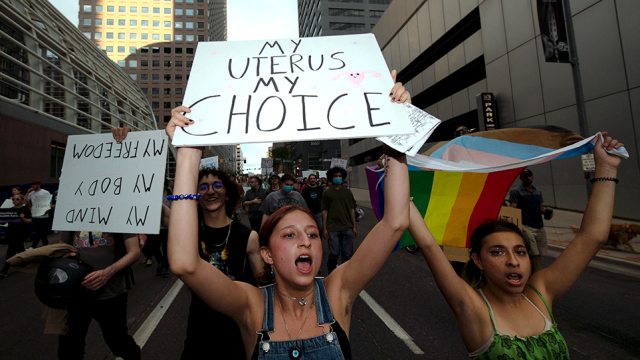
With Republicans avoiding the issue and Democrats focusing on purchasing power, abortion rights appear to have faded from the spotlight in the United States. But four states will hold major ballot measures on the issue in Tuesday’s midterm elections.
Four years after the Supreme Court overturned the constitutional protection of abortion rights, the country has become a patchwork of different state laws. This has led to endless legal disputes and poorer-quality medical care for millions of patients, with consequences that can be dangerous and, in some cases, fatal.
In Idaho, a deeply conservative state in the western United States that has adopted one of the strictest abortion laws in the country, the issue is “huge”, Jen Jackson-Quintano told Agence France-Presse (AFP). The activist is a member of one of several organisations supporting a citizens’ initiative that could restore abortion rights until foetal viability, generally between 22 and 24 weeks of pregnancy.
At present, Idaho bans abortion at every stage of pregnancy, with a narrow exception when necessary to prevent the mother’s death — but not simply to protect her health.
Voters in Nevada in the west and Virginia in the east will also vote on ballot measures to protect abortion rights, while Missouri, in the central United States, could remove that protection from its state constitution.
Nearly 20 states with Republican-controlled legislatures now enforce total abortion bans or permit the procedure only in the earliest stages of pregnancy.
The issue has become a major local concern, one that US President Donald Trump carefully avoided addressing during his midterm election campaign.
Conservatives caught in a difficult position
“Republicans obviously have no interest in bringing abortion to the forefront because it hurts them,” said Mary Ziegler, a law professor at the University of California, Davis. She is convinced that “the Trump administration is deliberately postponing” measures on the issue until “after the election”.
Around 60% of adults in the United States believe abortion should be legal in all or most cases, according to the Pew Research Center.
The Republican Party is also at odds with part of its own base. In Idaho, around 30% of those who signed the citizens’ initiative that led to the ballot measure are registered Republican voters, according to Melanie Folwell, director of Idahoans United for Women and Families.
This illustrates why abortion is not a “black-and-white” issue and why it can cut across party lines.
“The issue is actually much more nuanced because it is so personal,” Folwell said.
Many doctors told AFP that they felt “silenced” by Idaho’s strict ban. Some of their patients have had to be flown to other states to receive emergency medical treatment.
“It is dangerous to continue a pregnancy here,” said obstetrician-gynaecologist Becky Uranga, adding that doctors could end up in prison if complications arise.
Powerful religious and conservative groups are funding opposition to the ballot measure proposing to overturn Idaho’s ban.
On the other side, several hundred doctors have signed a letter urging voters to support the measure. They are furious at seeing their patients suffer miscarriages or serious pregnancy complications while being unable to provide the care they need.
Mass exodus of doctors
“We simply want to keep people healthy, happy and safe,” said family physician Lauren Colson.
“Criminalising abortion-related care makes everything more dangerous,” she added. “It does not protect foetuses.”
Idaho is experiencing a mass exodus of doctors and struggling to replace them because of the ban.
Since the restrictions took effect, more than one-third of the state’s obstetrician-gynaecologists have stopped practising, left Idaho or retired, according to a study published last year in the Journal of the American Medical Association.
Uranga, whose family has lived in the area for generations, has stayed. But she says she is “really exhausted”.
“I have been through some very difficult times,” she admitted.
Despite her pro-life beliefs and Catholic faith, the doctor considers the ban enacted in her state extreme.
“Being pro-life should mean being pro-choice,” she said.
Ask me anything
Explore related questions




