





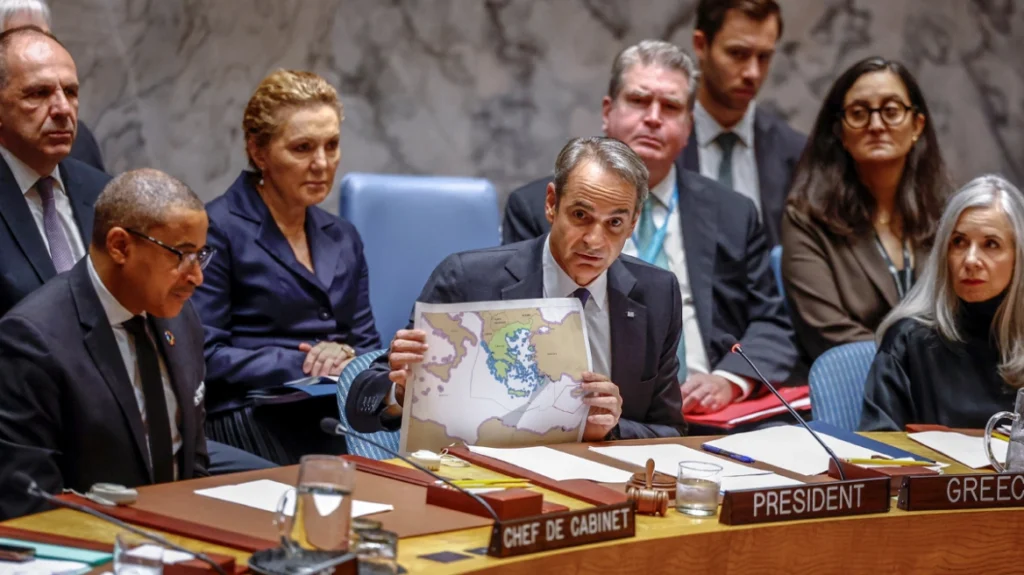
Yesterday’s appearance by Kyriakos Mitsotakis at the UN Security Council, where he also served as presiding officer of the meeting on international peace and security, was perhaps the most appropriate forum in which to denounce Turkey and Libya’s attempt to challenge geography through the Turkey-Libya Memorandum.
And he did so using a method he has employed in the past: a map that demonstrates in practical terms how the Turkey-Libya agreement completely disregards the sovereign rights of the Greek islands situated between the two countries.
The return to maps as a tool of public diplomacy is undoubtedly also a return to the past. In 2022, Mr. Mitsotakis also used a map while speaking at the UN General Assembly, referring to the “Blue Homeland” against the backdrop of a map depicting Mavi Vatan (Blue Homeland), which Recep Tayyip Erdoğan had given as a gift to his coalition partner, Devlet Bahçeli.
Four years later, with the period of calm waters appearing to be firmly in the past and the Turks preparing to incorporate the Blue Homeland doctrine into their domestic law, Mr. Mitsotakis is adopting a more forceful level of rhetoric.
It is clear that the sunny days in Greek-Turkish relations are now behind us, even though channels of communication between the two sides remain open. No summit meeting between Mitsotakis and Erdoğan has taken place since last February, when Mr. Mitsotakis visited Ankara for the High-Level Cooperation Council. There is also, however, no substantive agenda for such a meeting to take place.
And the closer Greece comes to exercising its sovereign rights—for example, by restarting seabed surveys for the installation of the GSI cable—the more Turkey raises tensions, taking a further step by joining forces with the authorities in Benghazi, Libya.
It is worth noting that Chevron’s seismic surveys in the blocks south of Crete are scheduled for December. Some of these blocks border the Turkey-Libya Memorandum area. It remains to be seen whether there will be a reaction, or whether the Libyans and Turks will proceed with surveys by the Turkish Petroleum Corporation (TPAO) for natural gas, on the basis of the Turkey-Libya agreement.
The rules and the jungle
With yesterday’s highly symbolic move of displaying the map showing the Turkey-Libya Memorandum inside the Security Council, Mr. Mitsotakis sought to send a clear message: Greece will defend international law in the very forum primarily responsible for upholding it—the United Nations.
At the same time, he is seeking to expose Turkey before the international community, particularly at a time when Recep Tayyip Erdoğan is attempting to take advantage of the deadlock in the process of selecting a new UN Secretary-General. He has put forward the name of experienced diplomat Feridun Sinirlioğlu, who currently serves at the Organization for Security and Co-operation in Europe (OSCE).
It is estimated that this objective was also behind some of Mr. Erdoğan’s telephone conversations with French President Emmanuel Macron and US President Donald Trump, although such a proposal is unlikely to succeed.
“Geography cannot be rewritten. And sovereign rights cannot be erased by drawing arbitrary lines on a map,” Mr. Mitsotakis said pointedly yesterday, citing the 2020 agreement between Greece and Egypt on the partial delimitation of their Exclusive Economic Zones (EEZs) as an example of good practice under international law. That agreement will serve as the basis for discussions on extending the EEZ, following consultations between Athens and Cairo.
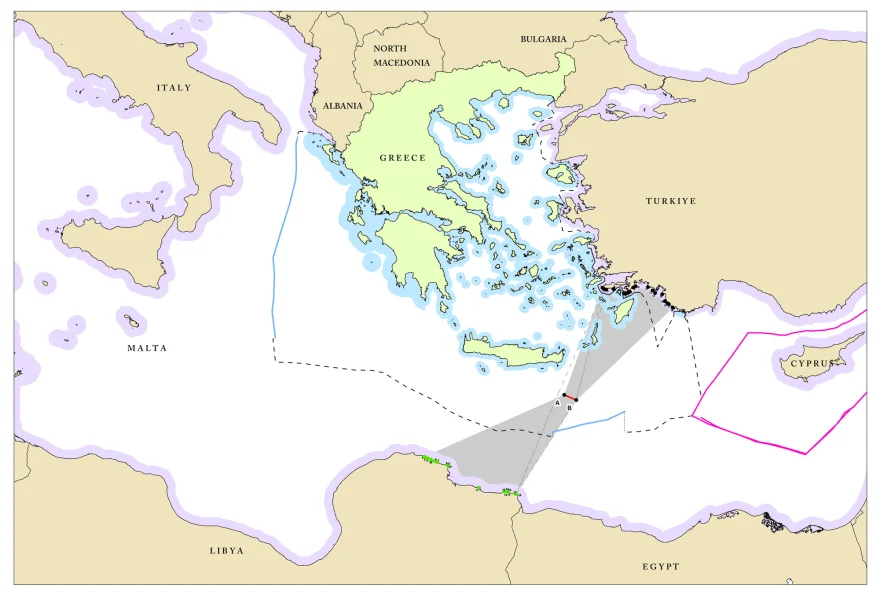
Without respect for common rules, “our sea” (Mare Nostrum) risks turning into a jungle of competing claims and self-serving arrangements. “Imagine if Greece and Tunisia decided to delimit maritime zones between them as though Sicily and Malta did not exist at all. Would anyone seriously consider such an arrangement lawful?” Mr. Mitsotakis stressed yesterday, adding that “no matter how much time passes, or how often illegal claims are repeated, what is illegal remains illegal.”
It is now clear to the government that national issues are once again moving to the forefront, following a prolonged period of calm. Government officials maintain that Greece “bought itself time” while simultaneously strengthening its military capabilities. It is now evident, however, that the waters are becoming turbulent again, and the winter just around the corner is likely to be particularly heated.
Ask me anything
Explore related questions




