





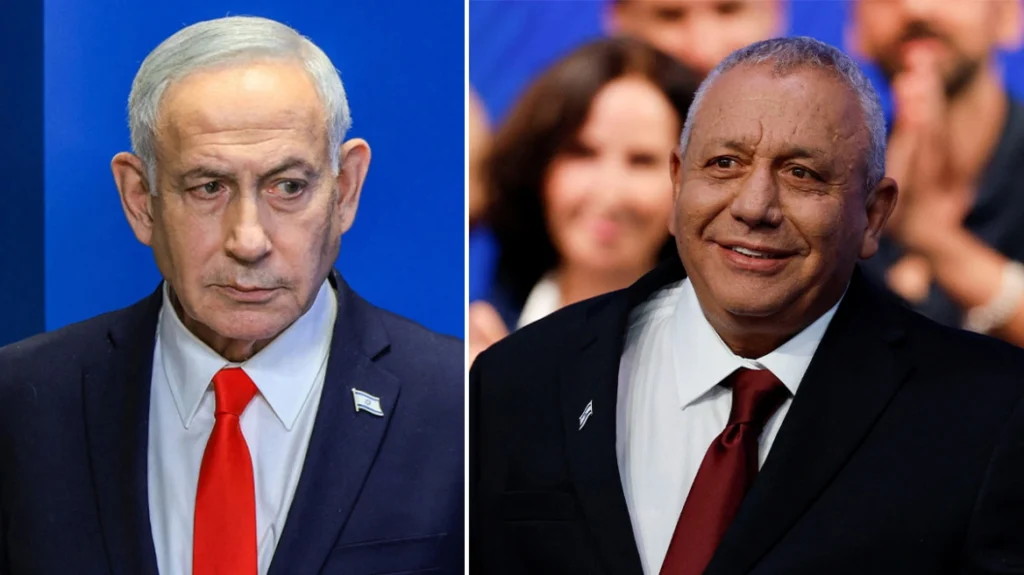
The parliamentary elections in Israel have ended without either side securing an outright majority, leaving a political puzzle for the camp of Prime Minister Benjamin Netanyahu and that of his rival, Gadi Eisenkot. Both will need to broaden their coalitions.
Here are the options available to Netanyahu, whose camp has 53 seats, and Eisenkot, whose has 48, as they seek to secure the 61 seats required for a parliamentary majority.
For the time being, the two appear to be best placed to receive the mandate to form a government, although President Isaac Herzog may assign the task to someone else.
A government led by Netanyahu
The prime minister’s camp, together with his far-right and ultra-Orthodox allies, came first in the election, securing 53 parliamentary seats, 27 of which went to his party, Likud.
If he wants to remain in power, Benjamin Netanyahu, who has already rallied everyone to his right, has no choice but to reach out to the opposition.
However, the obstacles to forming such a (national) unity government are considerable, since the four parties in Eisenkot’s “change bloc” presented this election as a referendum against Netanyahu.
Among them, the left-wing party led by Yair Golan (8 seats) appears, by far, to be the least likely to join forces with Netanyahu.
As for former minister Avigdor Lieberman (7 seats), once an ally of the prime minister before breaking with him, “the only possible coalition is one made up exclusively of Zionist parties, including Likud, but ‘without Bibi’,” the prime minister’s familiar nickname.
The position of the centre-right Together party (12 seats) is less clear-cut. Its leader, Naftali Bennett, who served briefly as prime minister, initially appeared to suggest that he would not rule out an alliance with Benjamin Netanyahu’s camp under certain conditions. He subsequently backtracked.
Finally, an alliance with Gadi Eisenkot’s party (21 seats), through a power-sharing agreement involving a rotation in the premiership, is sometimes mentioned. However, it seems unlikely that Eisenkot would accept it, having said that he would never serve under Netanyahu.
A precedent from recent history offers one possible scenario: in 2020, Benjamin Netanyahu and centrist Benny Gantz reached a similar power-sharing agreement despite their deep hostility, following three elections in less than a year. However, the agreement collapsed within a year, leading to another election.
Outside the opposition camp, there remains the highly unlikely option of an alliance with the Arab parties, which secured 19 seats. The prime minister repeatedly disparaged them during the election campaign and is now accusing them of electoral fraud.
Yet nothing seems impossible for Netanyahu, who reached out to Arab Israelis in both 2015 and 2021.
A government led by Eisenkot
Eisenkot has two main options for forming a government: a minority government supported in the Knesset by other parties, or a unity government with Netanyahu, as mentioned above.
As for a minority government, the two predominantly Arab electoral lists, which have emerged as kingmakers following their unprecedented electoral performance, have said they are ready to work with him.
However, aside from the strong opposition of Bennett and Lieberman to such an arrangement, a minority government would also be vulnerable and at the mercy of its new allies.
A former chief of the armed forces, Gadi Eisenkot is no pacifist. His new allies could turn against him in the event of deadly military operations in Gaza, for example.
That leaves the option of a national unity government led by Eisenkot.
Yair Lapid, one of the bloc’s leaders and the architect of a short-lived grand coalition in 2021 – which included an Arab party for the first time – today called on voters to be “patient” while his camp tries to put together a majority. “It will be difficult,” he acknowledged.
The least likely scenario for a national unity government would be one in which Benjamin Netanyahu agrees to give up his position. Defections from Likud are also unlikely, as the party appears firmly aligned behind Netanyahu.
Another possibility would be for the moderate Islamist Ra’am party (8 seats) to join the coalition, even though Gadi Eisenkot said during the election campaign that he would not allow this.
However, he might perhaps be able to persuade his current partners to accept the idea, given the profile of its leader, Mansour Abbas, who took part in the short-lived government led by Yair Lapid in 2021, and the fact that the number two candidate on the party list is a Jew and a former senior police officer.
Even then, several more seats would still be needed to reach the 61-seat threshold. Unless Gadi Eisenkot tries to seek support from the ultra-Orthodox parties, which are currently allies of Benjamin Netanyahu, at the cost of making concessions on the highly sensitive issue of their exemption from military service.
Ask me anything
Explore related questions




