





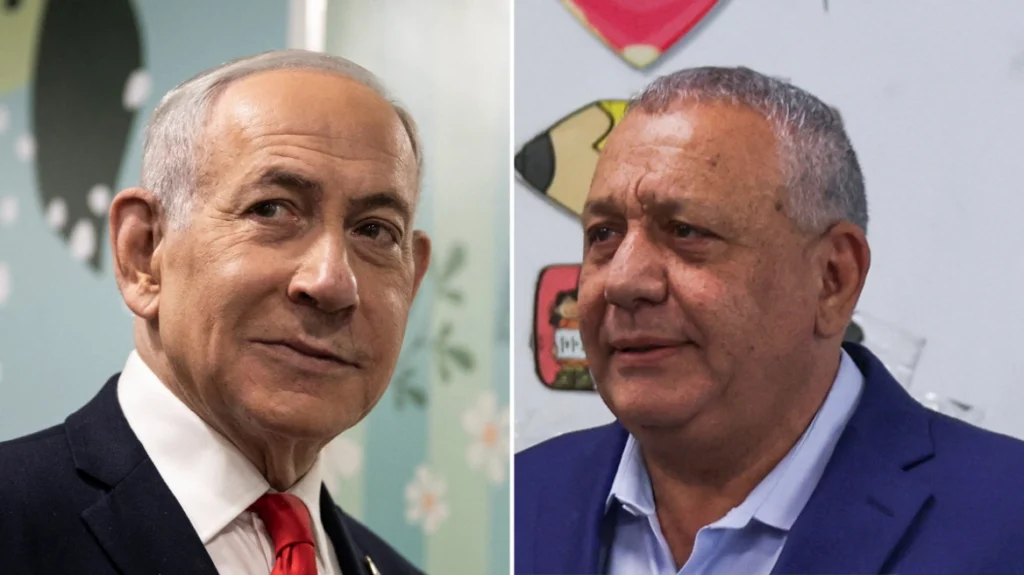
Israel is facing a prolonged period of political uncertainty, which could last weeks or even months, after the final results of the parliamentary elections failed to produce a clear winner.
Neither of the two major political blocs—that of Prime Minister Benjamin Netanyahu and that of his main rival, Gadi Eisenkot—secured the required majority of 61 seats in the Knesset, leaving open even the possibility of another election.
Netanyahu’s right-wing Likud party and Eisenkot’s centrist Yashar party lead the two rival political camps. Neither, however, has enough seats to form a government in the 120-member parliament.
The deep political and ideological differences between the parties make the formation of a governing coalition extremely difficult. Nevertheless, an agreement cannot be ruled out, even if it results in a fragile government that manages to remain in power for little more than a year.
According to a CNN analysis, there are four main scenarios for what comes next in Israel.
Political leaders will have approximately 12 weeks to reach an agreement. If their efforts fail, Israelis will be called to the polls once again.
Scenario 1: An opposition government backed by Arab parties
In terms of parliamentary arithmetic, the opposition’s most reliable route to removing Netanyahu from power would be cooperation between Jewish and Arab parties. However, this very requirement is also the biggest obstacle.
Two leaders of right-wing parties within the opposition bloc—former Prime Minister Naftali Bennett and former Defense Minister Avigdor Lieberman—oppose any government that would depend on the two Arab parties represented in the Knesset: the Joint List and Ra’am.
Their opposition extends both to Arab parties joining a governing coalition and to their providing external support for a minority government. Indeed, the two politicians have hardened their positions since Hamas’s attack on October 7, 2023.
In Israel’s history, only one government has included an Arab party as a full member of its governing coalition. That was Ra’am, which joined the eight-party coalition that succeeded in removing Netanyahu from power in 2021. However, that government collapsed just over a year later.
Even without forming a government, opposition parties could work together, using their parliamentary majority to replace the Knesset speaker and other officials in key positions.
In this way, they could limit the options available to Netanyahu’s caretaker government, which would continue to exercise power. Nevertheless, the prospect of forming a governing coalition capable of replacing Netanyahu remains particularly complicated and politically charged.
Scenario 2: A national unity government including Likud
A second option would be to break up the two existing political blocs and form a national unity government.
Such a government would almost certainly include Netanyahu’s Likud party, along with some of his current coalition partners, as well as at least one party from the opposition bloc.
According to CNN, Netanyahu is reportedly willing, in this scenario, to end his partnership with far-right National Security Minister Itamar Ben-Gvir.
He does not, however, appear willing to part ways with the equally far-right Finance Minister Bezalel Smotrich or the ultra-Orthodox parties.
For his part, Eisenkot has ruled out joining a government alongside Netanyahu. Any change in his position could be seen as an act of betrayal by many Israelis who want Netanyahu removed from power.
Scenario 3: A Netanyahu government with opposition lawmakers
Another scenario envisages Netanyahu attempting to attract opposition parties or individual lawmakers in order to secure the parliamentary majority he needs.
However, all four leaders of the opposition bloc’s parties—Gadi Eisenkot, Naftali Bennett, Avigdor Lieberman and Yair Golan—have stated that they will not join a government led by Netanyahu.
Furthermore, the prime minister’s bloc is eight seats short of the required majority.
This means he would have to persuade eight individual lawmakers to abandon the opposing camp in order to form a government—an extremely difficult hurdle to overcome.
Scenario 4: New elections in Israel
While all the above possibilities are being considered behind the scenes, Israeli President Isaac Herzog will hold a public round of consultations with the leaders of the parties that secured parliamentary representation.
After hearing their views, he will ask one of the political leaders to form a government.
The Arab parties are expected to express their support for Eisenkot, a development that could lead Herzog to give the Yashar leader the first mandate to form a government.
The political leader who receives the first mandate will have 28 days to form a government, with the possibility of a further 14-day extension.
If that attempt fails, the president will give the mandate to a second political leader, who will have just 28 days.
If that effort also proves unsuccessful, a majority of Knesset members will be able to ask the president to assign the mandate to a third candidate, who will have 14 days to form a governing coalition.
If none of these procedures produces an agreement, new elections will be held.
Netanyahu appears to be in an advantageous position when it comes to managing this timetable, since, as caretaker prime minister, he can wait and see how events unfold.
If his main rival, Eisenkot, receives the first mandate to form a government and fails, the mandate is likely to pass to Netanyahu himself.
Even if Netanyahu also fails, the political deadlock could lead to another election, with Netanyahu remaining caretaker prime minister for several more months, until a new government is formed.
Repeat elections, which could not take place before the spring of 2027, are now a real possibility.
Such an outcome would plunge Israel back into a state of political paralysis and mark the country’s seventh general election in eight years.
Ask me anything
Explore related questions




